- Kagoshima in September — Lingering Summer, Typhoons and Volcanic Ash
- Kagoshima September at a Glance — Key Numbers
- Kagoshima Climate Across the Year — All 12 Months
- Kagoshima Typhoon Statistics — Southern Kyushu's Peak Month
- September Kagoshima — Three Things to Watch: Typhoons, Ash, UV
- Reaching Kagoshima from Tokyo, Osaka, Fukuoka & International Gateways
- 4-Day Kagoshima Itinerary — City, Sakurajima, Ibusuki, Kirishima
- What to Pack for September in Kagoshima — Scene by Scene
- Seasonal Food in September Kagoshima — Shirokuma's Farewell, Kurobuta & Shochu
- When Exactly to Go — Aim Around Silver Week, Not During It
- Frequently Asked Questions (FAQ)
- Wrapping up
Kagoshima in September — Lingering Summer, Typhoons and Volcanic Ash
Short answer: September in Kagoshima (鹿児島) delivers average 26.3°C / highs 30.2°C / rainfall 222.9 mm / sunshine 176.4 hours, sitting right on the seam between late summer and early autumn. It is also southern Kyushu’s peak typhoon-approach month (1.2 systems on average), and Sakurajima (桜島) — the active volcano across the bay — can dust the city with ash. On the upside, the August heatwave has eased, and this is your last chance to enjoy Ibusuki (指宿) sand baths and the famous shirokuma shaved ice in their peak season. For most international visitors, the smoothest routes in are a domestic flight from Tokyo (Haneda/Narita) or Osaka (Itami/Kansai), or the Kyushu Shinkansen from Fukuoka — often free with a JR Pass.
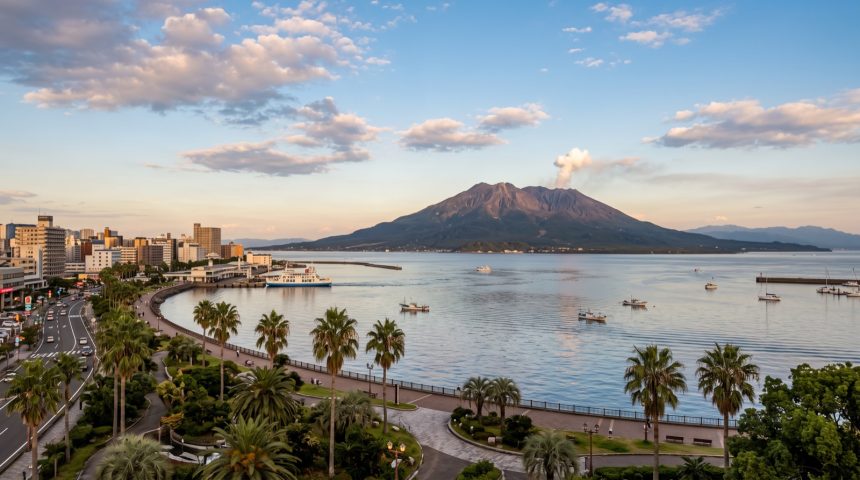
Welcome! This is GO!GO!TOUR, your travel partner for independent trips across Japan. Kagoshima sits at the southern tip of Kyushu on the Satsuma Peninsula, and it is one of the very few cities in the world where an active volcano — Sakurajima — floats in the bay directly opposite the downtown skyline.
September in Kagoshima looks nothing like September in Fukuoka or the rest of northern Kyushu. Because it lies at the southern end of the Japanese archipelago, it is hotter, sits directly in the typical typhoon landfall corridor, and has a daily ash forecast from Sakurajima that locals check the way others check pollen. Prepared travelers, however, get rewarded with the tail end of the summer season at a noticeably lower price tag.
In this guide we cover Kagoshima’s September weather from the perspective of an international independent traveler — temperature and rainfall, typhoon statistics, how to reach Kagoshima from Tokyo, Osaka and Fukuoka (plus international arrivals), a 4-day recommended itinerary, packing lists, and a full FAQ.
Kagoshima September at a Glance — Key Numbers
Here is everything you actually need to pack for and plan around, compressed into one table.
| Item | Data | Quick note |
|---|---|---|
| Average temperature | Avg 26.3°C / high 30.2°C / low 23.2°C | Mid-summer early in the month, early autumn by month-end |
| Rainfall & sunshine | 222.9 mm / 5.9 sunny hours per day | 3rd wettest month — typhoons & autumn rain front |
| Humidity & feels-like | Avg humidity 72% / feels like 30°C+ | Hot and sticky — stay hydrated |
| Average wind speed | 3.3 m/s | Spikes sharply when a typhoon approaches |
| UV index | Peak 8-9 (very high) | SPF 50+, sunglasses and a hat are non-negotiable |
| Typhoon risk | Southern Kyushu’s peak month (1.2/yr avg) | Prepare for possible flight or ferry cancellations |
| Sakurajima ash | Seasonal wind shift — occasional light fall in the city | Bring a mask, glasses, compact rain poncho |
| Main access routes | Domestic flight from Tokyo/Osaka, or Shinkansen from Fukuoka | Tokyo ~2h flight, Fukuoka Shinkansen 1h20m |
| Value for money | Flights & hotels ease 20-30% vs August | Avoid Silver Week (approx. 9/19-23) for the best rates |
| Sweet spot | Late September weekdays (excluding holidays) | Lower typhoon risk + lower prices |
Internalize this table and you are 80% of the way to a well-planned September Kagoshima trip. Now the details.
Kagoshima Climate Across the Year — All 12 Months
Kagoshima is not as far south as Okinawa, but as the southernmost major city on mainland Japan it consistently ranks among the country’s hottest. Here are the 1991-2020 climatological normals from the Japan Meteorological Agency (JMA) Kagoshima station, month by month.
| Month | Avg °C | High °C | Low °C | Rain mm | Sun h |
|---|---|---|---|---|---|
| Jan | 8.7 | 13.1 | 4.9 | 78.3 | 132.6 |
| Feb | 9.9 | 14.6 | 5.8 | 112.7 | 139.3 |
| Mar | 12.8 | 17.5 | 8.7 | 161.0 | 163.2 |
| Apr | 17.1 | 21.8 | 12.9 | 194.9 | 175.6 |
| May | 21.0 | 25.5 | 17.3 | 205.2 | 178.2 |
| Jun | 24.0 | 27.5 | 21.3 | 570.0 | 109.3 |
| Jul | 28.1 | 31.9 | 25.3 | 365.1 | 185.5 |
| Aug | 28.8 | 32.7 | 26.0 | 224.3 | 206.9 |
| Sep | 26.3 | 30.2 | 23.2 | 222.9 | 176.4 |
| Oct | 21.6 | 25.8 | 18.0 | 104.6 | 184.0 |
| Nov | 16.2 | 20.6 | 12.2 | 102.5 | 157.7 |
| Dec | 10.9 | 15.3 | 6.9 | 93.2 | 143.2 |
Source: JMA Kagoshima Observatory (station 47827), climatological normals 1991-2020.
What the table shows: Kagoshima’s peak heat sits in July and August (28-29°C average), while the wettest month by far is June with 570 mm of rain during Kyushu’s rainy season. September softens the heat slightly to 26.3°C but keeps monthly rainfall stubbornly above 220 mm — this is a genuine transition month, the tail of summer meeting the head of autumn. For context, that is still 5-8°C warmer than Tokyo or New York in September, so pack summer clothing as your baseline, not autumn wear.
Kagoshima Typhoon Statistics — Southern Kyushu’s Peak Month
“Is it safe to visit Kagoshima in September?” is by far the most common question we get. The honest answer: September is indeed southern Kyushu’s peak month for typhoon approaches, but the long-term average is only about 1.2 storms per month — meaning a typhoon is possible, not inevitable.
Here are JMA’s 1991-2020 climatological normals for typhoon approaches to southern Kyushu (a storm counts as an “approach” when its center passes within 300 km of the observing station).
Southern Kyushu typhoon approaches — direct impact on Kagoshima (Source: JMA)
A typhoon is counted as “approaching” when its center passes within 300 km of the station.
| Region | May | Jun | Jul | Aug | Sep | Oct | May-Oct |
|---|---|---|---|---|---|---|---|
| Southern Kyushu (Kagoshima) | 0.1 | 0.4 | 0.7 | 1.0 | 1.2 | 0.5 | 3.9 |
| Okinawa / Amami (奄美, reference) | 0.4 | 0.6 | 1.5 | 2.3 | 2.0 | 1.1 | 7.9 |
Source: JMA typhoon climatological normals, 1991-2020.
Southern Kyushu averages 1.2 typhoon approaches in September — lower than Okinawa/Amami (2.0) but the highest of any month in this part of Japan. Recent years (2020-2024) have actually been below normal, running at 0-1 approaches per year, so “September = guaranteed typhoon” is a myth.
Even within September, early and mid-month carry the highest typhoon and autumn-rain-front risk, while the last week (from around September 21st onward) becomes noticeably more settled. If your dates are flexible, late September into early October is the stablest window. Just be aware of Silver Week — the cluster of Japanese public holidays around September 19-23 — when domestic travel spikes and Kagoshima hotels, JR seats and rental cars fill up quickly.
Kagoshima is a place where a direct typhoon strike can shut down flights, ferries and JR trains for a day or two, so three simple precautions cover most contingencies:
- Book flexible-cancellation flights and hotels — LCC deep-discount fares are usually non-refundable, so read the fine print before you click.
- Travel insurance that covers cancellations and schedule changes — this is one region where “trip disruption” cover is worth the small premium.
- Rent from a car company with typhoon-friendly cancellation terms — most major rental companies waive cancellation fees if you present a “flight cancellation certificate” (欠航証明書) issued by the airline.
September Kagoshima — Three Things to Watch: Typhoons, Ash, UV
Three specific risks deserve extra attention in September.
1. What to do if a typhoon approaches. Even if the eye passes to one side, being within 200-300 km of the storm brings strong southerly winds, big swells and torrential rain. During that window:
- The Sakurajima ferry and boats to the Amami Islands are suspended.
- Limited express trains like the Ibusuki no Tamatebako run reduced schedules or shut down entirely.
- Convenience stores and supermarkets sell out of water and instant food quickly — stock up in advance.
- Avoid driving your rental car (falling signs and airborne debris are the real danger, not the rain itself).
2. Sakurajima volcanic ash — Kagoshima’s signature quirk.
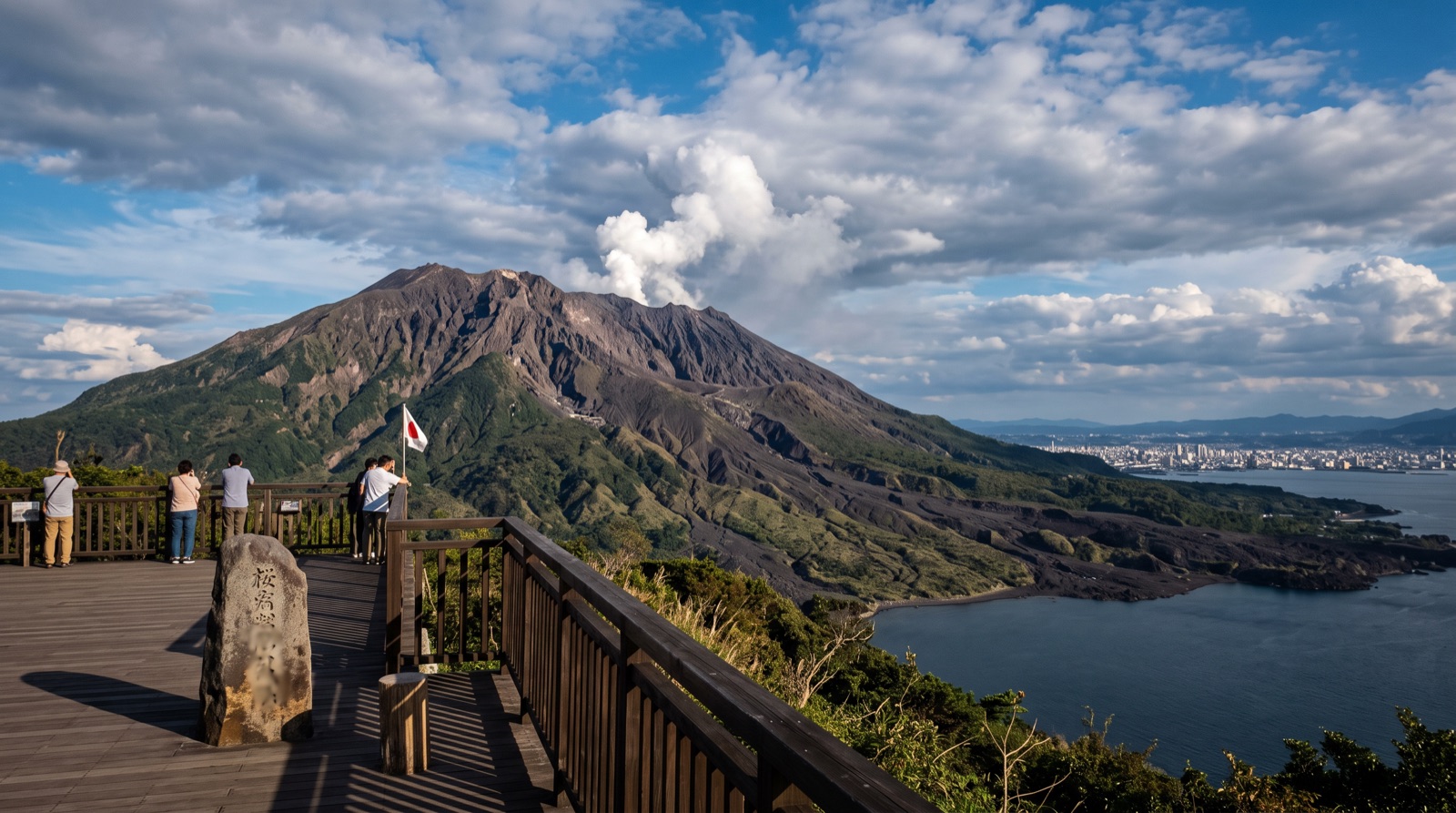
Sakurajima is a genuinely active volcano that produces small eruptions several times a day (this is still the case in 2026). JMA publishes a daily “ash fall forecast” (降灰予報, kōkai yohō), and depending on the wind direction ash does occasionally settle in downtown Kagoshima. What “onsen town Kagoshima” locals do — and what you should copy:
- Check the Sakurajima ash forecast (JMA site or local news app) before leaving your hotel in the morning.
- Wear a mask and glasses — contact-lens wearers should bring backup glasses.
- Skip white or light-colored clothing on ash days (ash stains are stubborn).
- For rental cars, check windshield washer fluid and wipers, and ask about a car-wash option at return.
- Flights being diverted or cancelled because of ash is extremely rare — you can leave that worry at the door.
3. The UV index is still summer-grade. Kagoshima’s September UV reaches 8-9 (very high), roughly on par with a Hawaii summer. Long outdoor stretches like the Sakurajima observatories or the Ibusuki sand bath require SPF 50+ / PA++++ sunscreen reapplied every two hours, plus a wide-brim hat and UV-blocking sunglasses.
If you rarely wear sunscreen at home, please make an exception in Kagoshima — the UV here is not the same as in most of Europe or the northern US.
Reaching Kagoshima from Tokyo, Osaka, Fukuoka & International Gateways
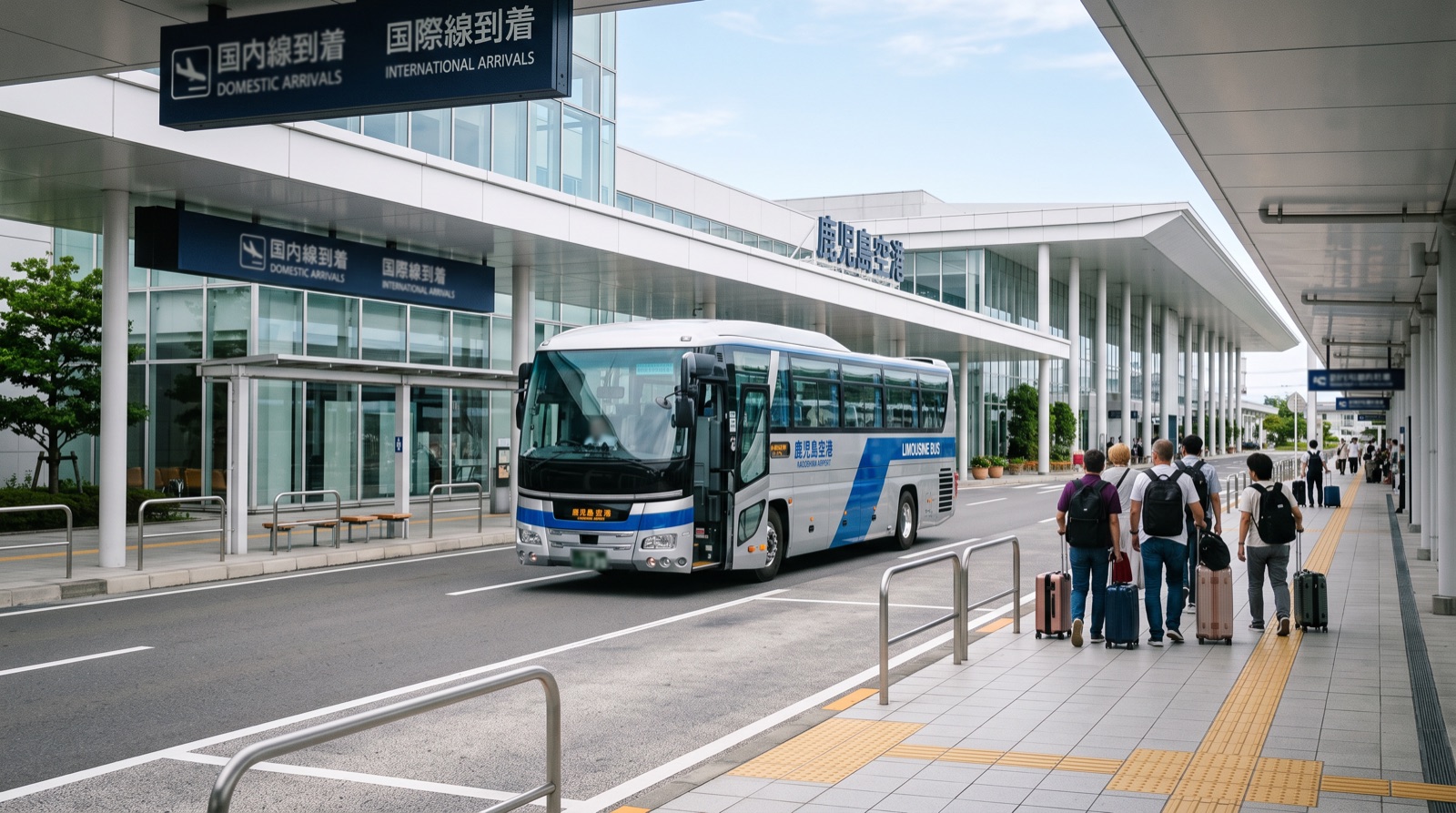
Kagoshima is a smaller regional hub than Fukuoka or Osaka, so most international travelers reach it via a connection. There are three practical routes: a domestic flight from Tokyo or Osaka, the Kyushu Shinkansen from Fukuoka, or one of the limited direct international flights (mostly from other Asian cities).
From Tokyo (Haneda / Narita)
| Route | Time | Notes |
|---|---|---|
| JAL / ANA from Haneda | ~1h55m flight | Roughly hourly departures; best for a fast in/out. From Narita, fewer options. |
| Shinkansen: Nozomi + Sakura | ~6h30m total | Tokyo → Hakata (Nozomi, ~5h) → Kagoshima-Chuo (Sakura, 1h20m). Scenic, low-stress, and mostly covered by a JR Pass. |
From Osaka (Itami / Kansai)
- JAL / ANA from Itami: ~1h15m flight, several daily departures — the fastest way from the Kansai region.
- Shinkansen from Shin-Osaka: Nozomi/Mizuho to Kagoshima-Chuo in about 4 hours. The Mizuho service runs Shin-Osaka → Kagoshima-Chuo direct with only a handful of stops, and is a great use of a JR Pass.
From Fukuoka — the main international gateway for Kyushu
- Kyushu Shinkansen (Sakura / Mizuho): Hakata → Kagoshima-Chuo in as little as 1h20m. The station is a 5-minute subway ride from Fukuoka Airport, so if your international flight lands in Fukuoka, this is by far the smoothest onward journey. Fully covered by both the JR Pass (nationwide) and the JR Kyushu Rail Pass.
- Domestic flight: Also possible (about 55 minutes), but by the time you factor in the airport transfer at both ends the Shinkansen is almost always faster.
Direct international flights to Kagoshima (KOJ)
Kagoshima Airport has a small but growing international terminal. Direct routes are limited and change often, so verify before booking:
- Seoul (Incheon) — LCCs including Jeju Air, T’way and Air Busan operate several flights per week (1h30-40m).
- Busan — Air Busan, 2-4 flights per week (~1h15-25m).
- Taipei — China Airlines runs a seasonal service; check by month.
- Shanghai / Hong Kong — occasional or seasonal only.
For most other international origins (Europe, North America, Australia, Southeast Asia), your best bet is to fly into Tokyo, Osaka or Fukuoka and add a domestic hop or Shinkansen leg.
The JR Pass angle
If you already plan to visit two or more Japanese regions, the nationwide JR Pass covers every Shinkansen and JR local train mentioned above (except the Nozomi and Mizuho premium services — Sakura is the JR Pass-friendly alternative on the Kyushu Shinkansen). A Tokyo → Kagoshima → Kyoto loop over 7-14 days is one of the best-value uses of the pass, and the whole trip can be done rail-only.
Getting from Kagoshima Airport into the city
- 🚌 Airport limousine bus to Kagoshima-Chuo station — about 40 minutes, approx. ¥1,400 (roughly US$9.50), every 15-20 minutes. The bus stop is right in front of international arrivals.
- 🚗 Rental car — pickup counters (Toyota, Nippon, Times, OTS and others) are a 2-3 minute shuttle ride from the terminal.
- 🚕 Taxi — about ¥8,000-10,000 (US$55-70) / 45 minutes to the city; only competitive for parties of four or more.
- Heading straight to Ibusuki or Kirishima? A rental car is essentially mandatory (Ibusuki is about 1h20m by road).
⚠️ Do not assume “airport = city”. Kagoshima Airport sits roughly 30 km northeast of downtown in Kirishima City. It is nothing like Fukuoka’s ultra-central airport (which is on the subway). Give yourself a relaxed evening on arrival day rather than trying to squeeze in dinner reservations at 8pm.
👉 Reserve a rental car in English: GO!GO!TOUR Kagoshima rental cars
4-Day Kagoshima Itinerary — City, Sakurajima, Ibusuki, Kirishima
The classic Kagoshima independent-traveler itinerary is a 4-day loop: city center → Sakurajima → Ibusuki (指宿) → Kirishima (霧島). September’s mix of summer heat and early autumn is ideal for spreading a sand bath, a ferry crossing and a mountain onsen (Japanese hot spring) across separate days.
Day 1 — Kagoshima city center (Sengan-en · Shiroyama · Tenmonkan)
- 12:00 Arrive at Kagoshima Airport → airport limousine bus to the city (40 min).
- 13:30 Hotel check-in in Tenmonkan (天文館), the main downtown district → lunch (kurobuta ramen or a Satsuma-style set meal).
- 15:00 Sengan-en (仙巌園) — the historic garden villa of the Shimazu (島津) clan, the samurai family that ruled the region for 700 years. The garden famously frames Sakurajima as its “borrowed scenery” and is part of a UNESCO World Heritage industrial site.
- 17:30 Shiroyama (城山) observatory for a panoramic sunset over Sakurajima and Kinko Bay.
- 19:00 Dinner at an izakaya in Tenmonkan — try kurobuta (black pork) shabu-shabu or kibinago (silver-stripe herring) sashimi.
Getting around: A one-day pass (¥600) covering the streetcar and the City View sightseeing loop bus is the easiest way to move around downtown. A rental car in the city center is more hassle than help thanks to parking.
Day 2 — Sakurajima (桜島) half-day by ferry
- 08:30 Kagoshima port ferry terminal → Sakurajima ferry (15 min, ¥200, 24-hour service, no reservation needed).
- 09:00 Island View sightseeing bus one-day pass (¥500) → Yunohira (湯之平) observatory (elevation 373 m, the closest point to the crater open to the public) → Arimura Lava Observatory.
- 12:00 Lunch — Sakurajima somen noodles + local loquat (biwa) soft-serve.
- 13:30 Ferry back → stroll along the Waterfront and Dolphin Port.
- 15:00 Ishibashi (石橋) memorial park or Yusentei residence.
- 18:00 Dessert at “Mujaki (むじゃき)” in Tenmonkan — home of shirokuma (literally “polar bear”), a shaved-ice mountain topped with condensed milk, fruit and jelly. Late September is the tail end of the season; from October the menu shrinks noticeably.
Day 3 — Ibusuki (指宿) sand bath · Lake Ikeda · Nagasakibana
- 08:26 Kagoshima-Chuo → limited express Ibusuki no Tamatebako (50 min, all reserved seats, fewer than 40 seats per train — book in advance).
- 09:20 Arrive Ibusuki → Saraku sand bath (¥1,100 including yukata and towel). You lie in 55-60°C geothermally-heated sand for about 10 minutes; it is famous locally as one of the best sweat-out experiences in Japan. Swimwear is not allowed — you wear only the provided yukata (a light cotton robe).
- 12:00 Lunch — the local specialty ondamago-don (a rice bowl with slow-cooked onsen egg).
- 13:30 Rental car or the “Ibusuki Sky” sightseeing bus to Lake Ikeda (池田湖) and Nagasakibana (長崎鼻) cape.
- 16:00 Healthy Land Tamatebako Onsen — outdoor bath with a view of Kaimondake (locally called “Satsuma Fuji” for its perfect cone).
- 18:30 Return to Kagoshima-Chuo.
Getting around: Beyond Ibusuki station, buses to Lake Ikeda and Nagasakibana are very infrequent. A half-day rental car (from about ¥6,000) or the “Ibusuki Sky” sightseeing bus is the practical option.
Day 4 — Kirishima (霧島) shrine & onsen → airport
- 09:00 Rental car from downtown to Kirishima Shrine (about 1 hour).
- 10:00 Kirishima Shrine visit and cedar-lined walking path — dedicated to Ninigi-no-Mikoto and one of the largest shrines in southern Kyushu.
- 11:30 Day-use onsen in the Kirishima hot-spring village (Maruo Onsen or Iodani).
- 13:00 Lunch — kuroushi (Kagoshima wagyu beef) set meal or another round of kurobuta shabu-shabu.
- 15:00 Drop off the rental car at Kagoshima Airport (about 20-30 min from the shrine/onsen).
Getting around: Day 4 is essentially rental-car only. It ties the loop together neatly because you can drop the car right at the airport. Public transport works in theory but requires multiple transfers, and Kirishima-jingu station is 4 km from the actual shrine — not walkable.
👉 Explore more Japan activities: GO!GO!TOUR activity catalog
What to Pack for September in Kagoshima — Scene by Scene
September packing has to bridge “peak summer in the first half” and “early autumn by the last week”, plus Sakurajima ash in the city and up to 8-10°C cooler air in the Kirishima highlands. Rather than one packing list, think in scenes.
| Scene | Tops | Bottoms | Essentials |
|---|---|---|---|
| City sightseeing (Tenmonkan · Sengan-en) |
T-shirt + light shirt overlay | Shorts or lightweight long pants | UV umbrella, wet wipes, hand fan, SPF 50+ sunscreen |
| Sakurajima (ferry + observatories) |
T-shirt + thin windbreaker | Long pants (ash + mosquitoes) | Mask, hat, sunglasses, 2× 500ml water |
| Ibusuki sand bath | Change of T-shirt + underwear | Shorts | Big towel, ziplock bag for sandy clothes. No swimwear — the facility provides a yukata. |
| Kirishima highlands (Ebino Kogen area) |
Long-sleeve base layer + fleece or thin down | Trekking pants | Windproof jacket, hiking shoes, headlamp, rain jacket + pants, gloves (late Sept mornings) |
Common essentials for everyone
- 🌂 Ultra-light rain poncho — convenience-store umbrellas snap in typhoon winds.
- 💧 500ml+ of water on you at all times, plus an oral rehydration drink (Japan’s OS-1 is easy to find at pharmacies).
- 🦟 Insect repellent — mosquitoes are still active through late September.
- 😷 Spare masks for ash-fall days.
- 🕶 UV-blocking sunglasses — pull double duty against sun and airborne ash.
Seasonal Food in September Kagoshima — Shirokuma’s Farewell, Kurobuta & Shochu
What to eat while you are here
- Shirokuma (白熊) shaved ice — the “polar bear” dessert, invented at Mujaki (むじゃき) in Tenmonkan. Late September is the last stretch of the peak season; from October the menu is cut back. Do not skip it.
- Kurobuta (黒豚) shabu-shabu — swish thin slices of Satsuma-native black pork through a light kelp broth and dip in citrus ponzu. “Ichi-Ni-San” and “Ajimori” are the celebrated places; book ahead in high season.
- Kagoshima kuroushi (黒牛) — the local wagyu brand, ranked alongside Matsusaka, Kobe and Omi as top-tier Japanese beef. Kirishima has some outstanding steakhouses and yakiniku spots.
- Satsuma-age (さつま揚げ) — deep-fried fishcakes with all kinds of fillings (yuzu, burdock, squid). At “Agetateya” in Tenmonkan you can eat them fresh out of the fryer.
- Kibinago (きびなご) sashimi — a small silver-striped herring, plated in the shape of a chrysanthemum flower and dipped in vinegared miso. Distinctly Satsuma.
- Karukan (かるかん) — a soft, snow-white confection made from yam, rice flour and sugar. The 200-year-old shop “Akashiya” is the original. Great as an edible souvenir.
- Satsuma sweet-potato shochu (芋焼酎) — Kagoshima is the birthplace of imo-jochu. Premium labels like “Mori Izo” and “Maou” are collectibles; on the rocks or mizuwari (mixed with water) is the local way.
When Exactly to Go — Aim Around Silver Week, Not During It
- Early September: Late August through the first week of September is Japan’s summer-school-holiday tail-end, so flights and hotels stay pricey. Prices ease sharply from around September 5th.
- Mid-September weekdays: Flights and hotels are 20-30% cheaper than July or August. Rental cars are easy to get and popular sights are relaxed. This is the sweet-spot value window.
- Silver Week (approx. Sep 19-23, 2026): Japan’s cluster of autumn public holidays — Respect for the Aged Day and the Autumn Equinox. Domestic travel spikes, and Kagoshima hotels, the Ibusuki no Tamatebako train and popular izakaya fill up. If your dates fall here, book at least 2-3 months out.
- Late September, post-Silver Week (from Sep 24 onward): Typhoon risk drops, prices drop, and the weather starts to feel like early autumn. Our top pick for international independent travelers.
The overall winner is a mid-September weekday, or the days right after Silver Week. You still get summer beaches and the sand-bath season, but with lower typhoon risk and materially cheaper airfare and hotels than in July or August.
Frequently Asked Questions (FAQ)
Q1. How dangerous are typhoons in Kagoshima in September?
Based on 30-year climatological normals, southern Kyushu sees an average of 1.2 typhoon approaches in September — the highest month of the year here, but recent years (2020-2024) have run at 0-1 per September, actually below normal. Early and mid-September carry the higher risk; from around the 21st onward things settle down. If a typhoon does hit directly, ferries, JR trains and flights can pause for a day or two, so flexible-cancellation flights, travel insurance and a rental-car company that waives fees on flight-cancellation certificates are the three things to line up in advance.
Q2. Is Sakurajima volcanic ash actually a problem for travelers?
For normal sightseeing, no. Sakurajima erupts on a small scale several times a day, but JMA publishes an ash-fall forecast and the wind usually blows the ash away from the direction it happens to be facing that day. Flights being cancelled or diverted because of ash is extremely rare. That said, on ash days it is smart to wear a mask, glasses (not contacts), SPF 50+ sunscreen, and dark clothing. If you rent a car, check the windshield washer fluid and wipers, and ask about a car-wash option at return.
Q3. What is the smoothest way to get to Kagoshima from abroad?
For most international travelers, the answer is: fly into Tokyo (Haneda / Narita), Osaka (Kansai) or Fukuoka, then take a domestic connection. From Tokyo, JAL and ANA run frequent 2-hour flights from Haneda. From Osaka, JAL/ANA from Itami take about 1h15m. From Fukuoka — the primary international gateway for Kyushu — the Kyushu Shinkansen Sakura reaches Kagoshima-Chuo in 1h20m and is covered by both the nationwide JR Pass and the JR Kyushu Rail Pass. Direct international flights to Kagoshima itself exist mainly from Seoul, Busan and (seasonally) Taipei; other origins should plan on a connection.
Q4. How much cheaper is a September trip vs. peak summer?
Mid-to-late September weekdays typically run 20-30% below July / August prices for both flights and hotels. Domestic flights within Japan and international connections both trend cheaper, and rental-car rates ease too. Just avoid Silver Week (approx. Sep 19-23), when domestic Japanese travel spikes and pushes rates temporarily back up.
Q5. Does the Sakurajima ferry run normally in September?
Yes — the Sakurajima ferry runs 24 hours a day, year-round, with no reservation required. Even overnight, sailings are only about 60 minutes apart. The one exception is typhoon approaches and rough-sea advisories, when service is suspended. Check the Kagoshima City official ferry page the morning of. You pay after disembarking (¥200 on foot, and cars are welcome — a small car is around ¥1,600 one way), so cash or an IC card is all you need.
Q6. Is the Ibusuki sand bath really comfortable in September?
It is actually one of the best months to try it. In August the ambient heat is more punishing than the sand itself; in September the 28-30°C afternoons make the post-bath recovery feel great. Morning sessions are less crowded and waits are short. All you need to bring is a change of underwear, a big towel and a ziplock bag — the yukata robe and standard towel are provided by the facility (Saraku). Remember: no swimwear, yukata only.
Q7. Any packing tips specific to Kagoshima in September?
The base outfit is “T-shirt + light overshirt + lightweight long pants”. Three Kagoshima-specific additions: (1) a mask, backup glasses, and dark clothing for Sakurajima ash days; (2) a windproof jacket and fleece for Kirishima’s highlands, which run 8-10°C cooler; and (3) a change of clothes, a big towel and a ziplock bag for the Ibusuki sand bath. City-only visitors can basically pack for high summer; if you are combining Sakurajima, sand baths and mountain onsen, use a layered approach.
Q8. How do I reserve the Ibusuki no Tamatebako sightseeing train?
JR Kyushu’s tourist limited express Ibusuki no Tamatebako is all-reserved seating with fewer than 40 seats per train, so same-day sellouts are common. Two ways to book: (1) at the Midori-no-Madoguchi ticket office at Kagoshima-Chuo station, or (2) online via the JR Kyushu Rail Pass website or the JR Kyushu online reservation system up to one month in advance. JR Pass holders can also make seat reservations at any major JR station in Japan. Reserve as early as possible during Silver Week and other holiday periods.
Wrapping up
September in Kagoshima brings the last gasp of summer, the first hint of autumn, and the region’s peak typhoon and ash risks all in one month. With averages of 26.3°C / highs of 30.2°C, you still get full-value beach days and sand baths, while flight and hotel prices retreat noticeably from the July/August peak. Manage the typhoon and ash risks with flexible bookings and a few small precautions, and you unlock a value-priced southern Kyushu trip that also lands the classic Sakurajima–Ibusuki–Kirishima trio.
Kagoshima September checklist
- Avg 26.3°C / high 30.2°C — high summer at the start, early autumn at the end
- Rainfall 222.9 mm — pack a compact rain poncho for typhoons and the autumn rain front
- UV 8-9 (very high) — SPF 50+, sun hat and sunglasses are mandatory
- Southern Kyushu’s peak typhoon month (1.2/yr) — but the last week settles down
- Sakurajima ash — mask, glasses (not contacts), dark clothing on ash days
- Access: 2h domestic flight from Tokyo, 1h15m from Osaka, or 1h20m Shinkansen from Fukuoka
- Airport → city: 40 min limousine bus, ~¥1,400 (US$9.50). Airport is 30 km outside downtown — don’t over-schedule arrival day
- Shirokuma shaved ice: last month of peak season — do not skip
- Ibusuki no Tamatebako sightseeing train: reserve in advance
- Avoid Silver Week (approx. Sep 19-23) → best value is mid-September weekdays or post-Silver Week weekdays
📌 Planning Your Kagoshima Trip with GO!GO!TOUR
Sakurajima, the Ibusuki sand bath, and Kirishima Shrine — southern Kyushu really only needs two things from you: a bit of homework and a flexible itinerary. GO!GO!TOUR handles the logistical side in English so first-time visitors can spend more energy on the actual trip.
- 🚗 Compare and book a Kagoshima rental car — English booking, airport pickup, and English-speaking support on the ground in Japan.
- 🗾 Browse GO!GO!TOUR activities — tours, tickets and experiences across Okinawa, Kyushu, Kansai and the rest of Japan.
Climate figures in this article are based on the Japan Meteorological Agency (JMA) Kagoshima Observatory 1991-2020 climatological normals. Typhoon, ferry and flight information varies with season and sea conditions. Fare and price ranges are indicative for September 2026 — always check the latest information on the operator’s official website before booking.