
- The Rental Counter Rejection You Can Avoid
- The 3-Category Matrix — Which Group Are You In?
- If You Hold a US Driver's License
- If You Hold a UK, Australian, New Zealand, Singapore, or Hong Kong License
- If You Hold a German, French, Belgian, Swiss, or Monégasque License
- If You Hold a Taiwanese License
- If You Hold a Chinese (Mainland) or Vietnamese License
- Geneva 1949 vs Vienna 1968 — Why the Format Matters
- At the Rental Counter — What Staff Actually Check
- The Double Expiry Rule for Geneva 1949 IDPs
- Frequently Asked Questions
- Ready to Book Your Rental Car in Japan?
- Related Reads
The Rental Counter Rejection You Can Avoid
You land in Japan, pick up your bags, walk to the rental car counter — and the staff hand your paperwork back. It happens more than you think. The rules on foreign driver’s licenses in Japan are stricter than most travel blogs suggest, and the “international driving permit” you assumed was universal may not be valid here at all.
This guide sorts it out by nationality. Whether you carry a US, UK, Australian, German, French, Taiwanese, or Chinese license, the answer is different — and in some cases, surprising. You will finish this article knowing exactly which documents to bring to the Okinawa or mainland rental counter, and which ones will get you refused.
Compare Okinawa Rental Cars with GO!GO!TOUR
The 3-Category Matrix — Which Group Are You In?
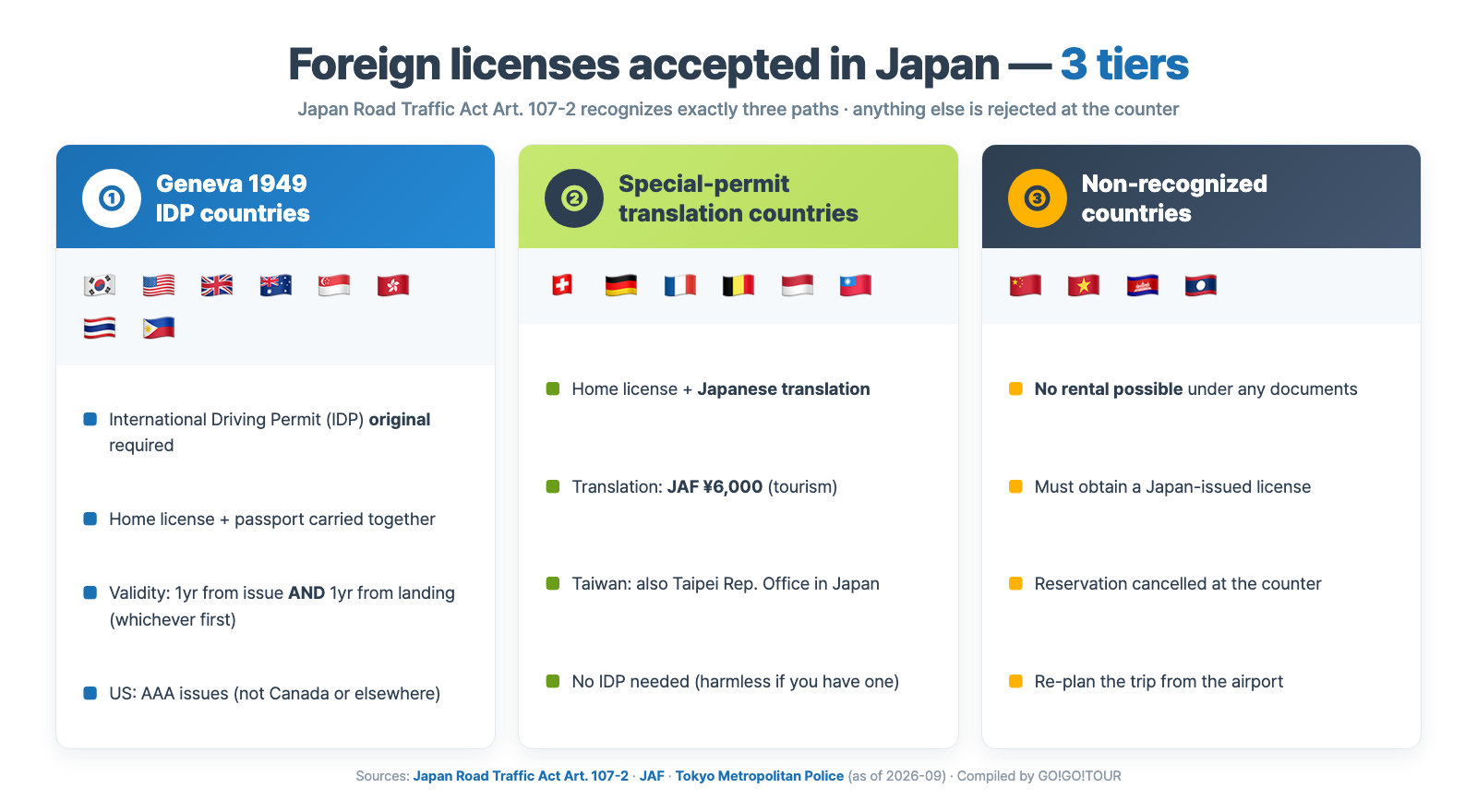
Japan’s Road Traffic Act, Article 107-2, recognizes exactly three legal ways for a foreign driver to operate a car in Japan. Every foreign license falls into one of three groups.
| Category | Who | What to bring | Valid for |
|---|---|---|---|
| A. Geneva 1949 IDP | US, Canada, UK, Australia, New Zealand, Singapore, Hong Kong, South Korea, Thailand, Philippines, India, and 140+ others | Home country license + Geneva 1949 IDP + passport (all originals) | 1 year from IDP issue date and 1 year from Japan entry — whichever ends first |
| B. Japanese translation | Germany, France, Belgium, Switzerland, Monaco, Taiwan | Home country license + certified Japanese translation + passport | Home license validity and 1 year from Japan entry |
| C. Not accepted | Mainland China, Vietnam, and any country outside categories A and B | Cannot rent a car in Japan (must obtain a Japanese license) | — |
The single most common mistake: assuming that “any international driving permit works in Japan.” It does not. Only IDPs issued under the Geneva 1949 Convention are recognized. Vienna 1968 Convention IDPs — the modern format used by several countries — are not valid in Japan.
If You Hold a US Driver’s License
You need a Geneva 1949 IDP, and it must be issued in the United States by AAA (American Automobile Association) or AATA. This is the single most misunderstood rule for American travelers, and it causes rejections at rental counters every week.
The Canada Stopover Trap
A US license holder cannot pick up an IDP during a stopover in Canada, Mexico, or anywhere else. The IDP must be issued by the same country that issued your underlying driver’s license. US license + Canadian IDP = invalid in Japan. The rental counter will reject you, and your reservation cancellation fee will be 100%.
What to Do Before You Fly
- Apply through AAA — online form or any local AAA office
- Cost: around USD 20, plus two passport-style photos
- Processing: same-day at a AAA office; 10–15 business days by mail
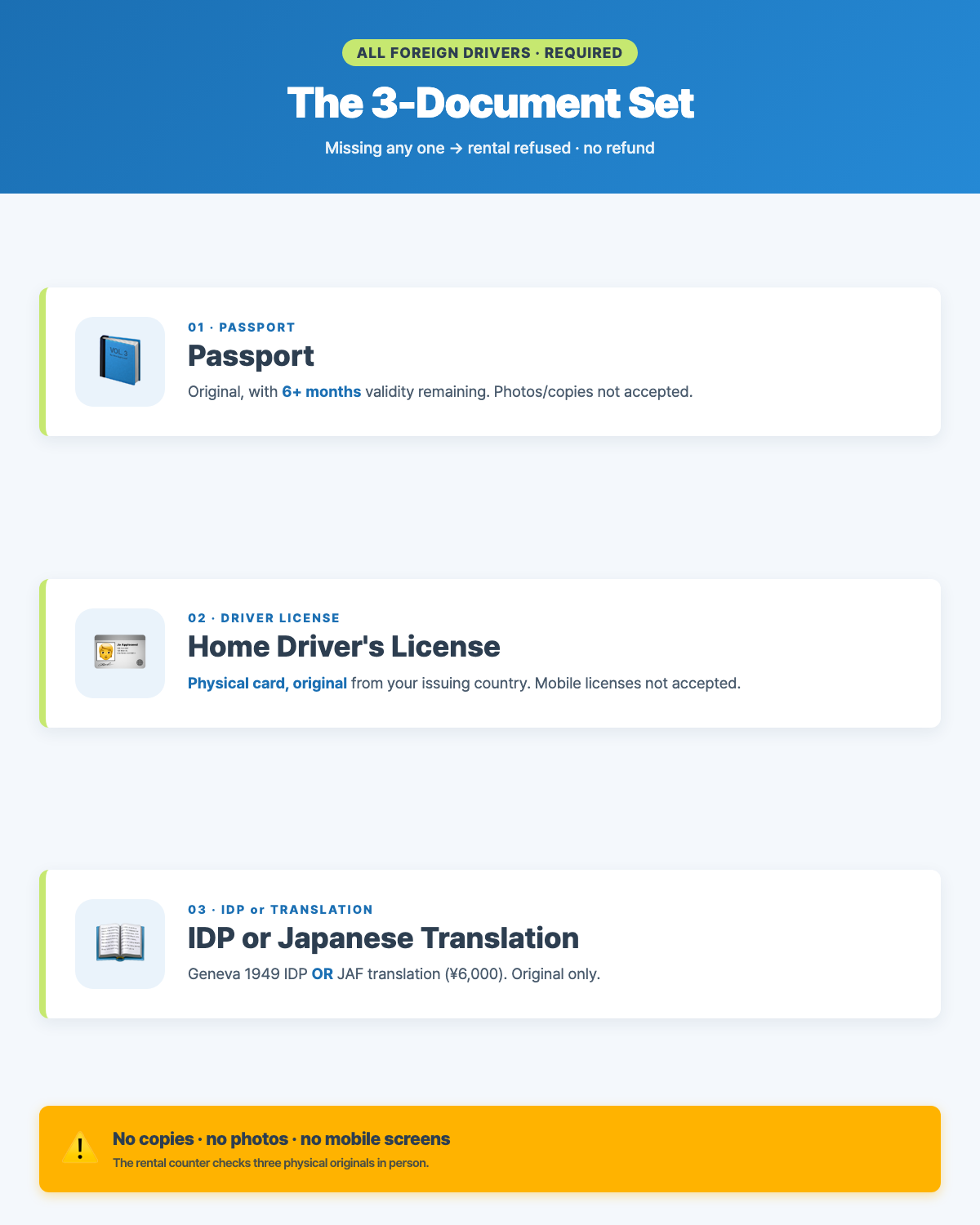
- Bring the original US license, the original IDP booklet, and your passport to Japan. Copies and phone photos are not accepted at the counter.
If You Hold a UK, Australian, New Zealand, Singapore, or Hong Kong License
You are also in Category A — the Geneva 1949 route. Bring your national license, a Geneva 1949 IDP issued by the same country, and your passport.
- UK: IDP issued by the AA, RAC, or a UK Post Office. Cost around GBP 5.50. Available same-day at Post Offices.
- Australia: IDP issued by AAA (Australian Automobile Association) state clubs — NRMA, RACV, RACQ, RAC WA, RAA, RACT, AANT. Cost around AUD 42.
- New Zealand: IDP issued by the NZ Automobile Association. Cost around NZD 24.
- Singapore: IDP issued by the Automobile Association of Singapore. Cost around SGD 20.
- Hong Kong: IDP issued by the Hong Kong Transport Department under the 1949 Convention format.
All five countries issue Geneva 1949 IDPs (the classic grey booklet). Vienna 1968 versions do not exist for these markets, so you cannot pick the wrong one — but always confirm the words “1949 Convention on Road Traffic” appear on your permit.
If You Hold a German, French, Belgian, Swiss, or Monégasque License
Here is the surprise: you do not need an international driving permit at all. In fact, an IDP will not help you in Japan even if you get one. What you need instead is a certified Japanese translation of your home country license.
This special rule is set by Japanese government ordinance (政令), and it applies to a fixed list of six territories: Germany, France, Belgium, Switzerland, Monaco, and Taiwan. Their licenses are treated as legally equivalent to a Japanese license — on the condition that you carry an official Japanese translation issued by an authorized body.
Who Can Issue the Translation
- The government agency that issued your original license
- Your country’s embassy or consulate in Japan
- JAF (Japan Automobile Federation) — the most common choice for tourists
- Zipplus Corporation — a private authorized issuer
Private translation agencies, notarized personal translations, and machine translations are not accepted at rental counters, no matter how professional they look. This trips up a lot of first-time visitors.
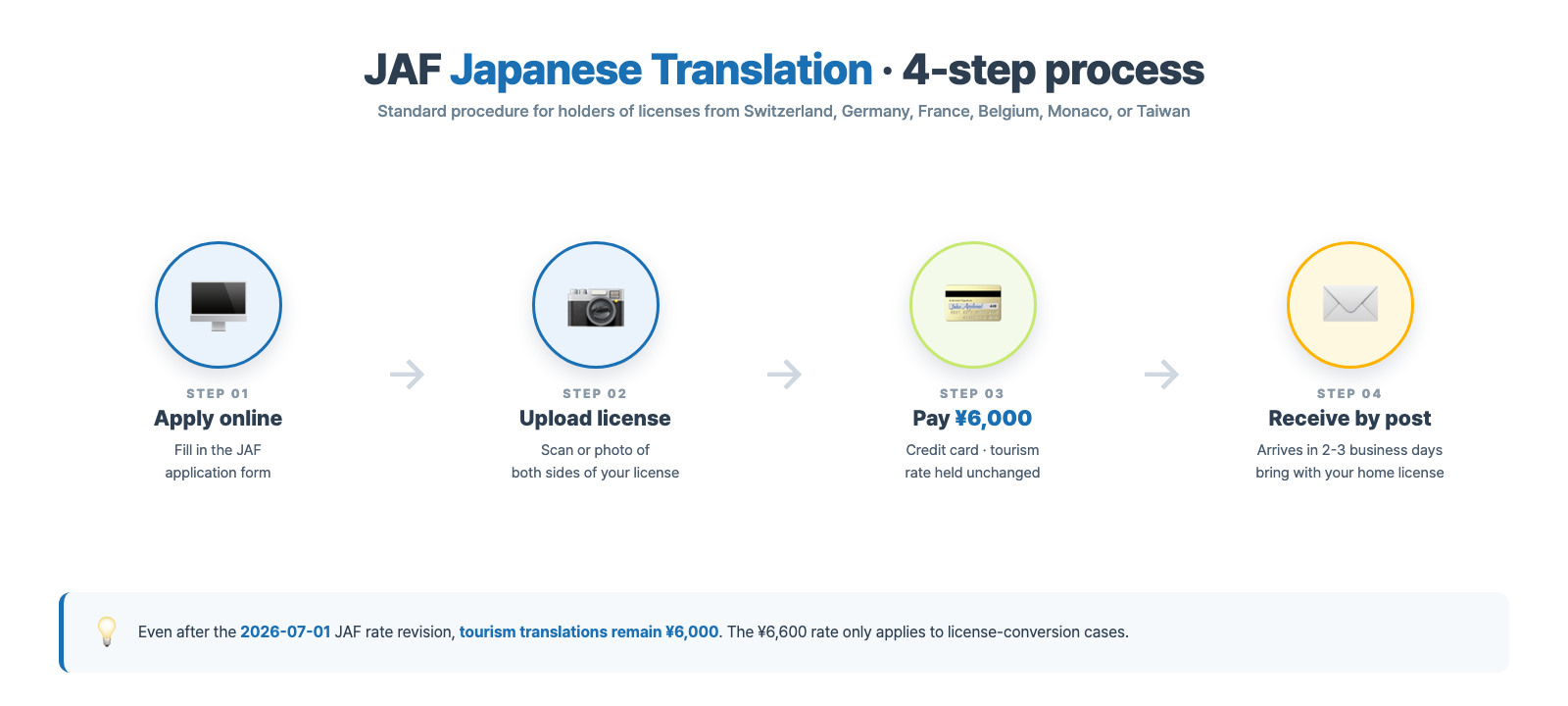
JAF Translation — The Practical Route
- Cost: JPY 6,000 (tax-exempt) for tourism driving. This price is unchanged in 2026 for tourism-purpose translations.
- Processing time: 2–3 business days for the six eligible countries
- Application: JAF online only. Payment by credit card or cash.
- Where to receive: JAF only ships within Japan. Plan to have the translation delivered to your hotel or accommodation shortly after landing.
- Requirement: Upload a clear image of your original driver’s license — front and back, both sides visible.
Why is this route better than an IDP for German, French, Belgian, Swiss, and Monégasque drivers? Because your home license itself is the recognized document. The translation just makes it readable to Japanese officials. You skip the IDP application entirely, and the translation is valid for the full validity period of your home license (capped at 1 year from your Japan entry date).
If You Hold a Taiwanese License
Taiwan is a special case. Taiwanese drivers use the Japanese translation route, and there are two accepted issuers:
- JAF — same online process as for European drivers. JPY 6,000, 2–3 business days.
- Taipei Economic and Cultural Representative Office (台北駐日經濟文化代表處) — the Taiwan representative office in Japan. Processing 3–7 business days after receipt of documents. Okinawa applicants can also apply here.
If you are already in Taiwan, the Taiwan-Japan Relations Association (台湾日本関係協会) issues the translation domestically. Either issuer’s translation is fully valid at Japanese rental counters. Private translation companies are not accepted.
If You Hold a Chinese (Mainland) or Vietnamese License
This is difficult news: you cannot legally rent a car in Japan on your home license, and no IDP from mainland China or Vietnam is valid here. Driving on such a license or permit is treated as unlicensed driving under Japanese law.
The reason is treaty membership. Japan is a party to the Geneva 1949 Convention. Mainland China is a party to neither the Geneva 1949 nor the Vienna 1968 convention. Vietnam joined only the Vienna 1968 convention. Because there is no shared treaty basis, IDPs from these countries have no legal force in Japan.
Practical Options
- Convert to a Japanese license (外免切替) — requires proof of at least 3 months of residence in the issuing country after obtaining the license, plus a written and practical test in Japan. Not realistic for short trips.
- Use a license from a third Geneva 1949 country — some travelers obtain a Philippine or Thai license and IDP, but this is a long-term project and not a quick workaround.
- Use trains, buses, taxis, and hired drivers — realistic for most trips. Japan’s rail and bus network is excellent in every major region except remote Okinawa areas.
By contrast, licenses from Thailand, the Philippines, Indonesia, Malaysia, and India (Geneva 1949 members) are fine — those drivers just need a properly issued IDP from their home country.
Geneva 1949 vs Vienna 1968 — Why the Format Matters
Both conventions are called “international driving permits” in casual English, but Japan only recognizes the Geneva 1949 format. Here is the difference at a glance.
| Item | Geneva 1949 | Vienna 1968 |
|---|---|---|
| Recognized in Japan | Yes | No |
| Format | Grey booklet, folded, 8-language layout per ISO standard | Card or updated booklet format |
| Sample member countries | US, UK, Australia, Canada, South Korea, Thailand, Philippines, Germany, France, and 140+ more | Russia, Vietnam, Brazil, Iran, and others (some countries are in both) |
The name on your permit does not tell you which convention it is issued under. Look at the cover — the words “1949 Convention on Road Traffic” (or “Convention Internationale sur la Circulation Routière du 19 Septembre 1949”) should appear. If your booklet only cites the 1968 convention, it will not be accepted in Japan.
At the Rental Counter — What Staff Actually Check
Rental car staff in Japan follow a strict checklist, especially at high-volume airport locations like Naha Airport in Okinawa. Here is what they verify, and the reasons they most often refuse a customer.
| Category | What the counter checks | Common rejection reasons |
|---|---|---|
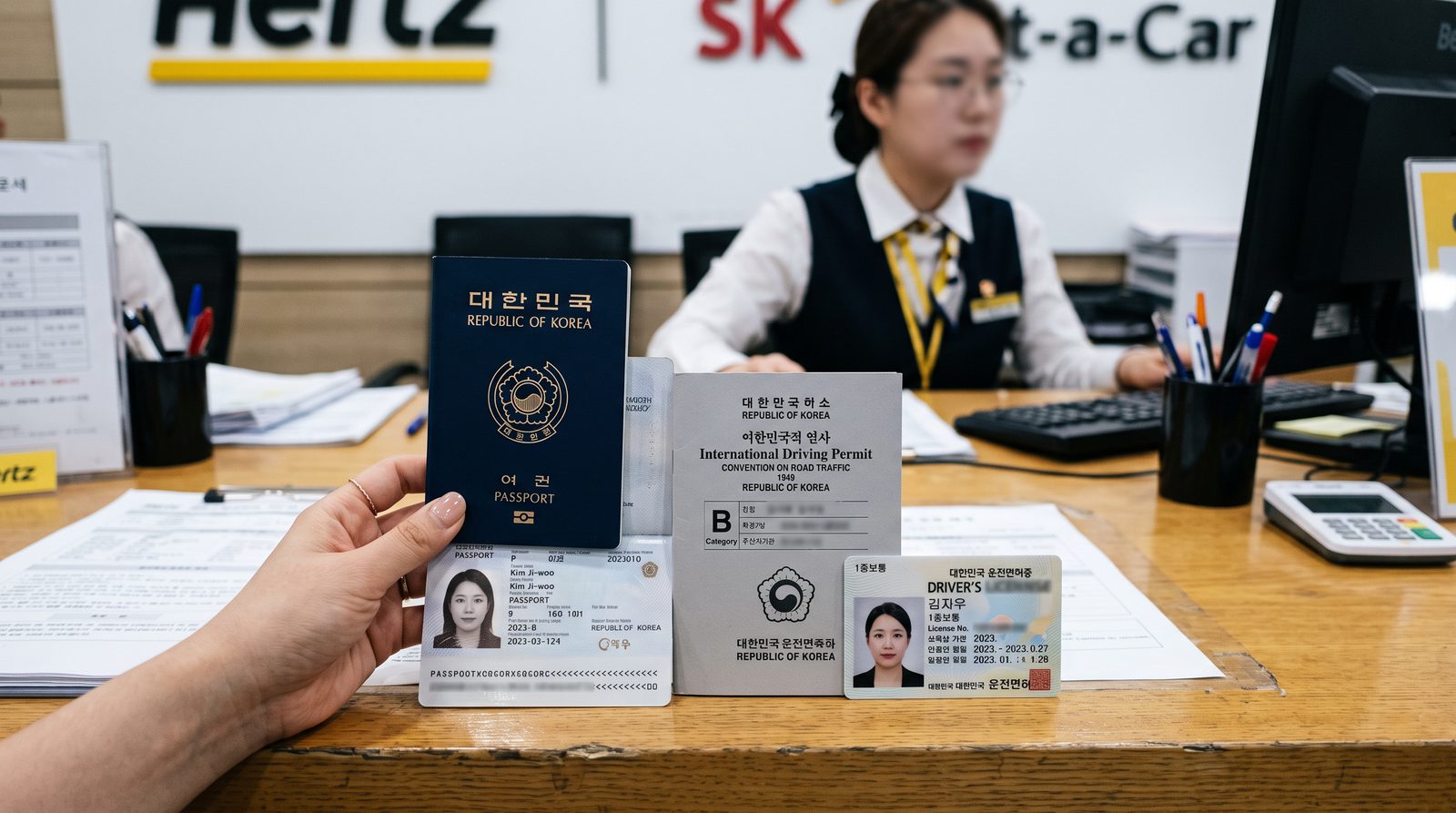
| A. IDP route | Original passport + original home license + Geneva 1949 IDP + Japan entry stamp | IDP issued more than 1 year ago; IDP from a different country than the license; photocopy or phone photo of IDP; passport name spelling does not match IDP |
| B. Translation route | Original passport + original home license + authorized Japanese translation + Japan entry stamp | Translation from an unauthorized agency; translation without the original license; expired home license |
| C. Not accepted | Cannot rent | Presenting a Chinese or Vietnamese IDP; presenting a “notarized translation” from a private company |
Three universal rules apply to every category:
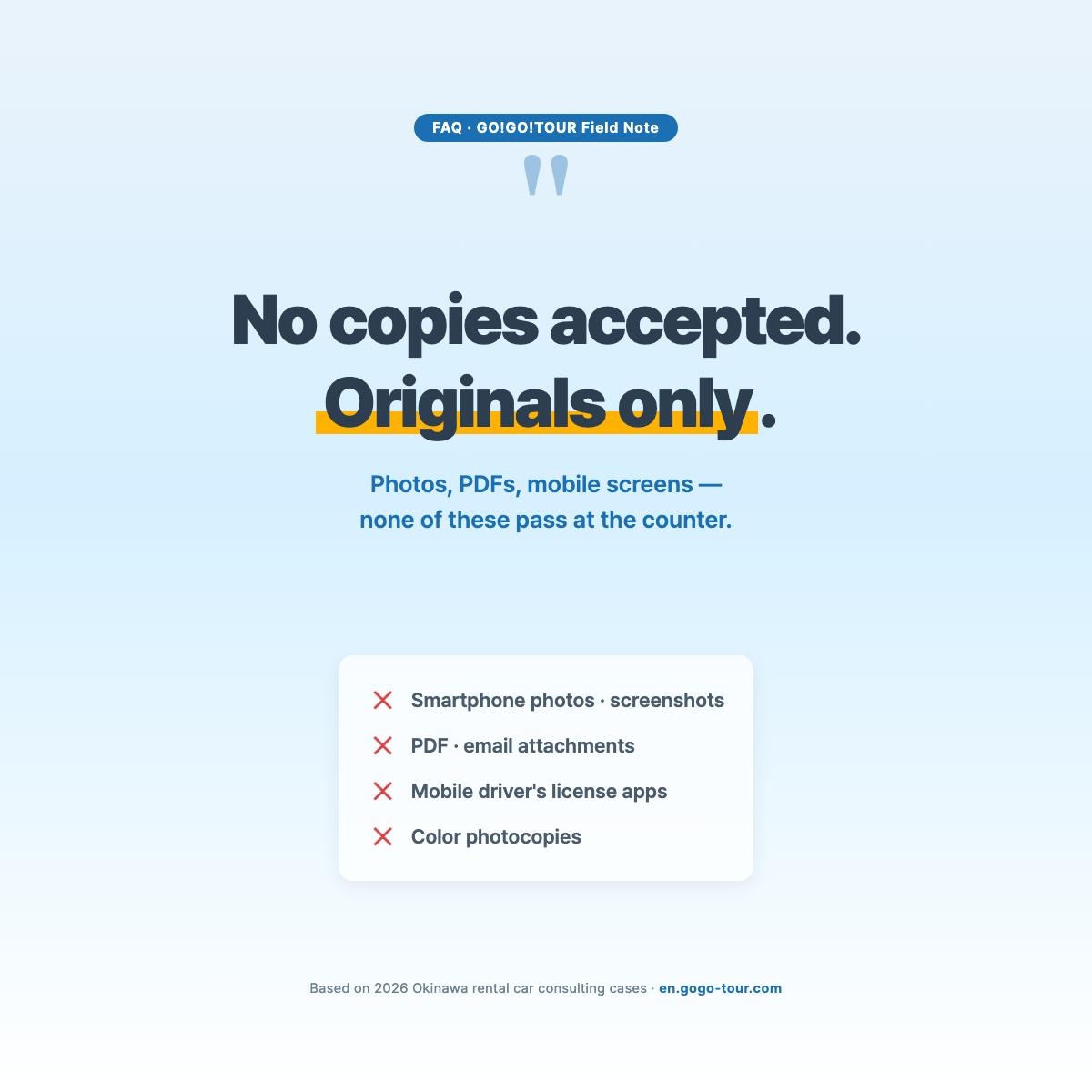
- All documents must be originals. Photocopies, scans, and phone photos have no legal force at the counter.
- All documents must be within validity. Both the license and the IDP or translation.
- Name spelling on all documents must match. Passport, license, and IDP must show the same Roman-letter spelling. Marriage name changes and transliteration differences are the most common cause of last-minute rejections.
The Double Expiry Rule for Geneva 1949 IDPs
Two clocks run at the same time on your Geneva 1949 IDP, and Japan applies whichever expires first.
- 1 year from the IDP issue date — printed on the permit itself
- 1 year from your Japan entry date — verified by the entry stamp in your passport
Example: IDP issued 2026-01-15. First Japan entry 2026-11-01. Your driving right expires on 2027-01-14 (the IDP issue-date clock hits first), not 2027-10-31. If you plan a longer stay or multiple visits, apply for a fresh IDP shortly before you fly.
A note for long-term residents: leaving Japan and re-entering does not reset the 1-year entry clock unless you have been out of the country for at least 3 continuous months. This is a common trap for expats trying to squeeze another year of IDP driving out of a quick Korea trip.
Frequently Asked Questions
Q1. My US driver’s license has “English” printed on it. Do I still need an IDP?
Yes. English text on your home license has no legal meaning under the Geneva Convention. You need a separate Geneva 1949 IDP booklet issued by AAA or AATA in the United States. The English on your card is just for domestic legibility.
Q2. Can I use a digital copy or a photo of my IDP on my phone?
No. All Japanese rental companies require the physical original IDP booklet at pickup. Photos, PDF scans, and digital wallets are not accepted, even at large chain counters. Bring the paper booklet in your carry-on.
Q3. My friend is a German citizen. Can she drive our rental car during our Japan trip?
Yes — but with the correct paperwork. A German license holder needs the original German license, a JAF-issued Japanese translation (JPY 6,000, apply online), and her passport. No IDP required. To be listed as an additional driver, add her name at the reservation stage so she is on the contract.
Q4. My mainland Chinese friend has an IDP issued in China. Can he rent a car in Japan?
No. Mainland China is not a party to the Geneva 1949 Convention, so Chinese IDPs are not recognized in Japan. Even if his IDP looks identical to a Geneva-format booklet, Japanese rental companies are legally required to refuse. His practical option is to be a passenger and share driving duties with a friend whose license Japan does accept.
Q5. I have both a US license and an EU license. Which route is easier?
If your EU license is German, French, Belgian, Swiss, or Monégasque, the translation route is usually easier — no need to visit AAA before flying, just apply to JAF online after landing (or before, and receive delivery to your hotel). For any other EU license, use the Geneva 1949 IDP route from your home country.
Ready to Book Your Rental Car in Japan?
Now that you know exactly which document to bring, the next step is securing the car. In Okinawa in particular, popular vehicles and dates sell out weeks or months in advance — especially over Golden Week, summer, and New Year holidays.
GO!GO!TOUR compares Okinawa rental car prices across multiple providers in one search. All bookings are in English, all major providers offer free airport shuttles from Naha Airport, and insurance options with full NOC waiver are available at every price point.
Compare and Reserve Your Okinawa Rental Car
Planning a longer road trip? Browse our list of Okinawa rental car providers or explore activities and experiences to build the perfect Okinawa itinerary.