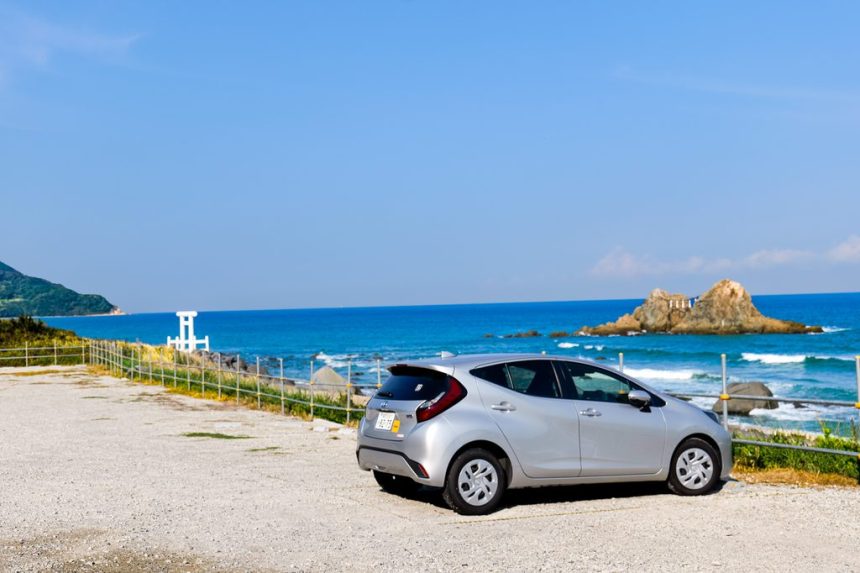
Itoshima’s Meoto Iwa — a one-hour drive west of Hakata, where a white torii frames the setting sun
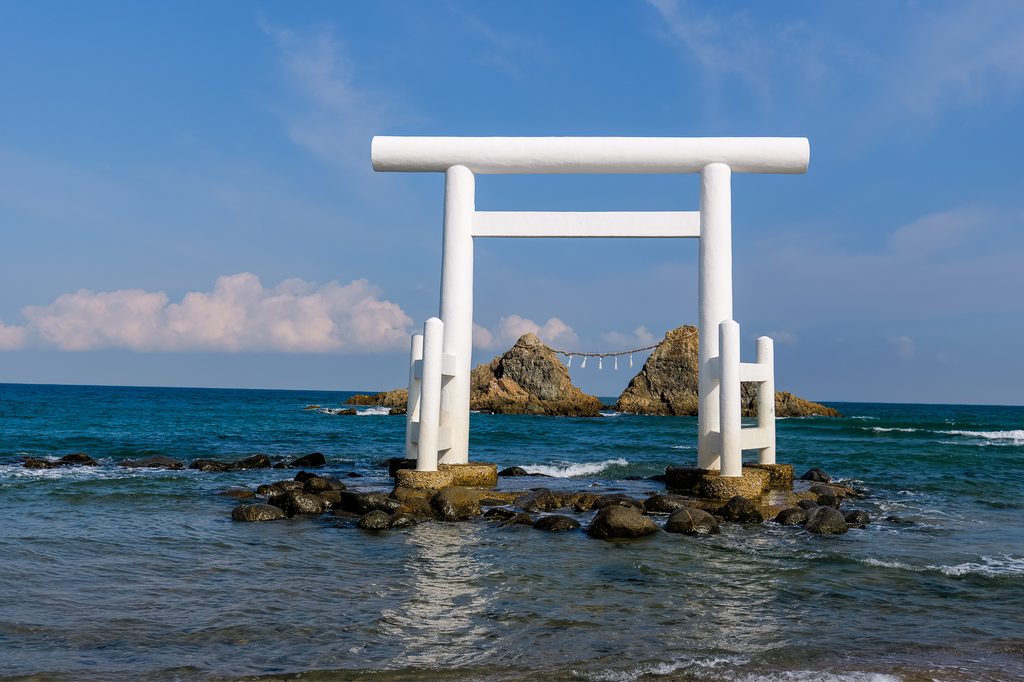
Just an hour west of Fukuoka’s Hakata district, the coastline suddenly opens onto the deep blue Genkai Sea — and floating 150 metres offshore, two dark rocks stand side by side beneath a stark white torii. This is Sakurai Futamigaura, better known to visitors as Meoto Iwa, the “husband-and-wife rocks.”
You will see this view on almost every Fukuoka Instagram feed, but photos flatten what actually makes it special: the light off the Genkai Sea, the shimenawa rope swaying between the two rocks, and — if you time it right — the sun dropping straight between them at the horizon.
This guide covers the practical side of visiting by rental car: parking rates, how to avoid the tour-bus crowds, when the sunset actually lines up between the rocks, and how to loop the spot into a half-day Itoshima drive.
If you plan to rent a car, you can browse vehicles and pick-up locations on our Fukuoka rent-a-car page — Hakata Station and Fukuoka Airport pick-ups both available.
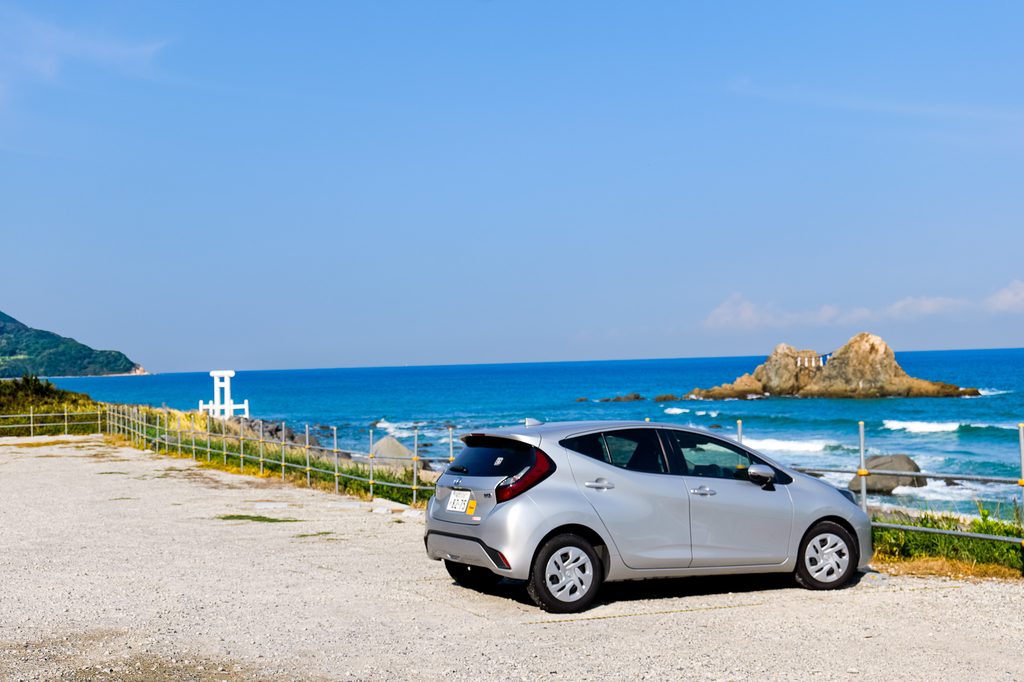
What exactly is Meoto Iwa?
The full name is Sakurai Futamigaura, located in Shima-Sakurai, Itoshima City, Fukuoka Prefecture. About 150 metres offshore, two rocks — locally also called Suzume Iwa — rise straight out of the sea. They are the sacred body (goshintai) of Sakurai Shrine, a Shinto shrine founded in 1632 by the second lord of the Fukuoka Domain, Kuroda Tadayuki.
The right-hand rock is male and the left-hand rock is female. In Japanese mythology, the two deities enshrined here — Izanagi and Izanami — are the creator gods who gave birth to the Japanese islands. That’s why this stretch of coast is treated as a “power spot” for couples, weddings, and anyone hoping to strengthen a relationship.
| Rock | Right — Male | Left — Female |
|---|---|---|
| Height | 11.8 m | 11.2 m |
| Enshrined deity | Izanagi-no-Mikoto | Izanami-no-Mikoto |
| Symbolism | Marital harmony, family lineage | Good matches, en-musubi (bonds) |
Position yourself on the beach and the white torii lines up neatly between the two rocks — the reason this is one of the most popular pre-wedding and proposal photo spots in Kyushu.
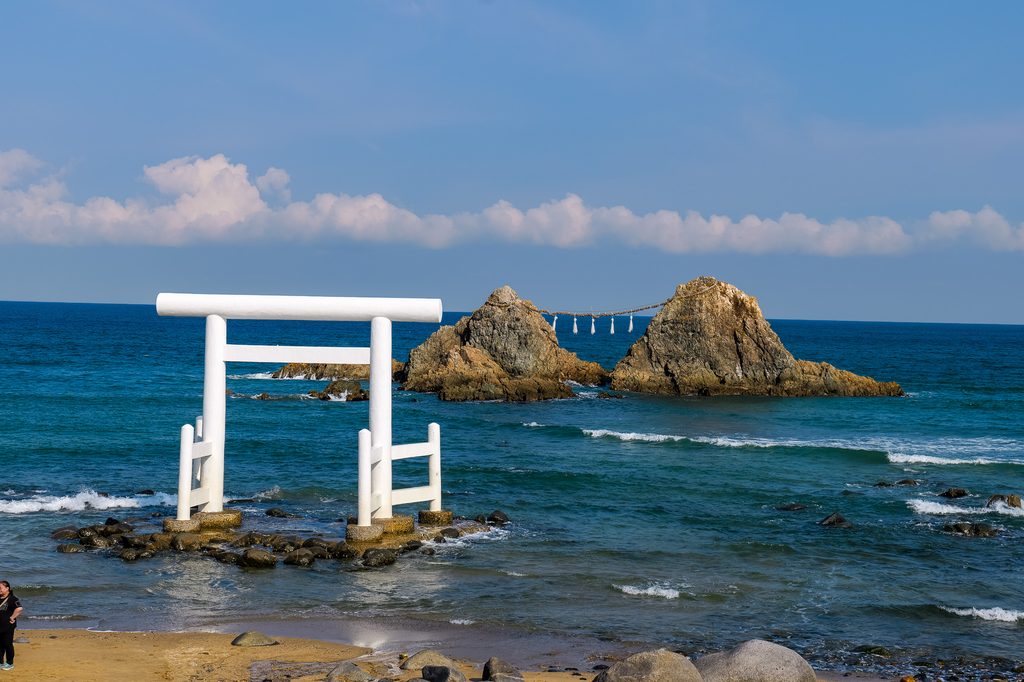
The shimenawa rope is replaced every spring
The heavy braided rope stretched between the two rocks is a shimenawa — a Shinto marker separating the sacred from the everyday world. This one is enormous: 30 metres long, 50 cm thick, and roughly 1 tonne in weight.
The rope is replaced every year during the spring spring tide, when the water pulls back far enough to reach the rocks on foot. The ceremony is called Ō-Shimenawa-Kake-Sai and is carried out by about 50 parishioners (ujiko) of Sakurai Shrine.
The 2026 date is May 3. The schedule runs roughly: 08:00 shrine rite, 09:00 rope-making on the shrine grounds, and around 15:00 the new rope is carried out to the rocks and installed with a purification blessing. If you happen to visit in early May and the rope looks unusually bright and clean, you are seeing the year’s brand-new one.
Parking: 300 yen per hour, first 10 minutes free
Entry to the beach is free — there is no ticket booth or fence. Parking is where the cost sits. The municipal Futamigaura Parking Lot sits right in front of the rocks and switched from free to paid on April 1, 2023.
| Item | Details |
|---|---|
| Rate | 300 yen per hour (first 10 minutes free) |
| Hours | 24 hours |
| Capacity | 47 cars |
| Vehicle limits | Length 5 m · Width 2.3 m · Height 2.1 m · Weight 2 t |
| Bikes & mopeds | Free |
The rate is charged per hour, not capped: staying 90 minutes will cost 600 yen. If you only stop for a quick photo and leave within 10 minutes, parking is free. Large tour buses cannot use this lot walk-up — they must reserve one of three private lots in advance (Futamigaura Park Seichi, Itoshima Sabo, or Palm Beach The Gardens).
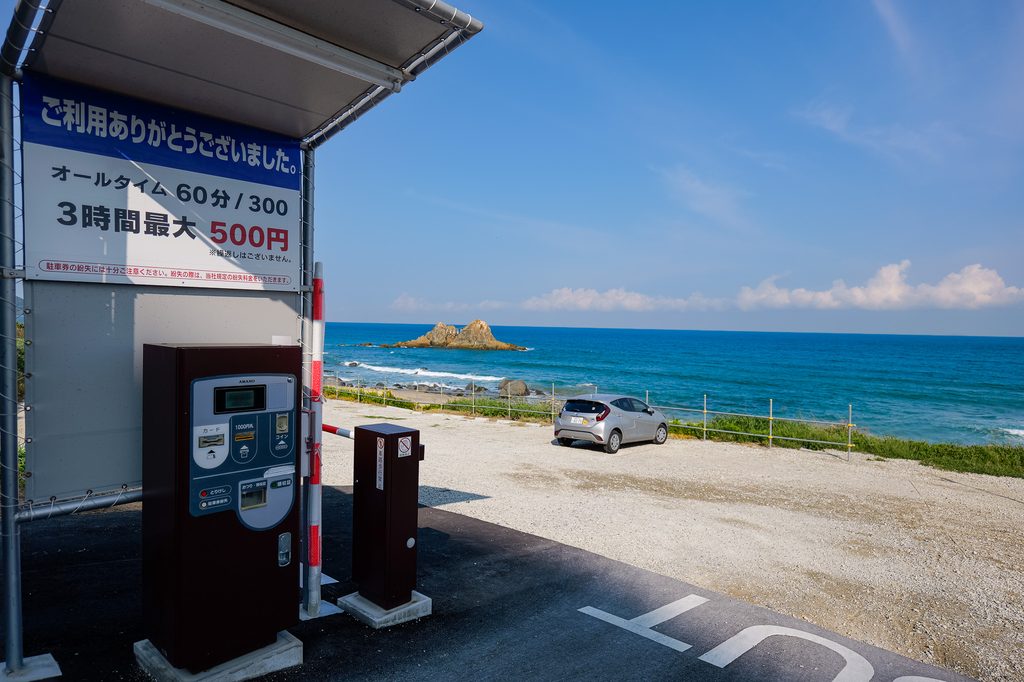
If the municipal lot is full on a summer weekend, the neighbouring Palm Beach paid lot and Itoshima Sabo customer parking usually still have space at 500–1,000 yen per day.
How long does the drive from Fukuoka take?
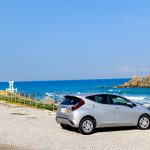
Meoto Iwa is one of the easiest self-drive day trips from central Fukuoka. Take the Urban Expressway west, transfer to the Nishi-Kyushu Expressway, and exit at Imajuku IC.
| From | Route | Time |
|---|---|---|
| Hakata / Tenjin | Urban Expressway → Nishi-Kyushu Expressway → Imajuku IC → Route 202 / Prefectural 54 | About 1 hour |
| Imajuku IC | Local roads toward Sakurai | About 30 minutes |
| Fukuoka Airport | Via Urban Expressway | About 1 hour 10 minutes |
You can technically do it without a car — JR to Chikuzen-Maebaru or the subway to Kyudai-Gakkentoshi, then a Showa Bus to “Futamigaura / Tsuki to Taiyo Itoshima Sabo mae,” a four-minute walk from the rocks — but bus frequency drops sharply in the evening, which is exactly the time you want to be here.
Driving in Japan — quick checklist for first-timers
- Left-hand traffic. Japan drives on the left, right-hand-drive cars. Give yourself extra time at the first junction.
- International Driving Permit (IDP). Required in addition to your home licence — 1949 Geneva Convention format. Get it before you fly.
- JAF card. Your rental will normally include roadside assistance, but a JAF membership card from your home motoring club (AAA, CAA, AA, etc.) often works reciprocally.
- ETC card. Ask the rental counter for one — the Urban Expressway and Nishi-Kyushu Expressway both use ETC for smooth tolls.
- Route 202. Two lanes, straightforward — a good first Japanese drive.
Go early or go for sunset — never in between
Meoto Iwa is listed in both Japan’s Top 100 Beaches and Japan’s Top 100 Sunsets. As a result, Japanese coach tours cycle through heavily between 10:00 and 15:00, and the parking lot regularly fills up in that window.
For a calm photo and easy parking, arrive either right after sunrise until 09:00, or about an hour before sunset.
Sunset times shift a lot across the year in Fukuoka:
| Season | Sunset (Fukuoka) |
|---|---|
| Summer solstice (around June 21) | ~19:30 |
| Autumn equinox (around September 23) | ~18:15 |
| Winter solstice (around December 22) | ~17:15 |
The single most photographed moment is the summer-solstice sunset, when the sun drops directly between the two rocks. In late June, photographers arrive 90 minutes early to claim tripod space along the seawall. If that shot is on your list, plan the same.
Nearby stops for a half-day loop
Meoto Iwa alone is a two-and-a-half-hour round trip from Hakata. With one more hour you can stitch it into a proper Itoshima half day — the surrounding coast is a string of cafes and photo stops.
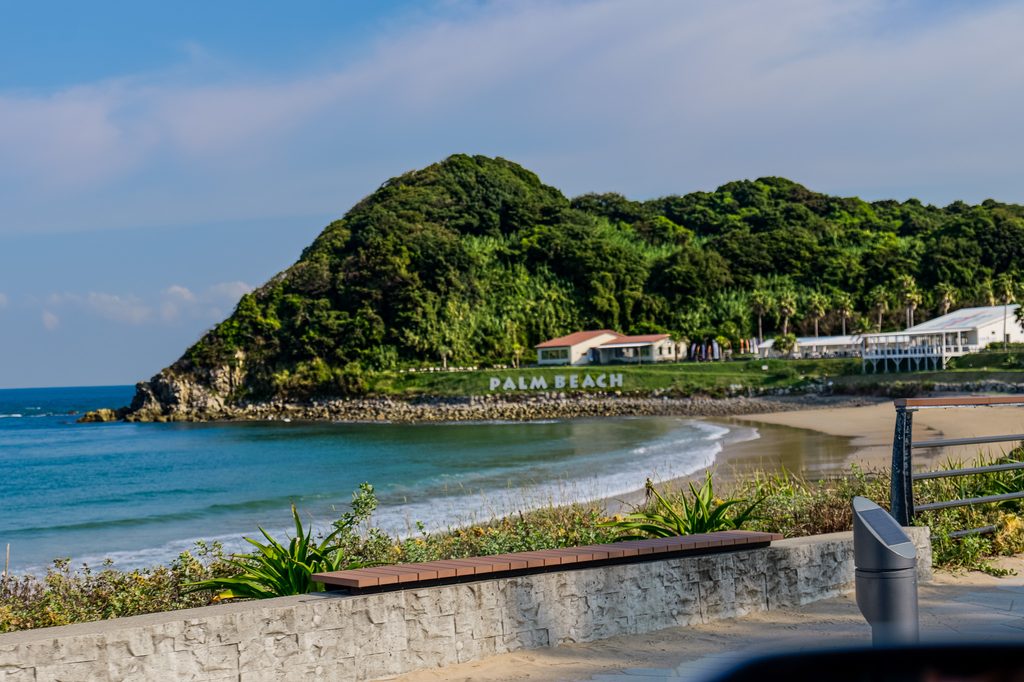
- Palm Beach The Gardens — the beachfront resort complex right next to Meoto Iwa, with an Italian restaurant, a gelato and waffle stand, a Japanese set-meal place, and the famous palm-tree swing photo spot.
- Itoshima Sabo — the cafe directly opposite the rocks. The bus stop out front literally uses its name.
- London Bus Cafe — a genuine red double-decker converted into a cafe, five to ten minutes west by car.
- Sakurai Shrine — the parent shrine of Meoto Iwa, five minutes inland by car.
- Keya no Ōto — one of Japan’s three great basalt sea caves, 20 minutes west along the coast.
A reliable loop: Meoto Iwa in the morning → lunch at Palm Beach → coffee at London Bus Cafe → Sakurai Shrine → back to Meoto Iwa for sunset.
If you’d like more context for planning the wider day, our Fukuoka model course page lays out other routes you can pair with an Itoshima morning.
Visitor checklist
- Admission: Free — the beach and rocks are open to all
- Parking: Municipal Futamigaura lot · 300 yen / hour · first 10 minutes free · 24 hours · 47 spaces
- Restrooms: Basic facilities next to the parking lot
- Payment: Pay-before-exit at the lot’s ticket machine — cash accepted, some IC cards work
- Transport: Rental car strongly recommended — bus service is sparse, especially at sunset
- Best time: Early morning or the hour before sunset
FAQ
Q. Is there an entrance fee for Meoto Iwa?
A. No. Admission is free — the beach, the rocks, and the white torii are all open to the public with no ticket booth.
Q. How much is the parking?
A. The municipal Futamigaura Parking Lot charges 300 yen per hour. The first 10 minutes are free and the lot is open 24 hours.
Q. How long is the drive from Fukuoka?
A. About one hour from Hakata or Tenjin by rental car — Urban Expressway to Nishi-Kyushu Expressway, exit at Imajuku IC, then roughly 30 minutes on local roads.
Q. Can I get there without a car?
A. It is possible but not practical. JR or subway to Itoshima, then a Showa Bus to “Futamigaura / Tsuki to Taiyo Itoshima Sabo mae,” four minutes on foot — but the bus frequency drops in the evening, which makes catching sunset difficult. A rental car is much easier.
Q. When is the shimenawa rope replaced?
A. Every year during the late-April to early-May spring tide, in a ceremony called Ō-Shimenawa-Kake-Sai. The 2026 date is May 3.
Q. What time of day is quietest for photos?
A. Japanese coach tours arrive between 10:00 and 15:00. Arrive early (up to 09:00) or about an hour before sunset for the least-crowded photos.
Q. Do I need an International Driving Permit to rent a car in Fukuoka?
A. Yes. Non-residents need a 1949 Geneva Convention IDP alongside their home licence. Get it in your home country before you fly — Japan does not issue them on arrival.
Closing — One rental car, one half-day, one of Kyushu’s best sunsets
One line sums it up: a white torii, two sea-standing rocks, and a sun that drops between them at the horizon — worth every minute of the two-hour round trip from Hakata.
Meoto Iwa is the single half-day drive we recommend most often for first-time Fukuoka visitors. If this is your first time behind the wheel in Japan, this is the route to start with.
Fukuoka rental cars can be compared by class on our Fukuoka rent-a-car page. For narrow coastal lanes and small municipal lots, the kei-car search is the friendliest option; for family luggage, the mid-size and wagon search gives more room.
For itinerary ideas beyond Itoshima, our Fukuoka model courses and Fukuoka activities pair well with a morning at Meoto Iwa.

Next time you fly into Fukuoka, don’t only walk the city. Pick up a rental car, drive an hour west, and stand on the beach at Meoto Iwa as the sun drops between the rocks. It really does look different in person than in the photos.