
Oita in September — weather, typhoons and packing for Beppu & Yufuin
Oita in September averages 24.2 °C (75.6 °F), with daytime highs around 28 °C (82 °F) and monthly rainfall of 255 mm (10 in). That is noticeably warmer and much wetter than a September in New York, London or Los Angeles. If you are planning a Kyushu onsen trip, the closest weather analog is a Gulf-coast US city in early October — warm, humid, and with a real chance of tropical storms.
September is also Japan’s peak typhoon-landfall month. It does not mean your trip will be ruined, but it does mean two things belong on the same planning checklist: what to pack for late-summer heat, and how to build a small buffer against flight or ferry disruption.
We are GO!GO!TOUR, and we handle rental cars and eSIM for travelers heading to Kyushu. This guide walks through the numbers first, then the practical decisions — what to wear, when to book, and how to move around Oita when the weather is unpredictable.

The one-minute summary
- Mean temperature 24.2 °C / 75.6 °F, daytime high near 82 °F. Early September still feels like summer.
- Rainfall 255 mm / 10 in — the 2nd wettest month of the year, right after the June rainy season.
- Peak typhoon month in Japan — build in a buffer day for flights and ferries.
- Big regional split — Yufuin (elevation 435 m) averages 20.7 °C / 69 °F, about 3.5 °C cooler than the coast.
- Compared to New York or London in the same month, Oita is warmer, more humid, and much rainier.
Oita City, Beppu, Yufuin and Hita — the regional split
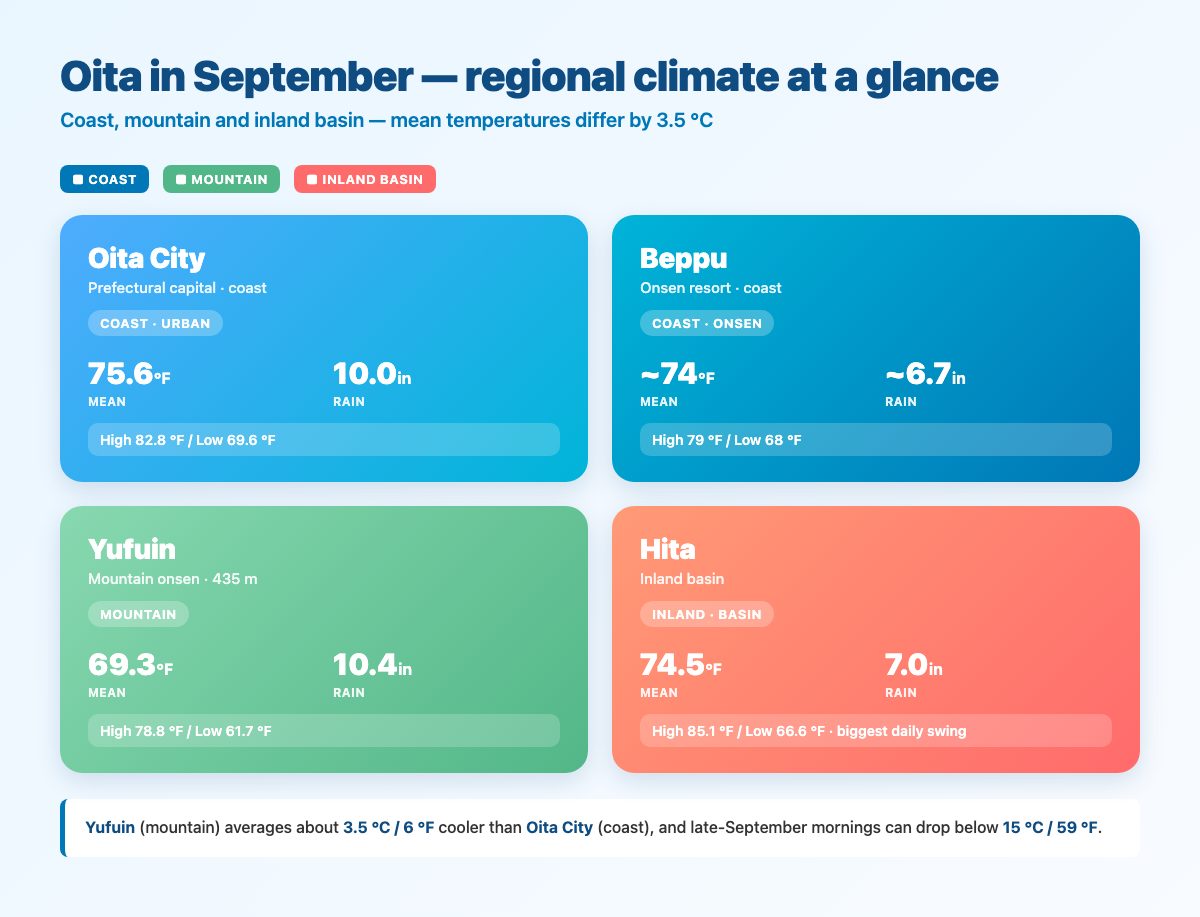
The prefecture is not one climate. In a single 40 km drive from Beppu (sea-level coast) to Yufuin (435 m plateau), the average September temperature drops by more than 3 °C. If your itinerary crosses that line — and most Oita trips do — you need to plan for both.
| Location | Mean | High | Low | Rain | Terrain |
|---|---|---|---|---|---|
| Oita City | 24.2 °C / 75.6 °F | 28.2 °C / 82.8 °F | 20.9 °C / 69.6 °F | 255 mm / 10.0 in | Coast, capital |
| Beppu | ~23–24 °C / ~74 °F | 26 °C / 79 °F | 20 °C / 68 °F | ~170 mm / 6.7 in | Coast, onsen resort |
| Yufuin | 20.7 °C / 69.3 °F | 26.0 °C / 78.8 °F | 16.5 °C / 61.7 °F | 265 mm / 10.4 in | Mountain (435 m) |
| Hita | 23.6 °C / 74.5 °F | 29.5 °C / 85.1 °F | 19.2 °C / 66.6 °F | 179 mm / 7.0 in | Inland basin |
- Coast (Oita City, Beppu): warm days, mild humid nights. Tropical-night lows persist into early September.
- Inland basin (Hita): hottest afternoons in the whole prefecture, but the biggest overnight cooling — a 10 °C daily swing.
- Mountain (Yufuin): think of it as a different season — bring one extra layer.
Where September sits in Oita’s year
To see whether September counts as summer or autumn in Oita, it helps to place it against the rest of the year. Here is the Oita City observatory’s 1991–2020 normals compressed to representative months.
| Month | Mean (°C / °F) | High | Low | Rain | Feel |
|---|---|---|---|---|---|
| March | 10.2 / 50.4 | 14.6 °C | 5.9 °C | 99 mm | Early spring |
| June | 22.6 / 72.7 | 26.5 °C | 19.3 °C | 314 mm | Rainy season peak |
| August | 27.7 / 81.9 | 32.2 °C | 24.3 °C | 166 mm | Peak heat |
| September | 24.2 / 75.6 | 28.2 °C | 20.9 °C | 255 mm | Late summer + typhoons |
| December | 8.7 / 47.7 | 13.0 °C | 4.6 °C | 47 mm | Winter onsen prime |
- Daytime highs drop about 4 °C from August, but short sleeves are still comfortable at midday.
- Rainfall is the 2nd highest of the year, driven by autumn cold fronts and typhoon systems.
- Overnight lows are cooler than August — but not yet cool. Early-September nights can still feel muggy.
How Oita September compares to home — for US, UK and Australian readers
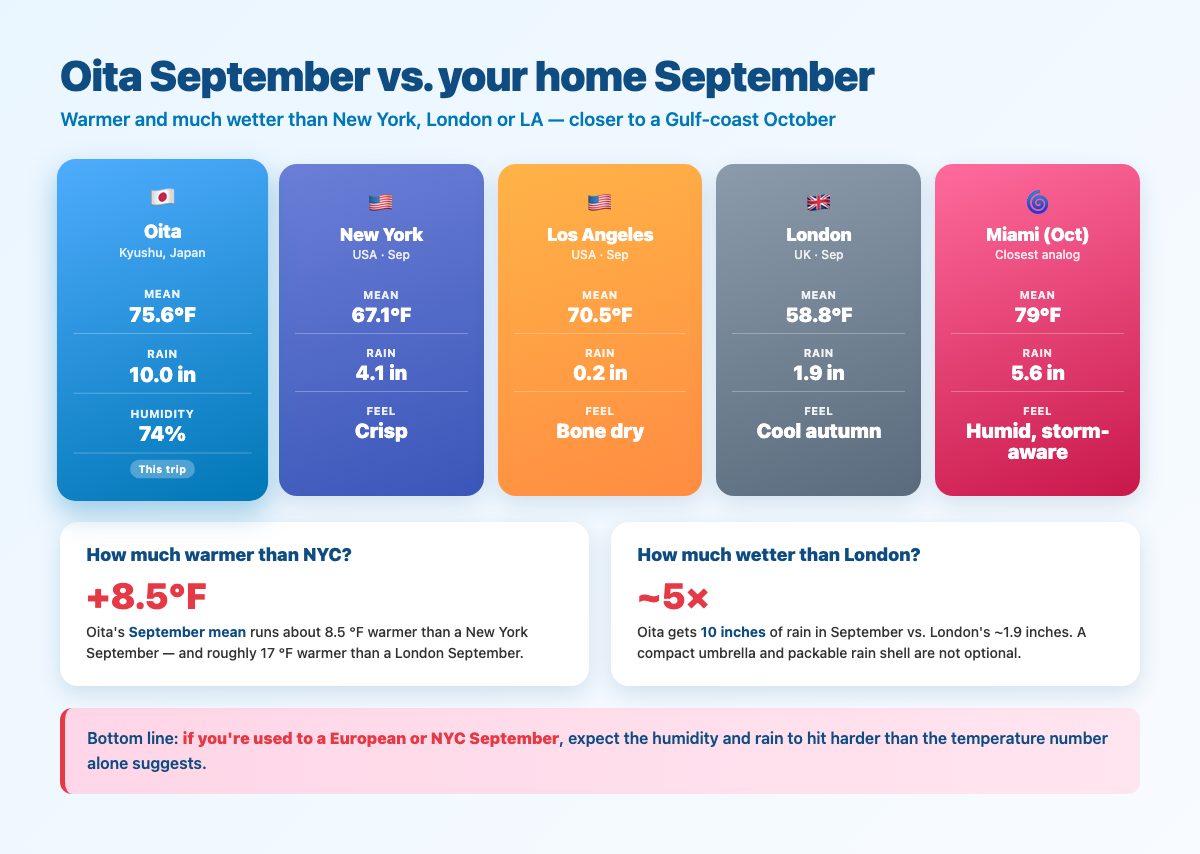
If you are packing based on what “September” means where you live, be careful — September in Oita is a very different month than September in London or New York.
| Reference city | Mean temp | Rainfall | Note |
|---|---|---|---|
| Oita, Japan | 24.2 °C / 75.6 °F | 255 mm / 10.0 in | Late summer + typhoons |
| New York, USA | 19.5 °C / 67.1 °F | 104 mm / 4.1 in | Crisp fall |
| Los Angeles, USA | 21.4 °C / 70.5 °F | 5 mm / 0.2 in | Warm and virtually dry |
| London, UK | 14.9 °C / 58.8 °F | 49 mm / 1.9 in | Cool autumn |
| Sydney, Australia | 15.0 °C / 59.0 °F | 62 mm / 2.4 in | Early spring (S hemisphere) |
| Miami (October) | 26 °C / 79 °F | 143 mm / 5.6 in | Closest analog |
The closest match for an English-speaking traveler is a Gulf-coast US city in early October — warm, humid, with genuine tropical-storm awareness required. If you are used to a London or Sydney September, expect the humidity to feel much heavier than the number alone suggests.
Early, mid and late September — the month is not one climate
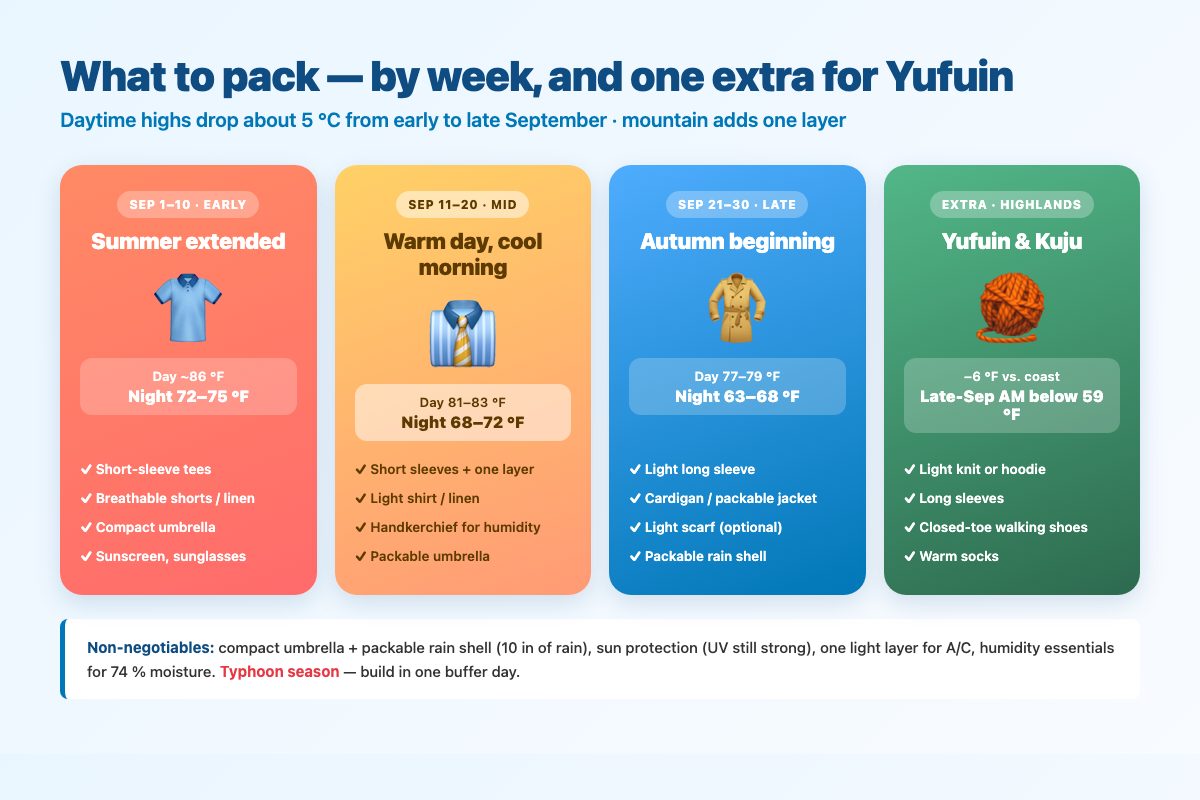
September in Oita is really three different weeks. Between the 1st and the 30th, average daytime highs drop by about 5 °C. Booking early in the month vs. late is almost like choosing between two different seasons.
| Period | Daytime high | Morning / evening | Feel |
|---|---|---|---|
| Early (1–10) | ~30 °C / 86 °F | 22–24 °C / 72–75 °F | Summer extended, tropical nights linger |
| Mid (11–20) | 27–28 °C / 81–83 °F | 20–22 °C / 68–72 °F | Warm days, cooler mornings |
| Late (21–30) | 25–26 °C / 77–79 °F | 17–20 °C / 63–68 °F | Autumn beginning, a light layer needed |
- Early September still delivers hot midday sun and warm nights — plan for indoor A/C escapes.
- By mid-month, mornings feel comfortable and evenings turn pleasant for onsen town strolls.
- Late September, Yufuin mornings can drop into the low 60s °F — the onsen itself will feel especially good.
Typhoons in September — what English-speaking travelers actually need to know
This is the part most first-time visitors ask about. The honest answer: September has more typhoon landfalls than any other month in Japan (about 1.0 landfall per September on the 1991–2020 average), but the impact on a specific Oita trip depends less on the raw statistic than on the storm’s track.
| Month | Formed | Approached | Made landfall |
|---|---|---|---|
| July | 3.7 | 2.1 | 0.6 |
| August | 5.7 | 3.3 | 0.9 |
| September | 5.0 | 3.3 | 1.0 (peak) |
| October | 3.4 | 1.7 | 0.3 |
- Direct landfalls on Oita are rare — only 3 in the last 75 years — but Oita often catches the tail of a storm that landed in Kagoshima or Miyazaki and tracked east through the Seto Inland Sea.
- September 2022 (Typhoon Nanmadol) brought over 400 mm of rain in 24 hours to parts of Oita, with flooding and landslides.
- The main practical risk for travelers is flight and ferry disruption — the Sunflower ferry between Osaka and Beppu, and flights into Oita (OIT) and Fukuoka (FUK), are the usual pressure points.
A short checklist
- Build in one buffer day on both ends of your itinerary.
- Confirm change / cancellation policies for flights, ryokan and rental cars before you book.
- Have a real-time weather source ready — the JMA English page (https://www.jma.go.jp/bosai/map.html?lang=en) and the NHK World-Japan app both work well.
An English-language data eSIM makes typhoon-tracking much easier at the airport or on the train. If you land without a Japanese SIM, our Japan eSIM plans activate on landing so you can check flight status and typhoon paths immediately.
What to pack — by week and by region
Numbers translated into a suitcase. Here is what actually goes in.
The core kit
- Compact umbrella and packable rain shell — 255 mm of rain in the month; typhoon fringes can hit.
- Breathable short sleeves for daytime; one light long-sleeve layer for A/C and evenings.
- Sun protection — the UV index is still strong in September; sunscreen, sunglasses and a hat matter.
- Cardigan or light packable jacket for late September and any Yufuin stop.
- Quick-dry socks and a spare T-shirt — Beppu’s “Jigoku Meguri” (Hells) walk sits in a hot, steamy micro-climate.
Extras for Yufuin and the Kuju highlands
- Add a light knit or hoodie — mornings can drop below 15 °C / 59 °F in late September.
- Closed-toe walking shoes — plateau paths and forest trails aren’t sandal territory.
- A book for the onsen ryokan porch — mountain autumn light is worth slowing down for.
Rainy-day plan B
- Umitamago Aquarium (near Beppu) — playful, family-friendly, entirely indoor.
- Beppu Jigoku Meguri — the “Hells” are outdoor but covered walkways; light rain is manageable.
- Onsen day — the classic Oita answer to bad weather.
Getting around when the weather changes fast
Oita’s main attractions — Beppu’s onsen, Yufuin’s ryokan district, the Kuju highlands, Usuki’s stone Buddhas — sit 20 to 60 km apart, and public transport between them thins out quickly. In a month where the forecast can flip from sunshine to typhoon fringe within 12 hours, having your own vehicle turns a rigid itinerary into a flexible one.
The JR Sonic limited express (about 2 hours from Hakata) and the JR Yufuin no Mori scenic train are both fine ways to reach the region, and both are covered by the Japan Rail Pass. But once you’re on the ground and want to swap “sunny hike in the highlands” for “rainy morning at the aquarium,” a rental car is what makes that trade possible on short notice.
At GO!GO!TOUR, we handle Oita rental cars from the main airports and city offices — you can compare vehicles and prices for your dates at the link below.
Note: driving in Japan requires an International Driving Permit (IDP) issued in your home country before you travel. Japan does not issue IDPs to foreign visitors on arrival, so this is a pre-trip errand.
If you’d rather see suggested itineraries before deciding, our Kyushu model courses include Beppu–Yufuin routings that work well in September weather.
Frequently asked questions
Q1. Is short sleeves enough for Oita in September?
For most of the day, yes. Average daytime highs are 28.2 °C / 82 °F and early September can hit 30 °C / 86 °F. But mornings, evenings and any stop in Yufuin call for a light long-sleeve layer or cardigan.
Q2. Should I cancel a September trip to Oita because of typhoons?
Almost never. Direct landfalls on Oita are rare, but the fringe of a Kyushu-landing storm can affect flights, ferries and rail. Build one buffer day into your itinerary and confirm cancellation policies in advance, and you will handle a bad-weather day without ruining the trip.
Q3. How does September in Oita compare to New York or London?
Warmer and much wetter. Oita averages 24.2 °C to New York’s 19.5 °C and London’s 14.9 °C, and receives 255 mm of rain — roughly five times London’s monthly total. Humidity of 74 % also makes the heat feel heavier than the number suggests.
Q4. Do I need different clothes for Yufuin than for Beppu?
Yes. Yufuin sits at 435 m elevation and averages about 3.5 °C cooler than Beppu. Late-September mornings there can dip below 15 °C / 59 °F, so a light knit or hoodie belongs in the suitcase if your itinerary includes a Yufuin overnight.
Q5. Do I need a rental car, or can I use JR Kyushu?
JR handles Hakata–Beppu–Oita City–Yufuin very well, and the JR Pass covers it. A rental car earns its keep once you leave the main line — Kuju highlands, Usuki, and the Kunisaki peninsula are all much easier by car, especially when weather forces last-minute plan changes.
Recommended Oita model courses
Once the weather planning is settled, the next question is which loop to actually drive. Oita’s headline sights cluster into a handful of natural day-trips — a Beppu onsen day, a Yufuin half-day, and a longer Hita–Kuju highland run — and most travelers combine two of them into a one-night, two-day itinerary. Below are the routings we most often suggest to first-time GO!GO!TOUR guests.
Beppu Onsen Day Course
A classic first day in Oita. Start with the Hells of Beppu (Jigoku Meguri) — Umi Jigoku’s cobalt-blue basin and the deep-red Chinoike Jigoku are the two most photographed stops, and both sit inside a single ticket loop. Take a mid-afternoon break for a Beppu-tower or beachfront view, then finish with an evening onsen bath at your ryokan of choice. Roughly half a day of walking plus one bath session; easy on a September afternoon when a light rain shower blows through.
Yufuin Half-Day Course
Yufuin pairs well with a Beppu overnight because the drive is only about 40 minutes over the mountain. Walk the Yunotsubo Kaido shopping street, wander down to Lake Kinrin for the classic Mt. Yufu reflection shot, then take an onsen bath at a day-use ryokan facing the peak. Half a day is enough — leave room for a coffee stop on the walk back to the car.
Hita and Kuju Highland Drive
For a longer loop, head inland. Hita Mameda-machi is a preserved Edo-era merchant quarter that photographs especially well in early-autumn light; from there it is roughly an hour to the Kuju Flower Park and the Kokonoe “Yume” suspension bridge (Japan’s tallest pedestrian suspension bridge, at 173 m). Plateau air runs a few degrees cooler than the coast, so a light layer belongs in the day bag even in early September.
Oita Golden Route (1 night, 2 days)
The most common overnight combination is Beppu + Yufuin. Day one covers the Hells and a Beppu ryokan stay; day two crosses to Yufuin for the shopping street, Lake Kinrin and a second onsen before returning to the airport in the mid-afternoon. It is the smallest itinerary that captures both the “steam-and-heat” side of Beppu and the calmer mountain feel of Yufuin.
These loops are easiest by car — a rental from Oita or Beppu station keeps everything within a comfortable half-day radius, and gives you room to swap the day’s plan if a typhoon fringe rolls through.
Bringing it together — plan for late-summer heat, plan for one weather curveball
Oita in September is a warm, humid, tropical-storm-aware month — closer in feel to a Gulf-coast October than to a European autumn. The prefecture also splits sharply between coastal onsen towns and mountain plateaus, so packing a single “September outfit” won’t quite cover it.
If you plan for late-summer heat, add one light layer for Yufuin, keep an umbrella in your day bag, and leave a buffer day on your itinerary, September is a genuinely rewarding month to visit. The August peak-season crowds have thinned, ryokan availability opens up, and the year’s first crisp mornings arrive in the mountains.
Useful links for planning your Oita trip
- Search Oita rental cars — GO!GO!TOUR — compare vehicles and prices for your dates
- Kyushu model courses — Beppu–Yufuin itineraries that work in September weather
- Japan eSIM plans — data on arrival for typhoon and flight tracking