Kiyomizu-dera Temple — A 1,200-Year-Old Wooden Stage Suspended Over Eastern Kyoto
If a first-time visitor to Kyoto had to pick a single spot to see, most locals would point to Kiyomizu-dera (清水寺). Perched on the wooded slope of Higashiyama, its famous wooden stage juts out over a mountainside gorge that fills with cherry blossoms in spring and blazes crimson in autumn. Registered as a UNESCO World Heritage Site in 1994 as part of the “Historic Monuments of Ancient Kyoto,” Kiyomizu-dera is the single most recognized image of the city and the anchor of any Kyoto itinerary.
This guide is written for foreign visitors arriving in Kyoto for the first time. Inside you’ll find the admission fee and opening hours, how to reach the temple, the story behind the “Kiyomizu Stage,” how the Otowa Waterfall works, the meanings behind the Sannenzaka and Ninenzaka slopes you walk down afterward, night illuminations, and how to slot it all into a half-day route. First-person, English-language, practical.
👉 Planning to see Kyoto plus Osaka, Nara, or Kobe in the same trip? A rental car makes the whole Kansai region one connected day. GO!GO!TOUR kansai rental car offers English support and pickup near the main JR terminals.
Quick Facts at a Glance
The overview most foreign travelers want before locking in a date.
| Item | Details |
|---|---|
| Official name | 音羽山 清水寺 (Otowasan Kiyomizu-dera) |
| Location | 京都府京都市東山区清水1丁目294 (Higashiyama, Kyoto) |
| Founded | 778 CE — one of the oldest temples in Kyoto |
| UNESCO status | World Heritage Site (1994) — “Historic Monuments of Ancient Kyoto” |
| Admission | Adults ¥400 / Elementary & JHS ¥200 |
| Opening hours | 6:00 – 18:00 (extended during summer and special night viewings) |
| Night illuminations | Spring cherry, summer Obon, autumn foliage seasons — separate ticket |
| Recommended time | 60 – 90 minutes for main hall and Otowa Waterfall / 2 – 3 hours including Sannenzaka walk |
| Payment | Cash, credit cards, and IC cards (Suica/ICOCA) accepted at the ticket booth |
| Access | City bus + short walk / rental car with paid coin parking nearby |
Why “Kiyomizu”? — The 778 CE Origin Story
Kiyomizu-dera’s founding story goes back to 778 CE. A monk named Enchin, guided by a dream, walked into the mountains east of the old capital and discovered a clear spring emerging from the forest — the Otowa Waterfall (音羽の滝). Shortly afterward the powerful samurai general Sakanoue no Tamuramaro, on a hunting trip, met Enchin and was convinced to give up killing. Together they built a wooden hall over the falls and enshrined a Kannon (Bodhisattva of Compassion) statue there — the original form of today’s Kiyomizu-dera.
The temple name literally means “Pure Water Temple,” a reference to the Otowa spring. The word “Otowa” (音羽) comes from the mountain that hosts the temple (Mount Otowa) and the waterfall itself. Old accounts say the sound of the mountain stream was likened to “the light rustling of feathers” — the characters combine “sound” (音) and “wing/feather” (羽). The temple’s full formal name is Otowasan Kiyomizu-dera.
Over more than 1,200 years, the buildings have burned down and been rebuilt many times. The main hall you see today was rebuilt in 1633 on the order of Shogun Tokugawa Iemitsu. The dramatic wooden platform projecting from the front of that main hall — the “Kiyomizu Stage” — is what made this temple globally famous.
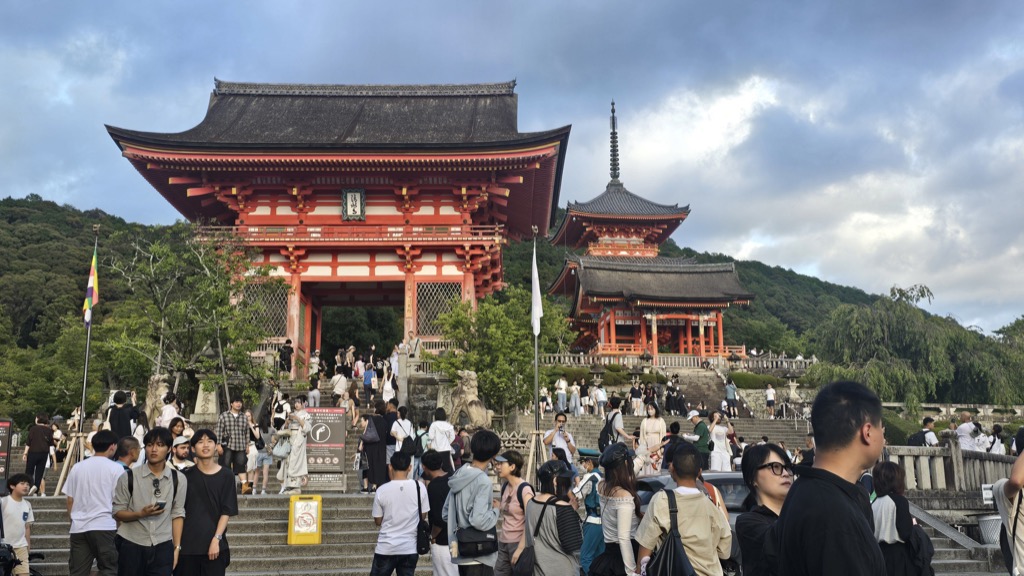
The first buildings you meet at the top of the hill are the vermillion Niomon Gate and the striking three-story pagoda — at about 31 meters, one of the tallest of its kind in Japan. Late afternoon light on the vermillion woodwork is especially beautiful and less crowded than midday.
How to Get to Kiyomizu-dera
Kiyomizu-dera sits on the wooded slope of Higashiyama, which means the last stretch is always uphill on foot. The good news: multiple transport options work well.
| From | Best route | Time | Notes |
|---|---|---|---|
| Kyoto Station | City Bus 206 / 100 to “Kiyomizu-michi” or “Gojo-zaka” + 10-minute walk uphill | About 15 – 20 minutes | Most popular route. Buses get crowded in peak season |
| Gion / Shijo | Walk via Sannenzaka | About 25 – 30 minutes | The classic sightseeing walk — Gion → Sannenzaka → Kiyomizu-dera |
| Osaka (Umeda) | Hankyu Line to Kawaramachi + city bus | About 90 minutes | Perfectly doable as a day trip |
| Kansai Airport (KIX) | Haruka Express to Kyoto + bus | About 100 minutes | Direct rail link from KIX to Kyoto Station |
From the “Kiyomizu-michi” bus stop, walk uphill about 10 minutes along Kiyomizu-zaka, a sloping shopping street lined with matcha shops, yatsuhashi (traditional sweets) makers, yudofu restaurants, and souvenir stalls. The street itself is part of the fun — plan to browse on the way up rather than saving it for later.
If you’re driving into Kyoto from elsewhere in Kansai, park at the paid Kyoto City Kiyomizu-zaka Tourist Parking Lot or one of the coin parking lots near Gojo-zaka. During peak season (cherry blossoms, autumn foliage, Golden Week) these fill by 9:00 AM, so arrive early. Combining Kyoto with Osaka and Nara in a single day works far better with a rental car — see GO!GO!TOUR kansai rental car for options and English booking.
Niomon Gate, Pagoda, and Sai-mon — The First Three Vermillion Icons
The first buildings you reach at the top of Kiyomizu-zaka form the temple’s classic postcard: the vermillion Niomon Gate, the smaller Sai-mon (West Gate) just behind it, and the three-story pagoda rising above both. All three fit into a single frame from the entrance plaza.
- Niomon Gate — Rebuilt at the end of the 15th century. Home to two enormous guardian statues (Nio) about 3.65 meters tall. The most photographed spot at Kiyomizu-dera
- Sai-mon (West Gate) — Historically the place where monks practiced nissokan, contemplation of the setting sun. Still one of the best sunset viewpoints in Kyoto
- Three-story pagoda — About 31 meters tall, among the largest three-story pagodas in Japan. Centerpiece of the night illuminations
From the gate to the main hall is a gentle uphill with occasional stone steps. Wear comfortable walking shoes. Baby strollers and wheelchairs have a designated alternate route — ask at the information desk beside the ticket booth.
The Kiyomizu Stage — 139 Wooden Pillars, Zero Nails
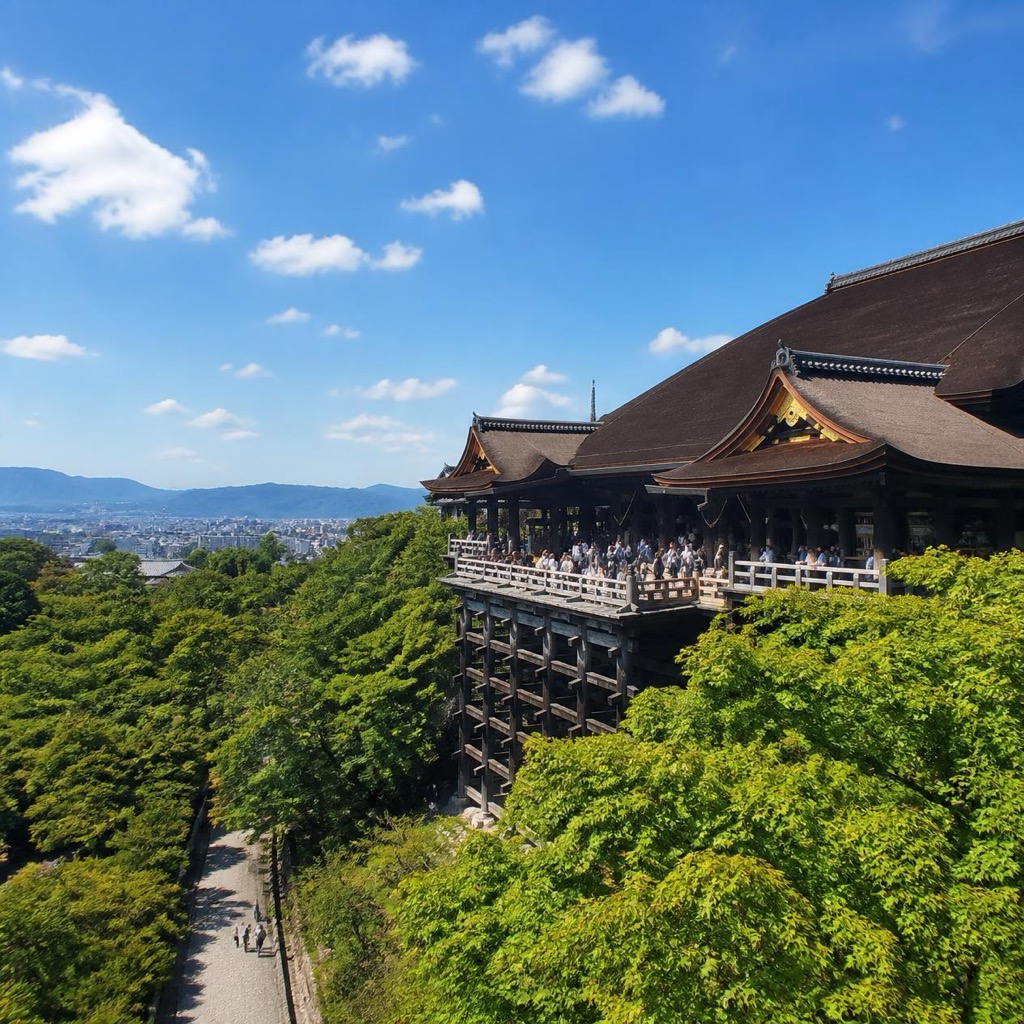
The absolute highlight of any Kiyomizu-dera visit is the main hall’s wooden stage (清水の舞台). Built into the slope with 139 giant zelkova pillars in a lattice pattern, the platform stretches roughly 13 meters above the ground. Remarkably, this massive structure was built without a single nail — it holds together purely through joinery. This traditional Japanese construction style is called kake-zukuri, and Kiyomizu-dera is its most famous surviving example.
Stand at the front of the stage and you’ll see the wooded gorge of Kinun-kei (“Brocade Cloud Valley”) falling away in front, with the Kyoto skyline — including Kyoto Tower — in the distance. In spring the valley below turns pink with cherry blossoms; in autumn it becomes an ocean of red maple. There’s a Japanese idiom, “to jump off the Kiyomizu stage,” used when someone makes a bold decision — that’s how vivid the drop feels.
The main hall’s roof is made of hiwada-buki (cypress bark shingles), a specialty craft that requires re-thatching roughly every 50 years. The most recent major restoration, the “Heisei Grand Repair,” finished in 2020 — so right now you’re seeing the temple with a freshly re-laid, light-brown roof that will darken with weathering over the next few decades. It’s a rare window to experience the “bright-roofed” Kiyomizu-dera.
The Otowa Waterfall — Choose One of Three Wishes
Behind the main hall you’ll walk down to the Otowa Waterfall, the spring that gave the temple its name. The water divides into three streams as it falls, and each stream is said to grant a different wish.
- 🌟 Left stream — Success in studies and wisdom
- ❤️ Center stream — Success in love and relationships
- 💪 Right stream — Long life and health
The critical rule: drink from only one stream. Local tradition says drinking from all three counts as greed, and the wish won’t come true. Long-handled ladles are provided along with UV sterilizers, so the experience is hygienic even in busy periods. During peak season (spring/autumn), expect a 30 – 60 minute wait. Come at 6:00 – 8:00 AM or after 17:00 to skip the queue.
Sannenzaka and Ninenzaka — The Slopes That Preserve Old Kyoto
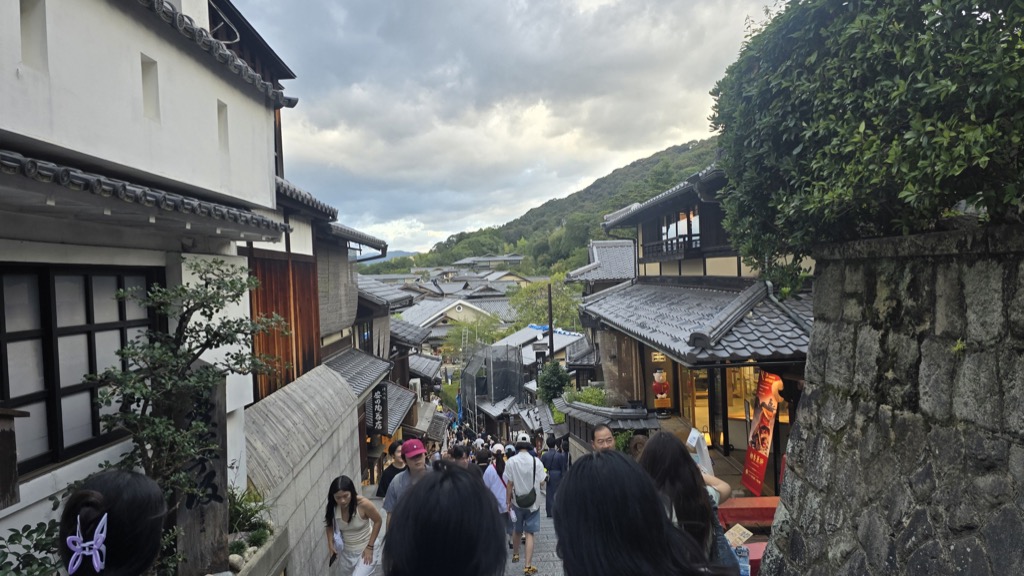
Walking down from Kiyomizu-dera toward Gion, you’ll pass through Sannenzaka (三年坂) and Ninenzaka (二年坂) — two connected sloping streets that form the most photogenic stretch of old Kyoto. This entire area is designated a National Preservation District, which means modern signage, vending machines, and utility wires are strictly controlled. The result is one of the few places in Kyoto where the townscape still looks close to how it did a century ago.
What Do Sannenzaka and Ninenzaka Actually Mean?
Both slopes have several origin stories that have been told for centuries.
- Sannenzaka (三年坂) — Also written Sannei-zaka (産寧坂). The characters san-nei mean “safe childbirth.” The most widely accepted origin is that pregnant women used to climb this slope to pray for a safe delivery at Kiyomizu-dera’s Koyasu Kannon (Bodhisattva of Easy Childbirth). An alternate theory dates the slope’s construction to the third year of the Daido era (808 CE) — hence “three-year slope”
- Ninenzaka (二年坂) — Also written Ninei-zaka (二寧坂). Said to have been built in the second year of the Daido era (807 CE), one year before Sannenzaka. Another explanation is simply that it sits “one step below” Sannenzaka in the sequence
- Both were originally pilgrimage paths to Kiyomizu-dera. Old machiya (wooden townhouses) still line both sides, making this the go-to spot for traditional Kyoto photography
A darker piece of folklore says “if you fall on Sannenzaka you’ll die within three years” (and the same for Ninenzaka with two years). In practice this is a strong warning about the worn, slick stone paving — watch your footing, especially after rain.
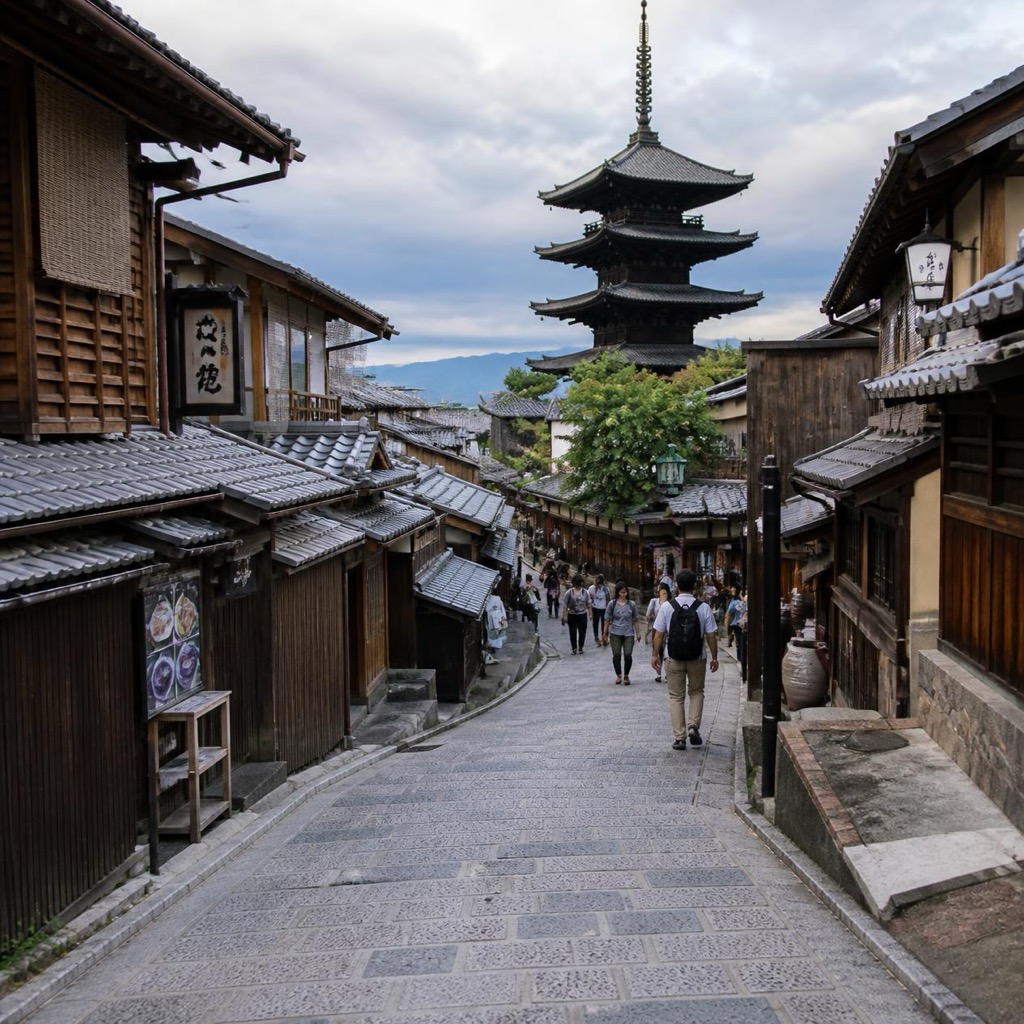
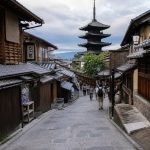
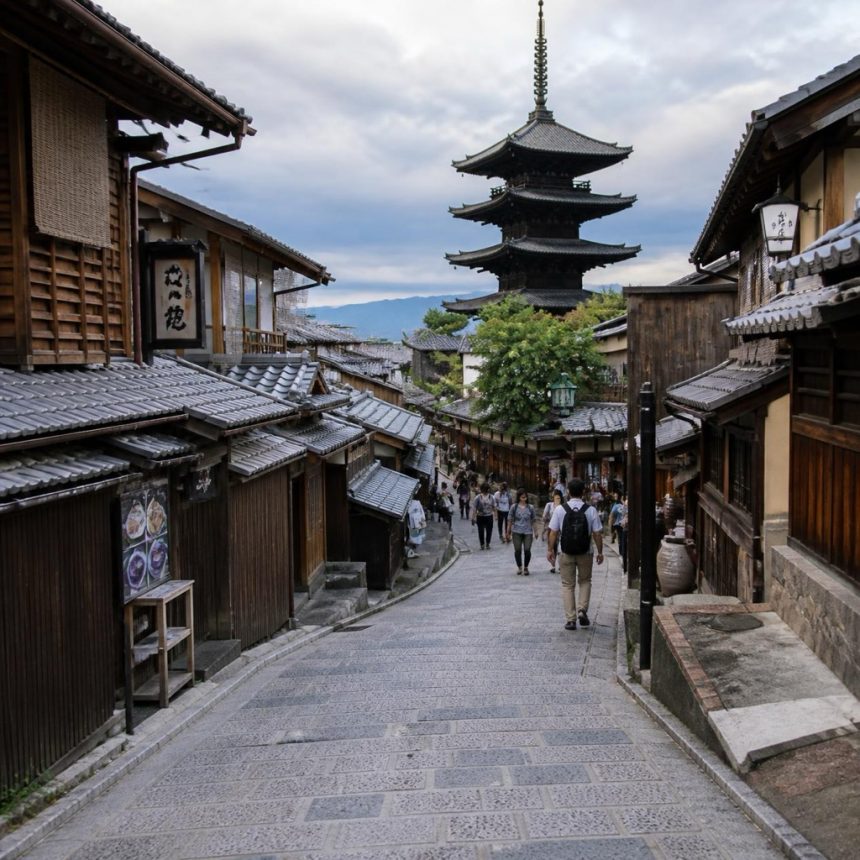
As you walk, the Yasaka Pagoda (八坂の塔, formally Hokan-ji Temple’s five-story pagoda) rises directly ahead. Stone steps, curved tile roofs, and the tall wooden pagoda behind them — this composition is the visual shorthand for “Kyoto”. Photograph it in the soft light of early morning or the golden hour before sunset.
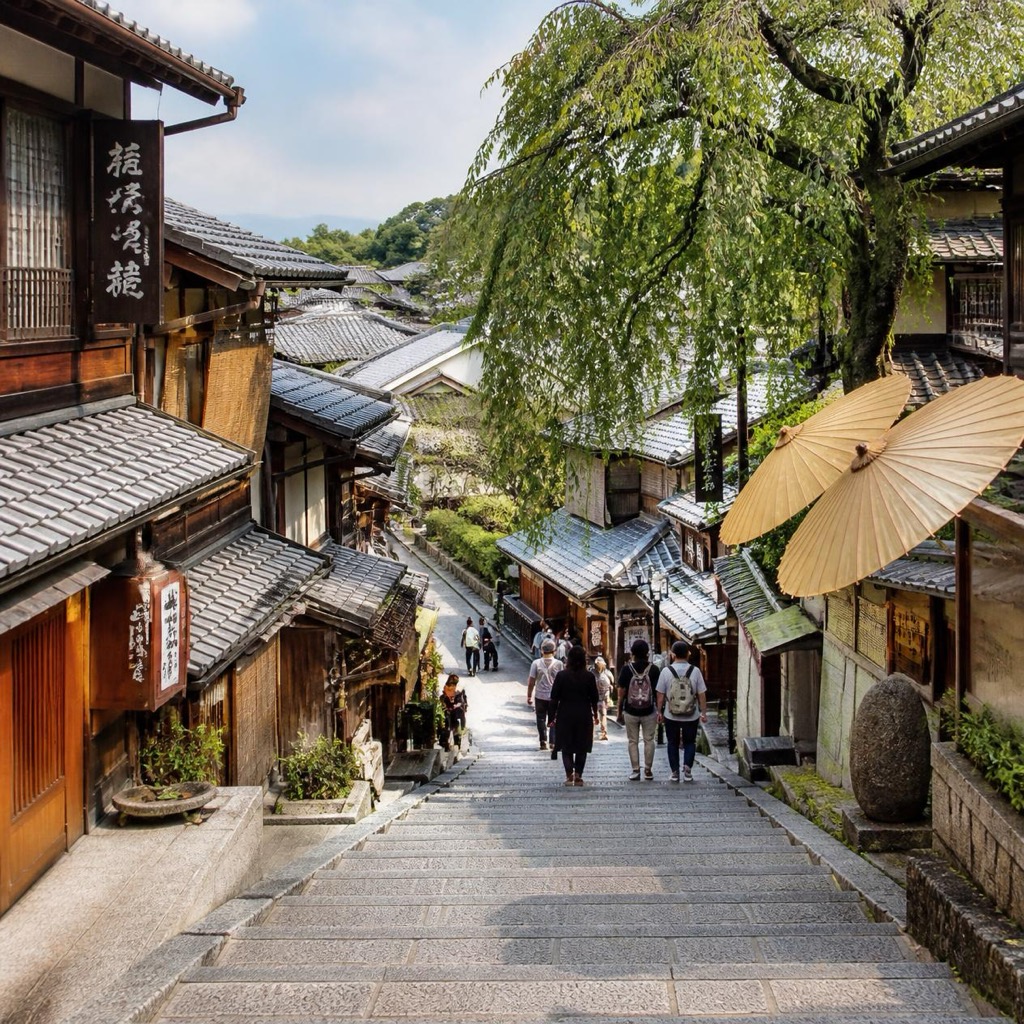
In spring the weeping cherry trees (shidare-zakura) along the steps form a pink canopy over the whole slope. When you catch them in the same frame as the paper umbrellas (wagasa) hung outside the shops, the shot feels like a scene from a period film. Take the upper steps slowly — the stone gets slippery, and there are stretches without a handrail.
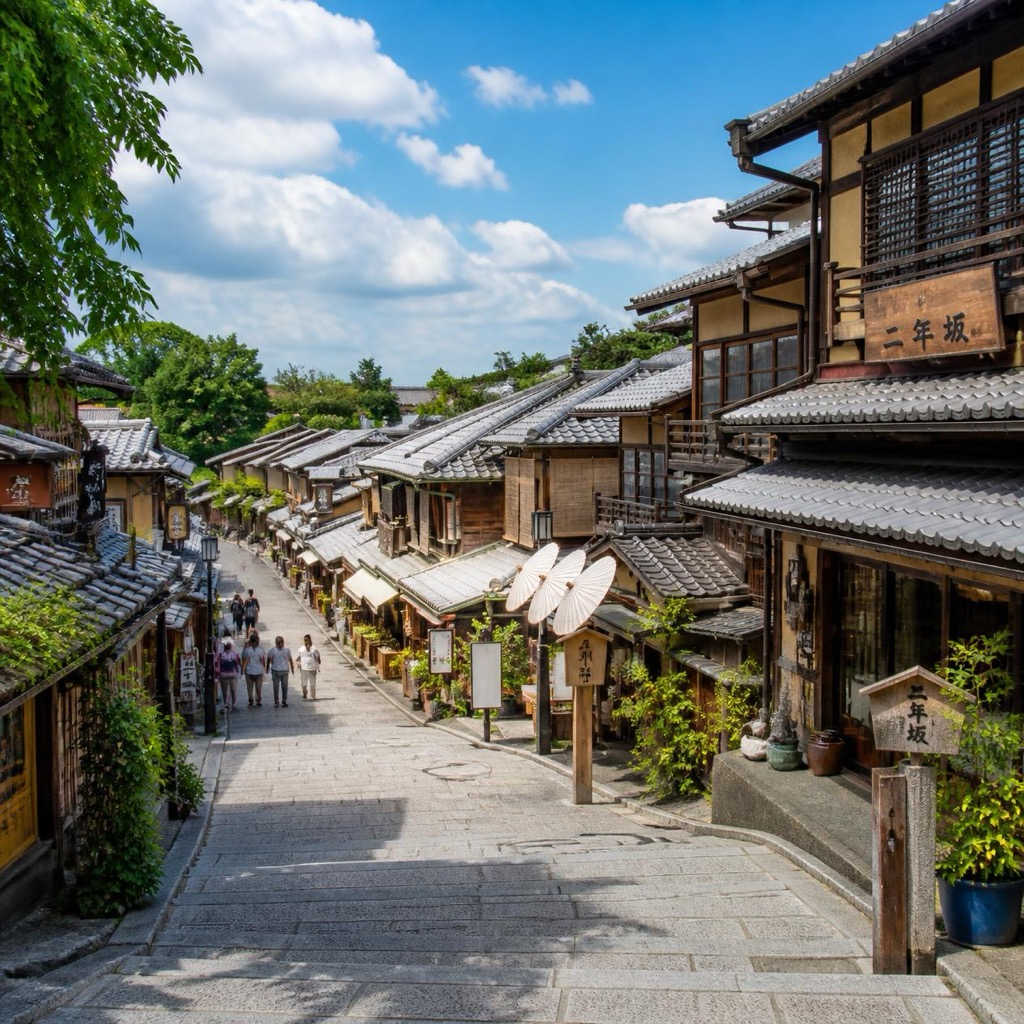
The wooden 二年坂 (Ninenzaka) sign on the right of the photo above is the district’s signature photo spot. This point marks the transition — Sannenzaka is above, Ninenzaka runs down toward Maruyama Park and Gion. The standard route is: Kiyomizu-dera → Kiyomizu-zaka → Sannenzaka → Ninenzaka → Maruyama Park → Gion / Yasaka Shrine, and it takes about 1.5 hours at a comfortable pace. It’s the golden loop of Kyoto sightseeing.
The shops along these slopes cover almost every “old Kyoto” category:
- 🍡 Matcha & wagashi — Century-old confectioners next to Instagram-friendly new cafés
- 🍦 Matcha gelato / soft-serve — Walk-and-eat classic
- 🥢 Yudofu (tofu hot pot) and yuba udon — Kyoto’s delicate tofu specialties
- 🎨 Omamori charms, folding fans, ceramics — Best souvenir density in Kyoto
- 👘 Kimono rental shops — Many visitors change into a kimono and walk the slopes in it
Hidden Modern Gems Inside the Old Streets
Look carefully as you walk down — a few surprising modern shops have been slipped inside the traditional machiya. Three worth knowing:
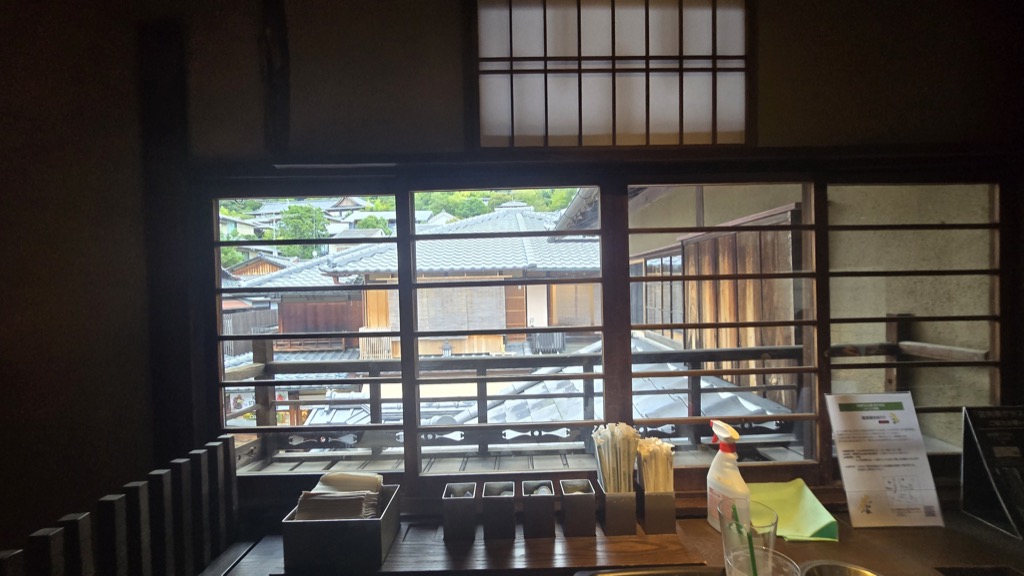
Starbucks Kyoto Ninenzaka Yasaka Chaya — Built inside a 100-year-old two-story machiya, this is the world’s only Starbucks where the second floor is a tatami room. You take off your shoes, sit on the floor, and sip your coffee looking out at the tiled roofs of the neighborhood. The store itself is a tourist attraction, so expect a wait almost any hour.
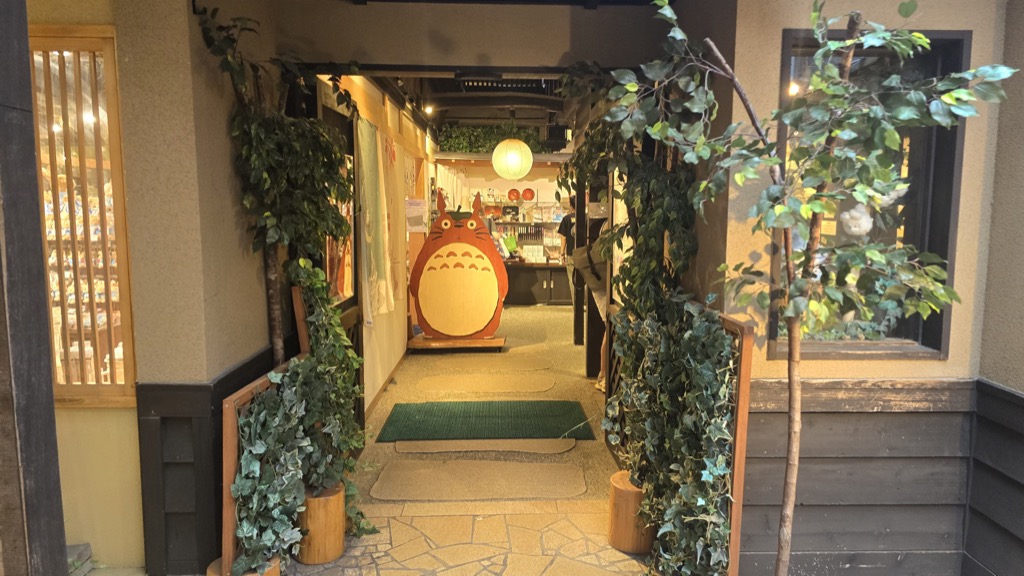
Donguri Republic Sannenzaka — Official Studio Ghibli character shop. A life-size Totoro greets you at the entrance, and inside you’ll find Totoro, Catbus, and Makkuro Kurosuke (soot sprites) plush toys, ceramics, and other goods, plus Kyoto-only exclusive items. Essential stop for Ghibli fans.
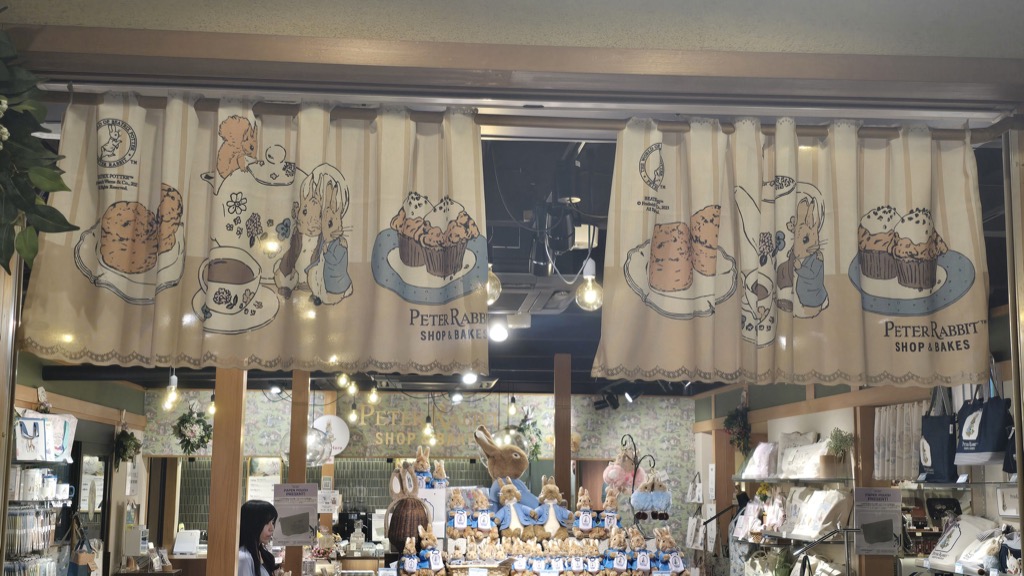
Peter Rabbit™ Shop & Bakes — A café and merchandise shop themed around Beatrix Potter’s classic children’s book. The signature product is Peter Rabbit-shaped baked buns in white chocolate, custard, and a few other flavors. The interior has an English cottage feel — a comfortable pause between temple stops.
Special Night Illuminations — Kiyomizu-dera After Dark
Three times a year — for spring cherry blossoms, summer Obon, and autumn foliage — Kiyomizu-dera opens for special night viewing (yakan tokubetsu haikan). Thousands of lights illuminate the main hall, the pagoda, and the seasonal blossoms or leaves, transforming the temple into something completely different from its daytime face.
| Season | Approximate dates | Highlight |
|---|---|---|
| Spring cherry | Late March – early April | Cherry trees below the main hall lit against the wooden stage — surreal |
| Summer Obon | Around August 14 – 16 | Tied to the Sennichi Mairi ritual — one visit equals a thousand days of merit |
| Autumn foliage | Mid-November – early December | Kinun-kei valley in red and the illuminated main hall — the year’s best view |
Night viewing requires a separate admission ticket (¥400). Exact dates are confirmed each year by the temple’s official site. If your schedule allows, visit once in the day and return again at night — you’ll effectively see two different temples.
Best Time of Day and Year
- Quietest hours — Right after opening (6:00 – 8:00 AM) or the last hour before closing (17:00 – 18:00). Midday (10:00 – 15:00) is the peak of international tour groups
- Best light for photos — Soft morning sunlight, golden hour before sunset, or the night illuminations
- Spring (late March – early April) — Cherry season. The Sannenzaka slope also blossoms
- Summer (June – August) — Lush green but Kyoto is humid and hot. Bring water
- Autumn (mid-November – early December) — Peak maple. The single most crowded time of year
- Winter (December – February) — Snow on the Kiyomizu Stage is stunning, but the Sannenzaka slope is slippery. Take it slow
Pair Kiyomizu-dera With the Rest of Kyoto and Kansai
Kiyomizu-dera on its own is a comfortable half day. To fill a full day or two, combine it with these neighbors:
- Gion and Yasaka Shrine — 25 – 30 minute walk. The historic geisha district, evening lanterns along the Shirakawa canal
- Fushimi Inari Shrine — 20 minutes by train. Famous vermillion torii tunnel
- Kinkaku-ji (Golden Pavilion) — 40 minutes by bus. Kyoto’s other most-photographed temple
- Arashiyama Bamboo Grove — 30 – 40 minutes by train. Classic afternoon spot
- Nara Park & Todai-ji — 45 minutes by Kintetsu limited express from Kyoto. Easy same-day add-on
FAQ — Quick Answers for First-Time Visitors
Q. How much is admission to Kiyomizu-dera?
Adults ¥400, elementary and junior high school students ¥200. Special night viewings require a separate ¥400 ticket.
Q. What are the opening hours?
6:00 AM to 6:00 PM year-round, with extended hours during summer and special night viewings. Last entry is 30 minutes before closing.
Q. What’s the easiest way to get there?
From Kyoto Station, take city bus 206 or 100 and get off at “Kiyomizu-michi” or “Gojo-zaka,” then walk uphill for about 10 minutes. If you’re driving, park at the Kyoto City Kiyomizu-zaka Tourist Parking Lot or a coin lot near Gojo-zaka.
Q. How much time should I plan for the visit?
Allow 60 – 90 minutes for the main hall and Otowa Waterfall, or 2 – 3 hours if you also walk down Sannenzaka and Ninenzaka afterward.
Q. Why is the Kiyomizu Stage so famous?
The 13-meter-high wooden platform is supported by 139 zelkova pillars without a single nail. This traditional kake-zukuri (“suspended” construction) is a masterpiece of Japanese carpentry and has become the temple’s global signature.
Q. What are the three streams at Otowa Waterfall for?
Left = success in studies, center = success in love, right = health and long life. Drink from only one — tradition says drinking from all three counts as greed and the wish won’t come true.
Q. What do Sannenzaka and Ninenzaka mean?
Sannenzaka (also written 産寧坂, Sannei-zaka) comes from prayers for safe childbirth at Kiyomizu-dera’s Koyasu Kannon, or alternately from the third year of the Daido era (808 CE) when the road was built. Ninenzaka (二寧坂) is dated to 807 CE, one year earlier. The superstition that “falling here means dying within three (or two) years” is a folk reminder to watch your step on the worn stone.
Q. When are cherry blossoms and autumn colors at their peak?
Cherry blossoms peak from late March to early April, autumn foliage from mid-November to early December. These are also when special night viewings run — expect the year’s largest crowds.
Q. Is the temple accessible for strollers or wheelchairs?
Not fully step-free, but designated alternate routes are available. Ask at the information desk beside the ticket booth for the accessible path.
Q. Where can I eat lunch nearby?
The Sannenzaka and Ninenzaka slopes are lined with yudofu, yuba udon, matcha cafés, and casual izakaya. Peak season waits get long — book ahead or eat before 11:30 AM.
Wrap-Up — The Wooden Stage, the Old Streets, the Essence of Kyoto
Thanks for reading. This guide walked you through Kiyomizu-dera’s admission and hours, the history of the wooden Kiyomizu Stage, the Otowa Waterfall ritual, the meanings and best walking route of Sannenzaka and Ninenzaka, and the seasonal night illuminations. Whether it’s your first time in Kyoto or your fifth, the temple offers a different face each season.
Quick checklist before you go:
- Admission ¥400, open 6:00 – 18:00 year-round
- From Kyoto Station: bus 206 / 100 to Kiyomizu-michi + 10-minute walk
- Avoid crowds — go early morning (6 – 8 AM) or in the last hour before closing
- Wear comfortable walking shoes. Bring water, hat, sunscreen in summer
- Drink from only one stream at Otowa Waterfall
- Plan 2 – 3 hours total to include Sannenzaka and Ninenzaka
Explore Kyoto and Kansai the easy way — GO!GO!TOUR car options with English support.
Whether you want a self-drive rental car to see Kyoto, Osaka, and Nara at your own pace,, GO!GO!TOUR handles the whole booking process in English.
🚗 GO!GO!TOUR Kansai rental car — pickup near JR terminals

The old wooden stage and the stone-paved slopes — see you in Kyoto 🏯🍁