- Sawada-no-hama Beach — Scattered Coral Boulders, an Empty Horizon, and the Best Sunset in the Miyako Islands
- Why This Beach Made Japan's "100 Best Coastlines"
- How to Get to Sawada-no-hama Beach
- The Tidal Flats — What You're Actually Looking At
- Sawada-no-hama as a Sunset Spot
- Parking, Walkways, and First Steps
- Should You Swim Here? (Short Answer: No)
- Practical Tips for Foreign Drivers
- Pair Sawada-no-hama With the Rest of the Irabu–Shimoji Loop
- FAQ — Quick Answers for First-Time Visitors
- Wrap-Up — Come for the Sunset, Stay for the Silence
Sawada-no-hama Beach — Scattered Coral Boulders, an Empty Horizon, and the Best Sunset in the Miyako Islands
If you’ve spent an afternoon at 17END and want to know where locals actually go to watch the sun disappear, the answer is a short drive away on the western shore of Irabu Island. Sawada-no-hama Beach — one of Japan’s “100 Best Coastlines” — is not the kind of beach that shows up on activity ranking lists. There are almost no facilities, no lifeguards, and you can’t really swim. But it may be the most photogenic and quietly moving stretch of coast in the entire Miyako region.
This guide is written for foreign visitors touring Miyakojima by rental car. Inside you’ll find how to reach Sawada-no-hama, where to park, when to arrive for the best sunset, why the beach is dotted with coral boulders, why you shouldn’t try to swim here, and how to pair it with the rest of the Irabu–Shimoji loop. Practical, first-person, no brochure spin.
👉 You’ll need a rental car. Public transit doesn’t reach Irabu Island’s west coast. GO!GO!TOUR Miyakojima rental car offers English support, transparent pricing, and pickup at both Miyako Airport and Shimojishima Airport. See our Miyakojima model courses to slot Sawada-no-hama into a half-day or full-day plan.
Quick Facts at a Glance
The overview most foreign travelers want before locking in a date.
| Item | Details |
|---|---|
| Spot name | Sawada-no-hama Beach (佐和田の浜) — western shore of Irabu Island |
| Location | 沖縄県宮古島市伊良部佐和田 (Sawada, Irabu, Miyakojima City, Okinawa) |
| Admission | Free, 24 / 7 — public coastline, no gate |
| Parking | Free lot for about 20 cars — rarely full even on weekends |
| Recognition | One of Japan’s “100 Best Coastlines” (selected by the Ministry of the Environment in 1996) |
| Best light | Late afternoon into sunset — roughly 17:30 to 19:30 depending on season |
| Recommended stay | 45 – 90 minutes — longer if you want to walk the tidal flats at low tide |
| Swimming | Not recommended — very shallow, uneven coral floor, no lifeguards. Swim at Toguchi Beach instead |
| Restrooms / shops | Basic restroom on-site; no shops or vending machines nearby |
| Access | Rental car effectively required — no useful public transit |
Why This Beach Made Japan’s “100 Best Coastlines”
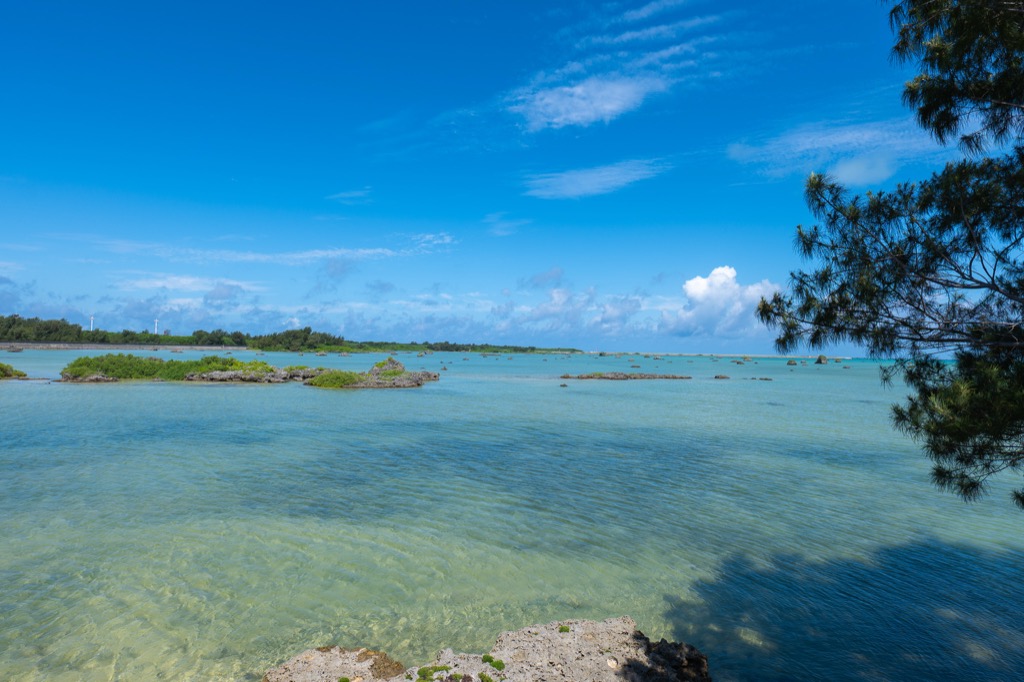
Sawada-no-hama looks different from every other beach in Miyakojima. Instead of an unbroken sweep of white sand and gentle turquoise, you get a wide, shallow tidal flat with dozens of large coral boulders scattered across it. At low tide the boulders become an alien-looking rock garden you can walk between; at high tide they turn into small islands.
Many of these boulders are believed to have been thrown onto the flats by the 1771 Great Meiwa Tsunami — an M8-class earthquake off the Sakishima Islands triggered a massive tsunami that reshaped this coast almost overnight. What you’re looking at, in other words, is not just a scenic beach but a living record of one of Japan’s most consequential natural events. The Ministry of the Environment recognized this in 1996 by naming Sawada-no-hama one of the country’s 100 Best Coastlines, a select group honoring both natural beauty and cultural significance.
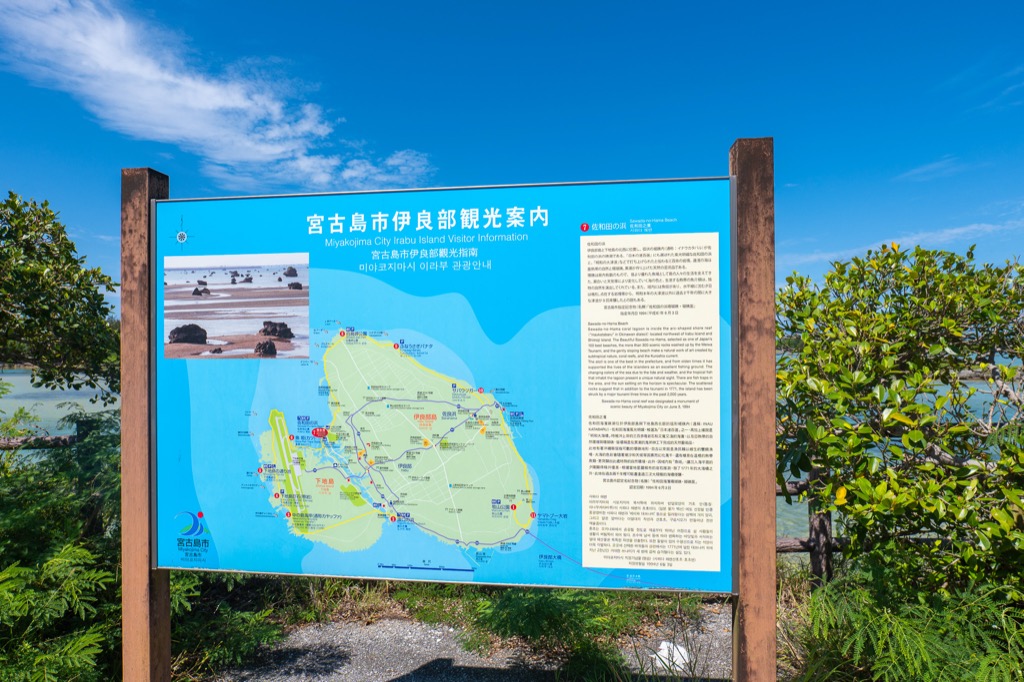
Right by the parking area you’ll find a large “Miyakojima City Irabu Island Tourism Information” board showing all the sights on Irabu and Shimoji islands on one map. Take a photo of it as a backup for offline reference — cell coverage on the smaller roads can be spotty.
How to Get to Sawada-no-hama Beach
Sawada-no-hama sits on the western coast of Irabu Island, connected to mainland Miyakojima by the 3,540-meter Irabu Ohashi Bridge. There is no useful public bus, and taxis are impractical, so effectively every visitor arrives by rental car.
| From | Drive Time | Notes |
|---|---|---|
| Shimojishima Airport (MMD) | About 10 minutes | Closest airport — great if flying in on Skymark from Kobe, Narita, or Naha |
| Miyako Airport (MMY) | About 30 – 35 minutes | Standard route if connecting via Naha on JAL or ANA |
| Hirara (main town) | About 25 minutes | Most hotels are based here — straightforward drive across the bridge |
| 17END | About 10 minutes | Ideal to pair — 17END for daytime blue, Sawada for sunset |
Cross the Irabu Ohashi Bridge (toll-free), continue west along Route 90, and the entrance sign appears on your right. The road is narrow in places, so a compact car in the Miyako area is easiest to handle for first-time visitors to Japan.
The Tidal Flats — What You’re Actually Looking At
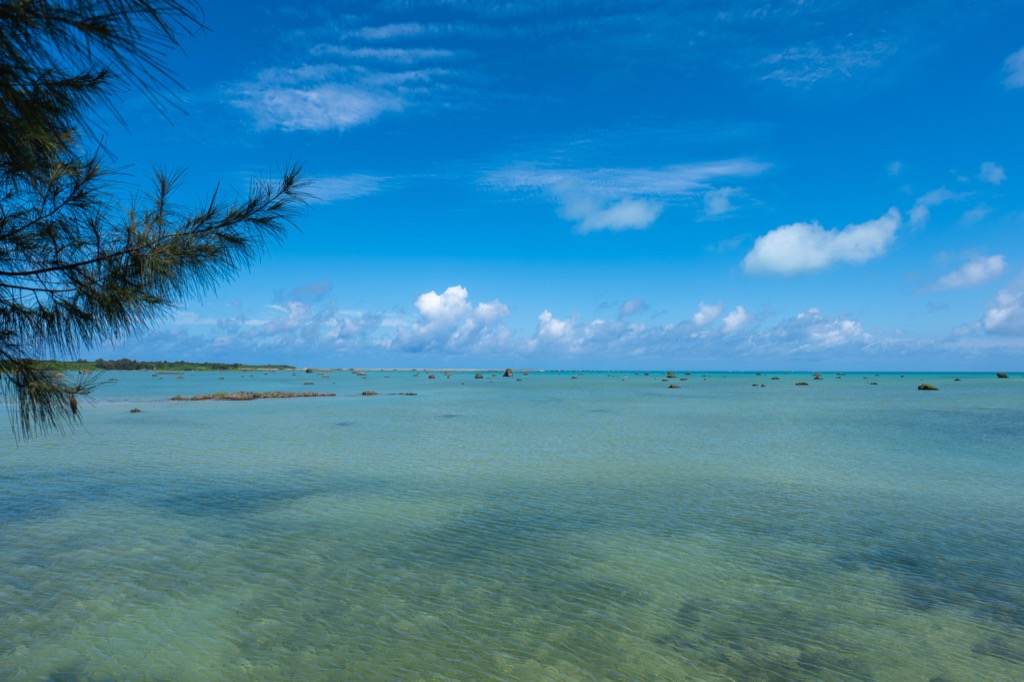
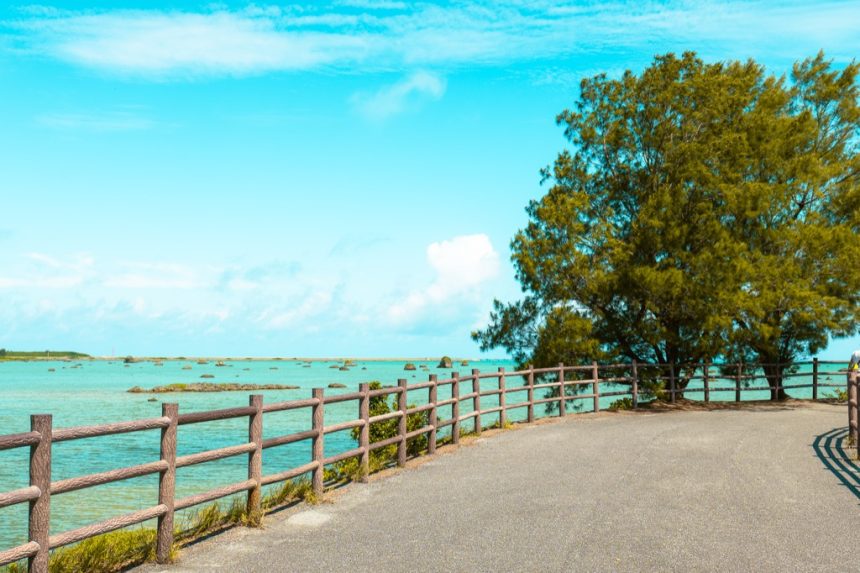
Step past the wooden fence at the edge of the parking area and the view opens up: an enormous, shallow shelf of clear turquoise water reaching hundreds of meters offshore, studded with coral boulders. On a windless day the surface mirrors the sky so cleanly you can lose track of where water ends and clouds begin.
The important frame to bring here is “look and walk, don’t swim.” The water is knee-deep or less across most of the visible flat, which makes it a poor swimming beach but a wonderful walking-and-photographing beach. Check a tide table before you visit — at low tide you can walk between the boulders on packed sand and coral rubble, and coral shapes normally underwater are exposed like a natural sculpture park.
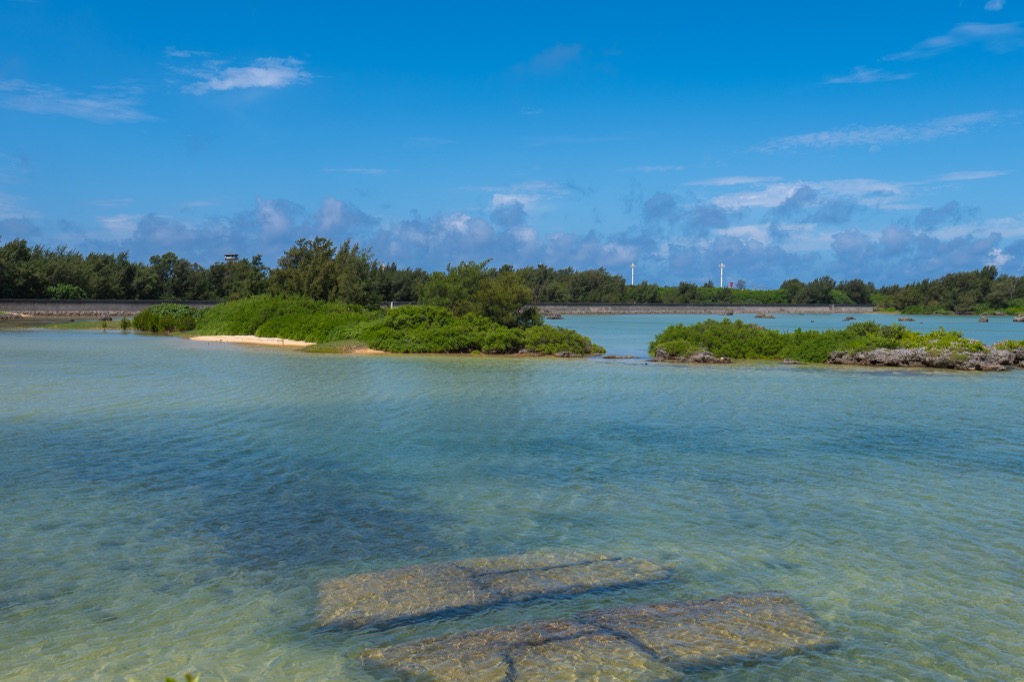
Look further out and you’ll spot small green islets and, in the distance, the observation tower on the Irabu Island interior. It’s a scene that rewards slowness — the more you sit and watch, the more the details reveal themselves. Where 17END is the “dynamic” Miyako Blue of runway spotting, Sawada-no-hama is the “still” Miyako Blue of contemplation.
Sawada-no-hama as a Sunset Spot
Sawada-no-hama’s other claim to fame is the sunset. Facing due west with no obstructions to the horizon, this is one of the best sunset viewpoints in the entire Miyako region. The tidal flats fill with orange reflection, the coral boulders become silhouettes, and if you stay past the sun itself you get an extra 15 – 20 minutes of magic hour as the sky shifts through pink, purple, and deep indigo.
Approximate sunset times by season — use these to plan your arrival:
| Season | Approx. Sunset | Recommended Arrival |
|---|---|---|
| March – April (spring) | Around 18:30 – 19:00 | 17:30 |
| May – July (early summer) | Around 19:15 – 19:30 | 18:15 |
| August – September (peak summer) | Around 18:45 – 19:15 | 17:45 |
| October – November (autumn) | Around 17:45 – 18:30 | 16:45 |
| December – February (winter) | Around 17:45 – 18:15 | 16:45 |
Arrive about an hour before sunset, walk the flats while the light is still golden, then settle in for the show. A phone with a small tripod is enough for great images; if you have a proper camera, a 24 – 70 mm range covers most of what you’ll want to frame.
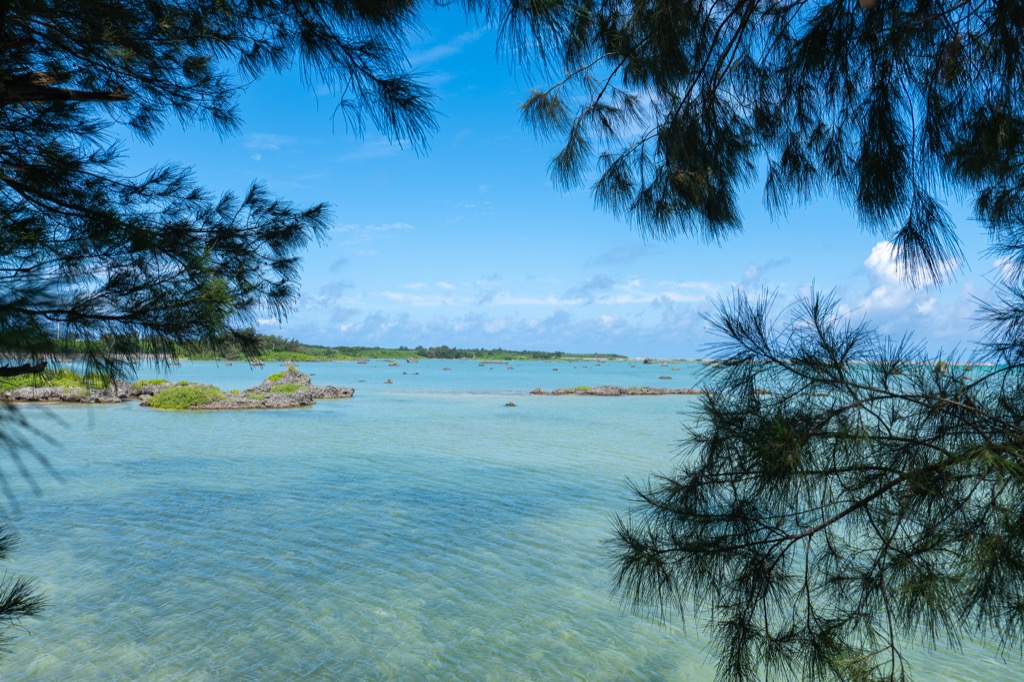
The Ryukyu pine trees (mokumaou) lining the walkway make a natural frame — worth composing a shot through the branches for the classic Sawada look.
Parking, Walkways, and First Steps
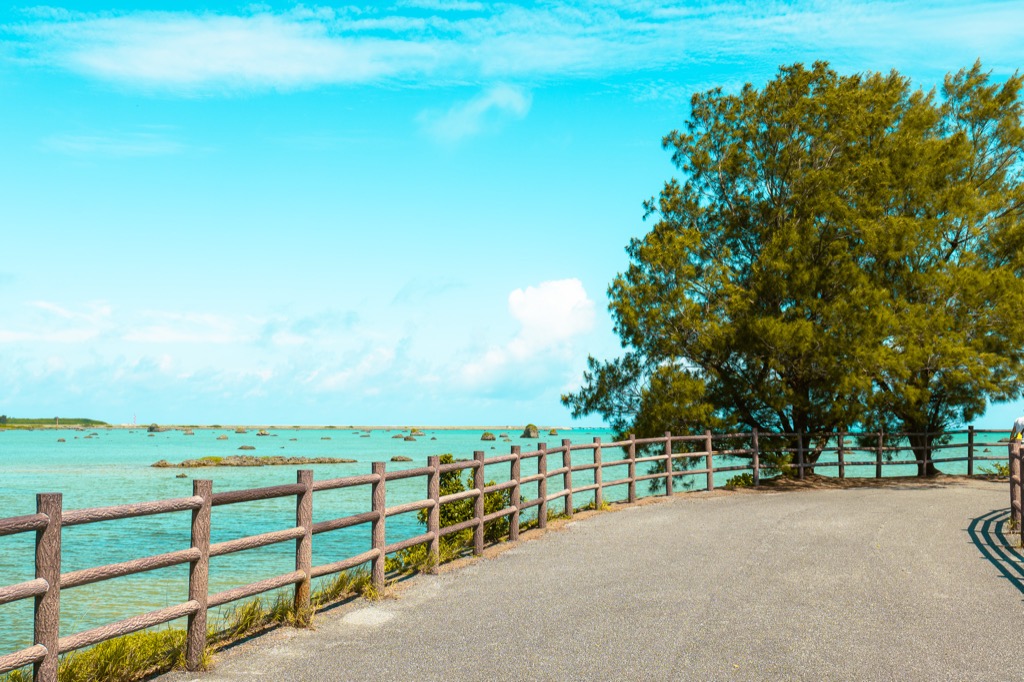
Parking at Sawada-no-hama is free, unmarked, and easy. The lot has room for about 20 cars, and even during peak sunset hour (16:30 – 18:30 in summer) you should find a spot without stress — the beach never draws the crowds that 17END or Sunayama do.
From the lot, a short walkway lined with a low wooden fence follows the shore for a few minutes. It’s flat and easy in any footwear, with benches spaced along the way if you want to sit and read while you wait for the light.
The Little Pier — a Quiet Perch Over Clear Water
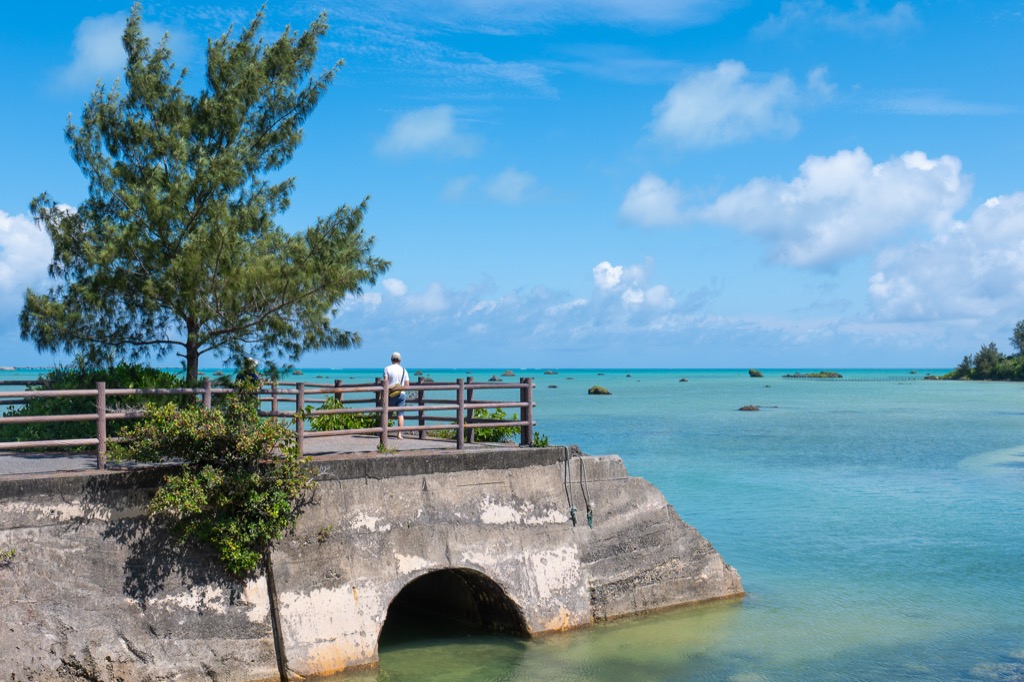
Toward one end of the beach a short concrete pier juts a few meters into the water. Walk out to the end and look straight down — the visibility is remarkable, and small fish, sea grass, and coral shapes drift past below your feet. It’s one of those spots where sitting quietly for ten or fifteen minutes lets Miyako’s slower rhythm sink in.
The pier has no railing at the tip. It’s not high, but families with small children should hold hands out to the end, and skip it entirely if the surface is wet after rain — the concrete gets slippery.
Should You Swim Here? (Short Answer: No)
It’s a common question, so worth addressing head-on. Sawada-no-hama is not a swimming beach. Three reasons:
- Extreme shallowness. Most of the visible water is knee-deep or less; you’d have to wade out hundreds of meters to reach anything you could actually swim in
- Coral rubble and boulders. The sea floor is broken coral and scattered rocks — bare feet or bare knees will get scraped, and stepping on live coral damages it
- No lifeguards or beach infrastructure. No monitoring, no swimming zone, no showers to rinse off in
If your day includes swimming or snorkeling, plan on moving to a different beach afterward:
- Toguchi Beach — about 10 minutes away. Wide white sand, calm turquoise water, gentle entry. The Miyako region’s go-to swimming beach
- Nakanoshima Beach (Shimoji Island) — about 15 minutes away. A natural reef-ringed bay nicknamed the “natural aquarium”, with schools of tropical fish and easy shallow snorkeling
- Yonaha Maehama Beach — 40 – 50 minutes on the south coast of mainland Miyakojima. A 7-kilometer stretch of powder-white sand often called “the finest in the East”
Want to book snorkeling, SUP, or a boat tour in advance? Browse Miyako marine activities and lock in your preferred slot before the peak season fills.
Practical Tips for Foreign Drivers
Things first-time visitors to Japan often want to know before flying in:
- You need an International Driving Permit (1949 Geneva Convention) issued in your home country before you fly. Drivers from Germany, Switzerland, Taiwan, Monaco, Belgium, and Slovenia must instead bring a JAF-certified translation of their home licence
- Japan drives on the left. Miyakojima’s quiet roads are a forgiving place to adjust — most drivers get comfortable within an hour
- Cash matters on the islands. Convenience stores accept cards, but small parking lots, snack stands, and family-run cafes are often cash-only. Carry small yen notes
- Fuel up on the mainland before crossing to Irabu. Gas stations on Irabu and Shimoji are sparse and many close early
- Drunk driving is zero tolerance — even a single drink can lead to arrest and heavy fines. Return the car to your hotel before dinner drinks
- No drones near 17END or Shimojishima Airport. Flying anywhere near the active runway is illegal
What to Bring
- Strong sunscreen (SPF50+) — even a late-afternoon visit exposes you to strong reflected sun
- Water shoes or grippy sandals — the tidal flat is uneven coral. Not a barefoot beach
- 1 liter of water per person — no vending machines nearby. Stock up in Hirara or at the airport
- Insect repellent — mosquitoes come out around dusk, especially on windless evenings
- Camera and small tripod — sunset and magic hour deserve at least one composed shot
- A phone flashlight — the walkway is unlit after sunset
- A trash bag — no bins on site. Pack out what you bring in
Pair Sawada-no-hama With the Rest of the Irabu–Shimoji Loop
Most travelers get more out of Sawada by combining it with two or three nearby spots. All of the following are within a 15-minute drive:
- 17END (Shimoji Island) — turquoise sea and runway threshold, best in the mid-morning to early afternoon. About 10 minutes away
- Nakanoshima Beach (Shimoji Island) — reef-ringed “natural aquarium” bay ideal for snorkeling. About 15 minutes away
- Toriike Pond (Shimoji Island) — twin sapphire sinkholes with a mermaid legend, designated a Natural Monument of Japan. About 10 minutes away
- Makiyama Observatory (Irabu Island) — panoramic view of the Irabu Ohashi Bridge and Miyako Blue coast. About 10 minutes away
- Toguchi Beach — white-sand swimming beach with showers and restrooms. About 10 minutes away
- Irabu Ohashi Bridge — the 3,540-meter toll-free bridge you cross to get here. Worth a photo stop on the way back
The classic full-day plan: 17END in the morning for turquoise water and plane spotting, Toguchi Beach or Nakanoshima at midday for swimming or snorkeling, Toriike Pond in the afternoon for the sinkholes, and Sawada-no-hama at sunset to close the day. Full itinerary suggestions are on the Miyakojima model course page.
FAQ — Quick Answers for First-Time Visitors
Q. Is there an admission fee at Sawada-no-hama?
No. Free, 24 / 7, no gate. Parking is also free.
Q. Can I swim at Sawada-no-hama?
Not really. The water is very shallow and the seafloor is broken coral. For swimming, head to Toguchi Beach (about 10 minutes away). For snorkeling, Nakanoshima Beach on Shimoji Island is the local favorite.
Q. What’s the best time to visit?
Late afternoon into sunset. Arrive about an hour before sundown to walk the tidal flats while the light is golden, then stay for the sunset and 15 – 20 minutes of magic hour after.
Q. Is low tide or high tide better?
Both have their appeal. Low tide lets you walk between the coral boulders like a natural sculpture garden. High tide gives you smoother water for reflections. Check a tide table if you have a specific look in mind.
Q. Are there restrooms or shops on site?
A basic restroom is available at the parking area. There are no shops, vending machines, or cafes within walking distance — buy water and snacks in Hirara or at Shimojishima Airport before you drive over.
Q. Do I need a rental car to visit?
Effectively yes. There is no useful public bus or taxi service to this stretch of Irabu Island. A rental car from Miyako Airport or Shimojishima Airport is the standard choice.
Q. Can I pair Sawada-no-hama with 17END, Toriike, and other spots in one day?
Yes — all major Irabu and Shimoji sights are within a 15-minute drive of each other. A typical day: 17END in the morning, swimming beach at midday, Toriike in the afternoon, Sawada at sunset.
Q. What are the coral boulders on the beach?
Most are believed to have been washed ashore by the 1771 Great Meiwa Tsunami, an M8-class event that struck the Sakishima Islands. They’re part of the reason the beach was named one of Japan’s 100 Best Coastlines in 1996.
Q. How long should I plan to spend there?
Plan on 45 – 90 minutes for a normal visit. Add another 30 minutes if you want to walk the flats at low tide, or arrive early enough to stay through magic hour after sunset.
Wrap-Up — Come for the Sunset, Stay for the Silence
Thanks for reading this far. This guide walked you through what Sawada-no-hama actually is, how to get there, when to arrive for the best sunset, why you shouldn’t swim, and how to pair it with the rest of the Irabu–Shimoji loop. It’s a beach that rewards slowing down rather than checking a box — the visitors who leave the most satisfied are the ones who came with time to spare.
To make the most of Miyakojima, book a rental car with GO!GO!TOUR and drive out yourself. Reserving early — especially May through October — keeps the day relaxed.
Quick checklist before you go:
- Free entry, free parking, open 24 / 7 — no bookings needed
- Best light is late afternoon into sunset and magic hour
- Walk the tidal flats at low tide; enjoy the reflections at high tide
- Not a swimming beach — head to Toguchi (swim) or Nakanoshima (snorkel) nearby
- Water shoes, insect repellent, and a phone flashlight make the visit smoother
- A rental car is essentially required on the Irabu–Shimoji side of Miyakojima
Book Your Miyakojima Rental Car with GO!GO!TOUR — English Support, Easy Pickup, Trusted by First-Time Visitors.
GO!GO!TOUR is locally operated in Miyakojima with English-speaking staff, transparent pricing, and pickup at both Miyako Airport and Shimojishima Airport. The whole rental process — from booking to vehicle handover — can be completed in English.
🗺️ Miyakojima Model Courses — Half-Day, Full-Day, and Multi-Day Itineraries
🏖️ Miyako Marine Activities — Snorkeling, SUP, Diving, Boat Tours

Scattered coral boulders and a horizon painted in gold — see you out there for the Miyako sunset 🌅✨