- Renting a car in Okinawa — the short answer first
- Why drive in Okinawa — 6 reasons
- What to bring to the counter
- 8 Okinawa rental companies and platforms compared
- Driving in Okinawa — 14 things to know
- Where to drive — north, centre and south
- Okinawa car rental FAQ
- Wrap-up — choose the car and the rest of Okinawa falls into place
Renting a car in Okinawa — the short answer first
To drive away from an Okinawa rental counter you need four things in hand: an International Driving Permit issued under the 1949 Geneva Convention, your home country driving licence, your passport, and a credit card in the main driver’s name. Originals only — photos and photocopies are refused, and the minimum driving age in Japan is 18.
On price, expect ¥3,500–10,000 per day before extras. Kei cars and compacts start around ¥3,500, minivans and campervans run well above ¥10,000, and full-cover insurance adds roughly ¥1,000–2,000 a day on top of fuel, tolls and parking.
The reason almost every visitor ends up driving here: Okinawa’s best places are spread along 100 km of main island, and the monorail only covers central Naha. Buses reach the rest, but slowly. A car turns a four-day trip into a week’s worth of coastline.
Start by seeing what is actually available for your dates: Okinawa rental cars on GO!GO!TOUR.
Why drive in Okinawa — 6 reasons
If your trip stays inside Naha, the monorail is enough. The moment you plan a single day further north, the car changes the shape of the whole trip.
- The north and centre open up. The monorail ends in Naha. American Village, Churaumi Aquarium and Kouri Island are hours away by bus with transfers and waiting; by car they are direct.
- You can change your mind on the day. No bus timetables, no tour meeting points. Rain sends you indoors, traffic sends you to lunch first, and a beach you spot from the road becomes a stop.
- Travelling with kids or parents gets easier. Strollers and large cases stay in the boot instead of being carried between every stop.
- Three or more people, and it is the cheapest option. Split the rental, fuel, parking and tolls and the per-person cost drops below buses and taxis on most itineraries.
- Water activities become practical. Snorkelling and diving generate wet gear and a change of clothes, and some of the best entry points are awkward to reach on public transport.
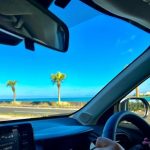
- The driving is the sightseeing. The Kaichu Road, the Kouri Bridge and the west coast highway are the view — and you can stop where you like to photograph it.
What to bring to the counter
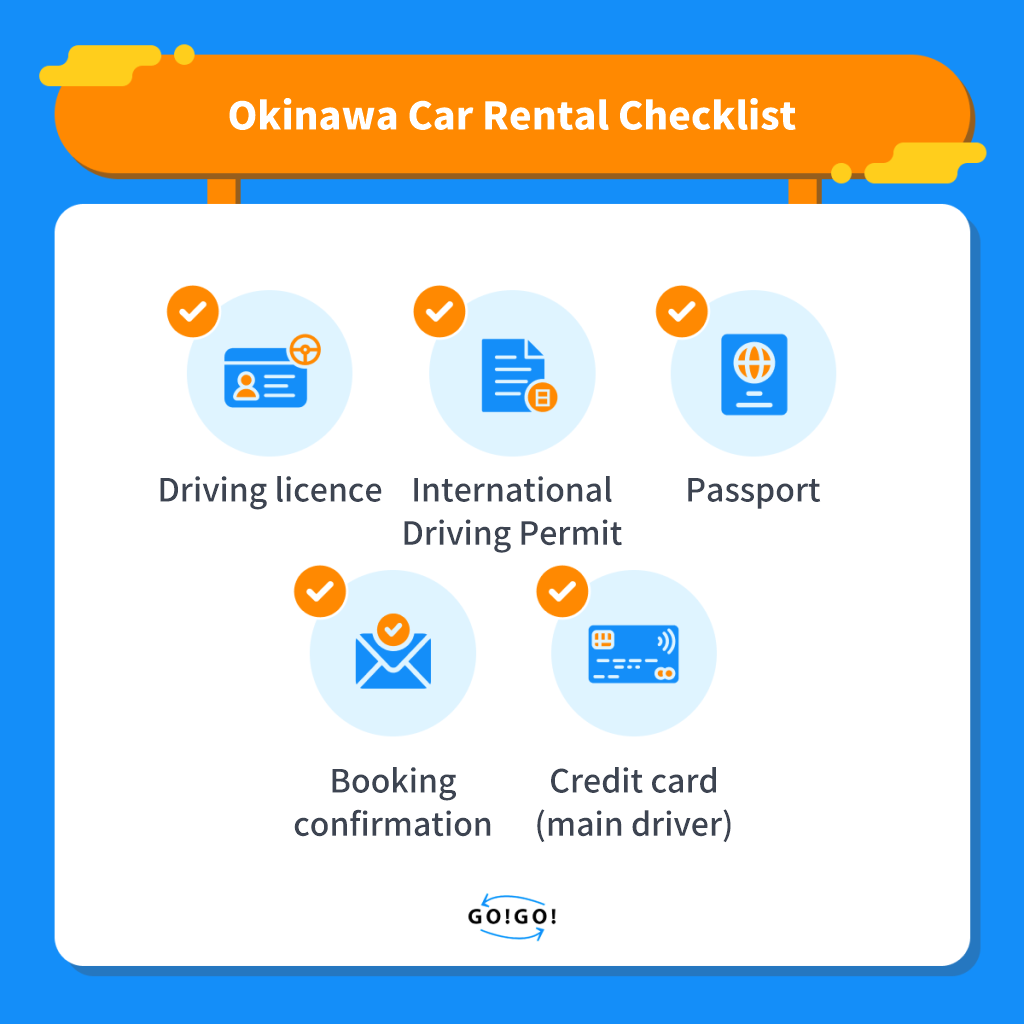
- Your home country driving licence. The IDP is only valid alongside it, so bring both.
- An International Driving Permit (Geneva 1949). Issue it in your own country before you fly — it cannot be obtained in Japan. It is valid for one year from the date of issue.
- Your passport. The name must match the booking exactly.
- Your booking confirmation. It carries the plan details, the pickup and drop-off branch, and the shuttle meeting point.
- A credit card in the main driver’s name. Some operators accept nothing else, so check the condition before you rely on a travelling companion’s card.
One important exception
Travellers from Switzerland, Germany, France, Belgium, Monaco, Slovenia, Estonia and Taiwan cannot use an IDP in Japan. Instead they bring their national licence plus an official Japanese translation issued by an authorised body such as JAF or the relevant embassy or association. If that is you, arrange the translation before you travel — it is the single most common reason a booked car is not released.
Sharing the driving? Every additional driver must be registered at pickup with their own licence and permit. An unregistered driver at the wheel can void your insurance entirely.
Compare Okinawa rental cars in English, in one place
8 Okinawa rental companies and platforms compared
Comparing headline day rates alone tells you very little. What decides the final bill is whether insurance is included, whether the airport shuttle is free, and whether child seats and ETC cards cost extra. The figures below are indicative starting points; they move with vehicle class, rental length, season and plan, and the booking page is always the authority.
| Company / platform | From (per day) | What it is good for |
|---|---|---|
| GO!GO!TOUR | ¥3,500–6,000 | Booking platform comparing Japanese chains and Okinawan local operators side by side. English interface and live chat, plus Web Check-in so you upload documents before you fly and skip the counter queue. One-way rental supported. |
| TOYOTA Rent a Car | ¥6,500–9,000 | Large Japanese chain running mostly Toyota vehicles. Dense branch network and standardised procedures. One-way rental supported. |
| OTS Rent-A-Car | ¥7,000–10,000 | Okinawa’s own major operator. Strong on Naha Airport shuttles, road-safety briefings for visitors and a 24-hour roadside assistance line. One-way rental supported. |
| ORIX Rent a Car | ¥6,000–8,500 | National chain with the widest class range — kei cars, hybrids, SUVs and minivans — and plenty of plan options. One-way rental supported. |
| Nippon Rent-A-Car | ¥6,500–9,500 | Long-established chain known for consistent vehicle condition; some branches keep longer opening hours. One-way rental supported. |
| Tabirai JAPAN | Varies by operator | Comparison site. Many results quote an all-in price including insurance, navigation and tax, which makes total-cost comparison straightforward. |
| ToCoo! Car Rental | Varies by operator | Large aggregator with a wide price range and frequent promo codes. Sells the ToCoo! Expressway Pass (TEP), a flat-rate unlimited toll product. |
| Japan C.R.C | ¥15,000–35,000 | Campervan specialist with an Okinawa depot. Most vehicles are under 3.5 tonnes and drivable on an ordinary licence, with sink, fridge and air conditioning on board. |
To compare properly, add up rental + CDW + NOC + ETC card hire + fuel + parking + any one-way fee + shuttle charges. A cheap headline rate that excludes the cover you actually need rarely ends up being the cheapest trip.
Want to see every operator at once? Browse the full list of partner rental companies.
Driving in Okinawa — 14 things to know
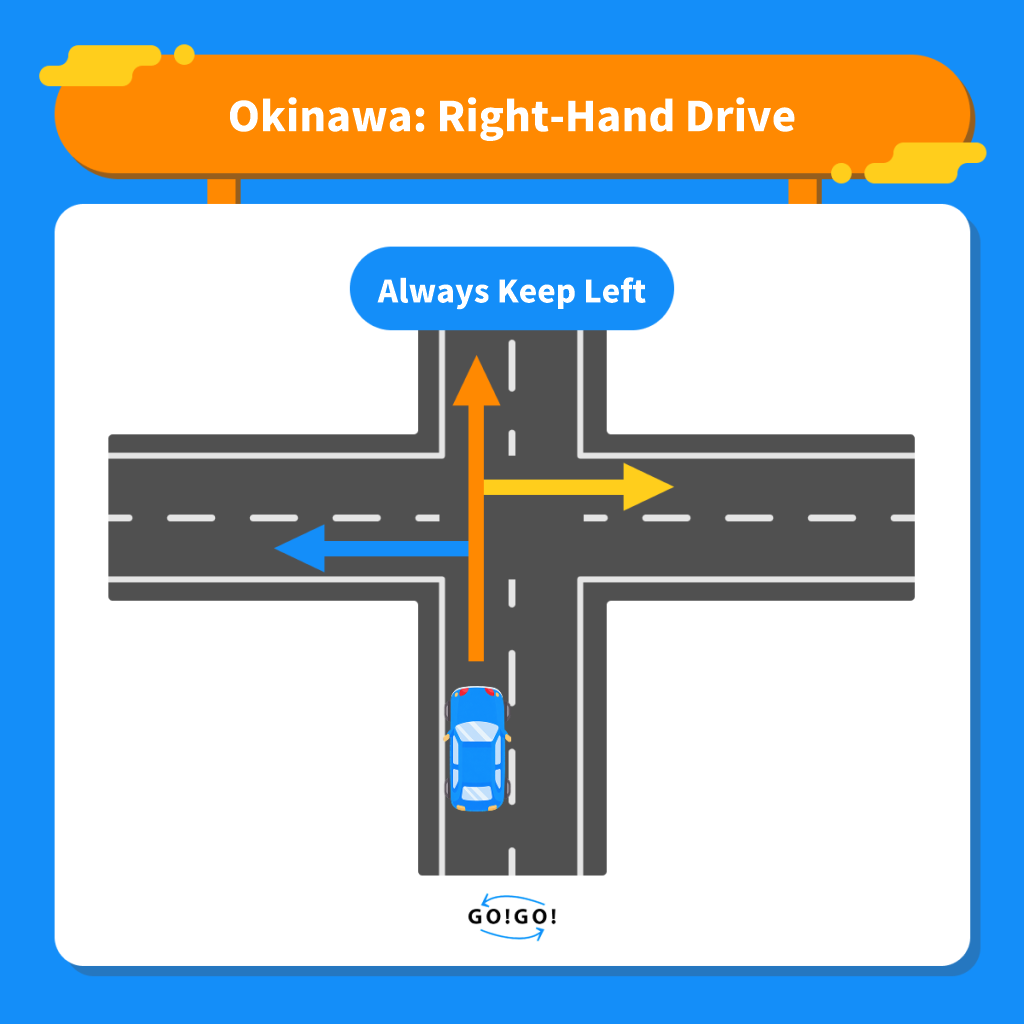
Japan drives on the left, with the steering wheel on the right. If that is the reverse of home, read this list before you turn the key.
- Book early. Summer, Golden Week and New Year sell out from the largest vehicles down. Reserve the car when you book the flight, and read the cancellation terms while you are there.
- Check what your licence permits. An ordinary car licence plus IDP generally covers vehicles seating up to nine. If you want a 10-seater, confirm your own licence class allows it before booking.
- Have a typhoon plan. Okinawa sees typhoon activity mainly in August and September. Flights, shuttles and opening hours all change at short notice, so know the cancellation and postponement rules in advance.
- Give yourself time with right-hand drive. Before moving off, find the indicators, wipers, gear selector and mirrors. The classic first-day mistake is the wipers instead of the indicator — the stalks are mirrored.
- Keep left, and say it out loud at every turn. Most incidents involving visitors happen on the first right turn onto an empty road.
- No turning on red. Unlike some countries, you may not turn at a red signal in Japan in either direction.
- Seatbelts for everyone, child seats under six. Children under six years old must use a child seat — reserve one when you book, as stock is limited.
- Watch for “Y” plates. Vehicles with a plate starting “Y” belong to US military personnel or their families. If an accident involves one, the process runs through additional procedures and takes longer.
- Watch for “わ” and “れ” plates. These mark rental cars, so the driver is probably a visitor too. Leave extra following distance.
- Speed limits are 40–50 km/h on ordinary roads, 80 km/h on the expressway. Signage on the road always overrides the general rule.
- There is exactly one expressway. The Okinawa Expressway runs up the middle of the island. Without an ETC card you take the general lane and collect a ticket.
- Bus lanes operate in Naha on weekday mornings and evenings. Sections of Route 58 and other city roads restrict lanes to buses at set times — check the signs and the hours before you commit to a lane.
- Kokusai-dori closes to cars on Sundays. A transit mall normally runs 12:00–18:00 every Sunday between the Kencho-kita-guchi and Saionbashi intersections. Rain or events can change it, so follow the notices on the day.
- Park only in proper car parks. Illegal parking is enforced strictly, even for a quick drop-off, and popular sights fill their car parks early. And in the far north, watch for wild boar, crabs and the Okinawa rail crossing the road after dark or rain.
Where to drive — north, centre and south
The main island is about 100 km top to bottom. Driving back to Naha every evening burns the day in the car, so work one region per day and order the days around where you sleep.
North — the day you go for the water
- Cape Manzamo. The elephant-trunk rock and a wide sweep of the East China Sea. The walk takes about 20 minutes, which makes it an easy stop on the way north rather than a destination.
- Kouri Island. Crossing the Kouri Bridge puts blue water on both sides of the car. The island’s garlic shrimp is the classic reason to stop once you are over.
- Churaumi Aquarium. The Kuroshio Sea tank and its whale sharks are the island’s signature sight. The park is large, so allow half a day with children — see our full Churaumi Aquarium guide.
Centre — American Okinawa and an easy family day
- American Village. Shops, restaurants and a seafront in one block. Shop in the afternoon, walk the beach at sunset, then stay for the lit-up streets — it holds a whole evening.
- Minatogawa Foreign Housing District. Former American housing converted into cafés, bakeries and small design shops. The district is compact; one to two hours covers it.
- Okinawa Children’s Zoo. Animals plus hands-on exhibits, and an easy day with small children — helped considerably by having the stroller and the bags in the car.
South — close to the airport, ideal for your last day
- Senagajima. Minutes from Naha Airport, with a whitewashed cliffside mall, sea views and aircraft passing low overhead on approach.
- Okinawa World and Gyokusendo Cave. A long limestone cave plus Ryukyuan crafts and traditional performances. Check performance times before you arrive.
- Sefa-utaki. The most sacred site of the Ryukyu Kingdom and still a place of prayer. The stillness between the great rocks is the point — keep your voice down and follow the posted rules.
Not sure how to sequence the days? Take a ready-made Okinawa model course and adapt it.
Okinawa car rental FAQ
Is CDW enough, or do I need the full-cover plan?
Take both. The base rate includes compulsory liability cover, but it does not make your own exposure zero.
CDW (collision damage waiver) removes the contractual excess on damage to the vehicle — scrapes, cracked glass, repair costs. NOC (non-operation charge) is separate: it covers the operator’s lost business while the car is off the road being repaired. They protect against different things, so one without the other leaves a gap. Budget roughly ¥1,000–2,000 per day for the pair.
Do I need an ETC card in Okinawa?
It depends how often you use the expressway. Okinawa has only one, so a single return trip between Naha and the north is just as easy through the general lane with a paper ticket.
If you expect several runs up and down the island, compare the ETC card hire fee against the actual tolls and any flat-rate pass. Note that an ETC reader in the car does not mean an ETC card comes with it — hire terms and settlement rules differ by operator, so confirm at booking.
Which car size should I book?
Count people and suitcases together. A five-seater does not mean five adults plus five large cases. Add a stroller or a child seat and the next class up pays for itself in comfort.
- Kei car (K). Honda N-BOX and similar. A 660cc box that is cheap, frugal and easy to park — ideal for one or two people travelling light.
- Compact (S). Toyota Yaris, Honda Fit. Nimble in town, excellent fuel economy, comfortable for two or three.
- SUV / mid-size (M/W). Toyota RAV4 and similar. High seating, good visibility and enough power to make the long run north relaxed for three or four.
- Minivan (V). Toyota Noah or Alphard. Seven to eight seats with sliding doors — the right answer for extended families or four adults with full-size luggage.
What happens at pickup at Naha Airport?
The sequence is: call the branch, ride the shuttle, check in, review the contract and insurance, inspect the car, drive away.
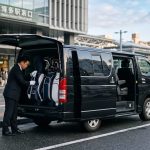
After baggage claim, contact the operator as your confirmation email instructs and wait at the designated point. Very few operators hand cars over at the terminal kerb, so read the meeting point carefully before you land.
At the depot you present your passport, home licence, IDP and booking; any additional drivers register at the same time. Before you set off, walk around the car with the staff member, check scratches, tyres, fuel level and equipment, and photograph or film everything. Refuel with the specified grade before return, keep the receipt, and allow time for the inspection and the shuttle back to the terminal.
Wrap-up — choose the car and the rest of Okinawa falls into place
Okinawa’s sights are scattered across 100 km of island, so the rental decision quietly sets the shape of your whole trip. Settle three things — size, cover, pickup point — and everything after that is coastline.
GO!GO!TOUR compares the big Japanese chains and Okinawa’s local operators on one screen, in English. Naha Airport pickup and drop-off, out-of-hours collection at selected branches, and Web Check-in to shorten the counter queue.
✨ Five reasons travellers book with GO!GO!TOUR
- English support online. Ask before you book, so there are no surprises at the counter.
- A genuinely wide choice of cars. Multiple partner depots in one search, from kei cars to eight-seat minivans.
- Web Check-in. Upload your documents before you fly and spend less time at the desk on arrival day.
- Flexible pickup and return. Selected branches handle out-of-hours collection, which matters on late arrivals into Naha.
- Delivery and shuttle options. Paid hotel delivery, hotel return and pickup services are available.
If your dates are set, start by filtering on car class and insurance — those two decide almost everything else.
Book your Okinawa rental car with GO!GO!TOUR
Find an Okinawa rental car by class
- Kei car (K) — easy in narrow lanes and small car parks, and very cheap to run
- Compact (S) — for two or three, Yaris and Fit class
- Mid-size / wagon (M/W) — four or five people, big luggage, long days
- Minivan (V) — six to eight seats for families and groups
- All partner rental companies — compare every operator in one list
Plan the rest of your Okinawa trip
- Okinawa model course — a ready-made driving route to adapt
- Find activities by category — snorkelling, diving and more to slot into the drive
- Japan eSIM — activates on arrival, works with maps and translation apps
- Discount coupons — check current promotions before you book

※ Prices, opening hours and terms in this article reflect information handled by GO!GO!TOUR at the time of writing, and vary by season, model and operator. Confirm the final quote on the booking page. — GO!GO!TOUR Editorial Team