- Kumamoto Castle — the Kyushu road-trip castle you have to walk at least once
- Kumamoto Castle essentials — admission, hours & parking
- Walking the earthquake reconstruction site — Fukko-no-Michi and the Great Keep
- Inside the six-floor main keep — what you actually see
- Kato Shrine — how to visit
- Best walking route for couples and families — Ninomaru Plaza & Josaien
- Travel tips — long weekends, photos, timing
- Frequently asked questions
- Wrap-up — block out a half-day in your Kyushu drive for Kumamoto Castle
Kumamoto Castle — the Kyushu road-trip castle you have to walk at least once
Hello from GO!GO!TOUR, your Kyushu rental car and self-drive travel partner.
On this trip we spent half a day at Kumamoto Castle (熊本城), the symbol of Kumamoto Prefecture on the west side of Kyushu.
The first thing worth knowing is that this is a living castle still being rebuilt in front of you. Traces of the April 2016 Kumamoto earthquake are still visible across the grounds, and right next to them runs Fukko-no-Michi (復興の道 / the Reconstruction Path), a special elevated walkway that fully opened at the end of 2025. Seeing collapsed stone walls beside freshly rebuilt ones is a view you only get here.
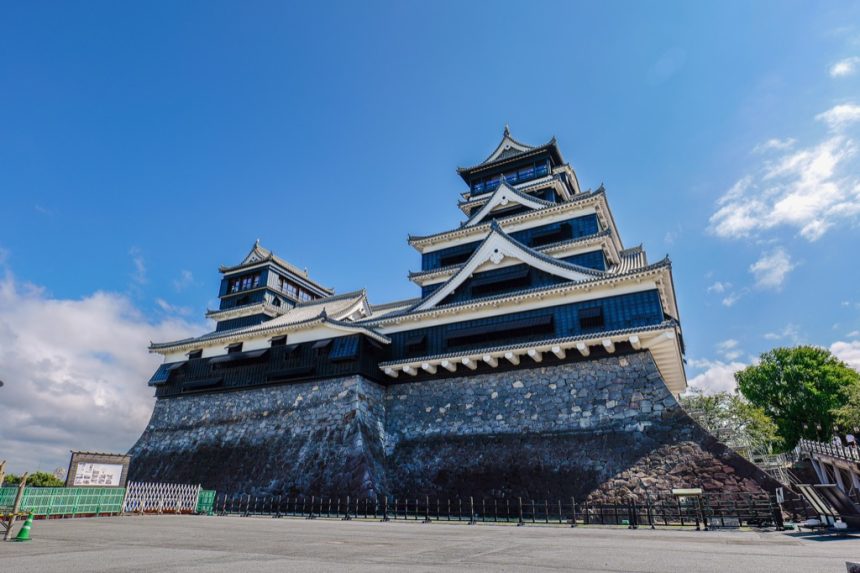
We visited on the Respect for the Aged Day long weekend in September. It was busy, but the sky opened up into a crisp blue and the photos came out beautifully. Three shots alone made the visit worth it: the main keep framed straight-on from the wide Ninomaru Plaza, the Great Keep looming above from Kato Shrine, and the stone-wall repair site seen from above on Fukko-no-Michi.
In this guide we walk through Kumamoto Castle in the order we actually experienced it: what you’ll see across the six floors of the main keep, what kind of shrine Kato Shrine is, and how to plan admission, parking and timing. Kumamoto slots neatly into a Kyushu road-trip day connecting Fukuoka, Aso and Kurokawa Onsen — pick up your car via our Kumamoto rental car search and drop it into a half-day slot.
Kumamoto Castle essentials — admission, hours & parking
Here is what to lock in before you arrive.
| Item | Details |
|---|---|
| Admission (high school & up) | 800 JPY (640 JPY for groups of 30+) |
| Elementary & junior high | 300 JPY (240 JPY group rate) |
| Preschool children | Free |
| Opening hours (Sep–Jun) | 09:00–17:00 (last entry 16:00 · last keep entry 16:30) |
| Opening hours (Jul–Aug) | 09:00–19:00 (last entry 18:00) |
| Gates | Weekdays: south gate only / Sat–Sun & holidays: both south and north |
| Closed | December 29 and during severe weather |
| Address | 1-1 Honmaru, Chuo-ku, Kumamoto City, Kumamoto |
| Time needed | Keep + grounds walk: 1.5–2.5 hours |
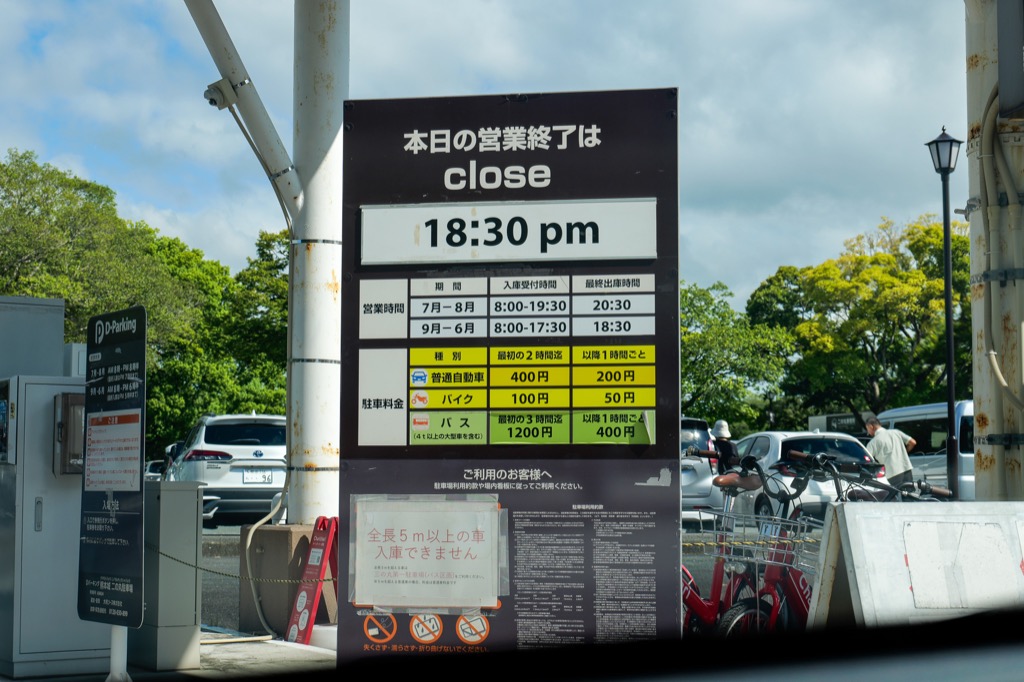
For parking, the two main options are the Ninomaru Parking (210 cars) on the west side and the Josaien (Sakuranobaba Josaien) underground parking (58 cars) on the south side.
– Ninomaru Parking: 400 JPY for the first 2 hours, then 200 JPY per additional hour
– Josaien underground: 400 JPY for the first 2 hours, then 200 JPY per additional hour (April 2026 revision)
– Free shuttle bus: Josaien ⇔ South Gate ⇔ Ninomaru Parking (09:00–17:00, every 10–15 minutes)
Parking rates may be revised in the future — please double-check the official notice before you go. Several private coin parking lots operate nearby with a range of rates, so a quick check can save a bit.
Walking the earthquake reconstruction site — Fukko-no-Michi and the Great Keep
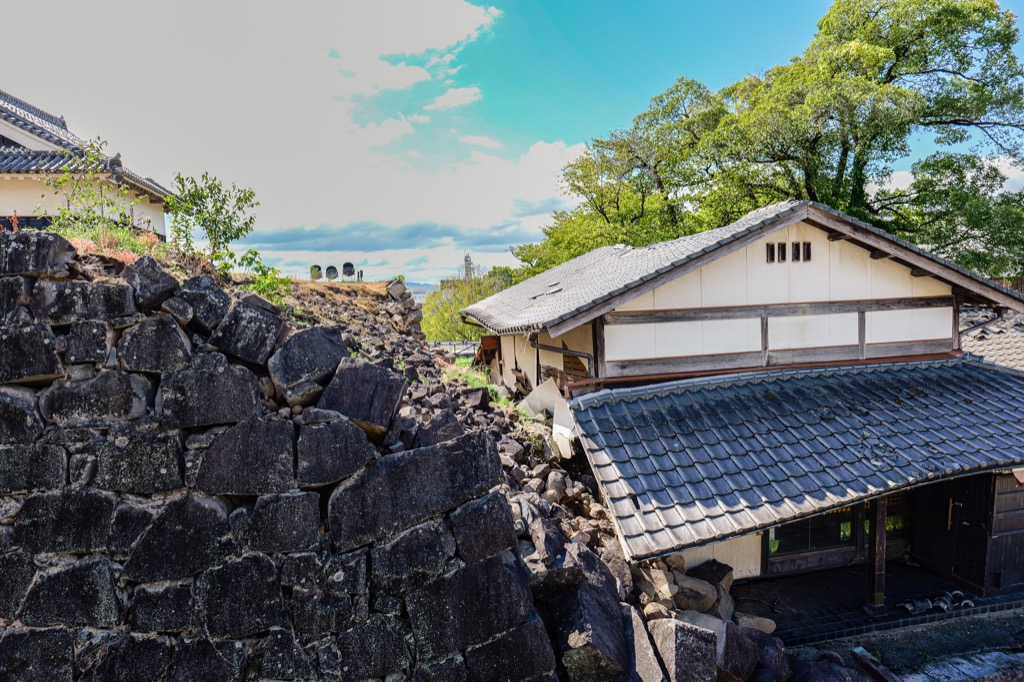
The moment you start walking around Kumamoto Castle, you notice sections of collapsed stone wall preserved exactly as they fell. The April 2016 Kumamoto earthquake damaged 33 structures on the grounds, and ten years on the reconstruction is still very much ongoing rather than finished. For background on the earthquake itself and traveler-side tips, we cover it in more detail in our 2026 Kumamoto earthquake travel guide.
– Fully restored: Great Keep and Small Keep (spring 2021) · Nagabei long wall · Kenmotsu Yagura
– Currently under repair: Uto Yagura (stone-wall dismantling from 2024) · Iidamaru 5-story Yagura (from 2025)
– Target for full reconstruction: 2052
The way visitors can now watch this 36-year mega-project from above is via the special viewing path Fukko-no-Michi (Reconstruction Path).
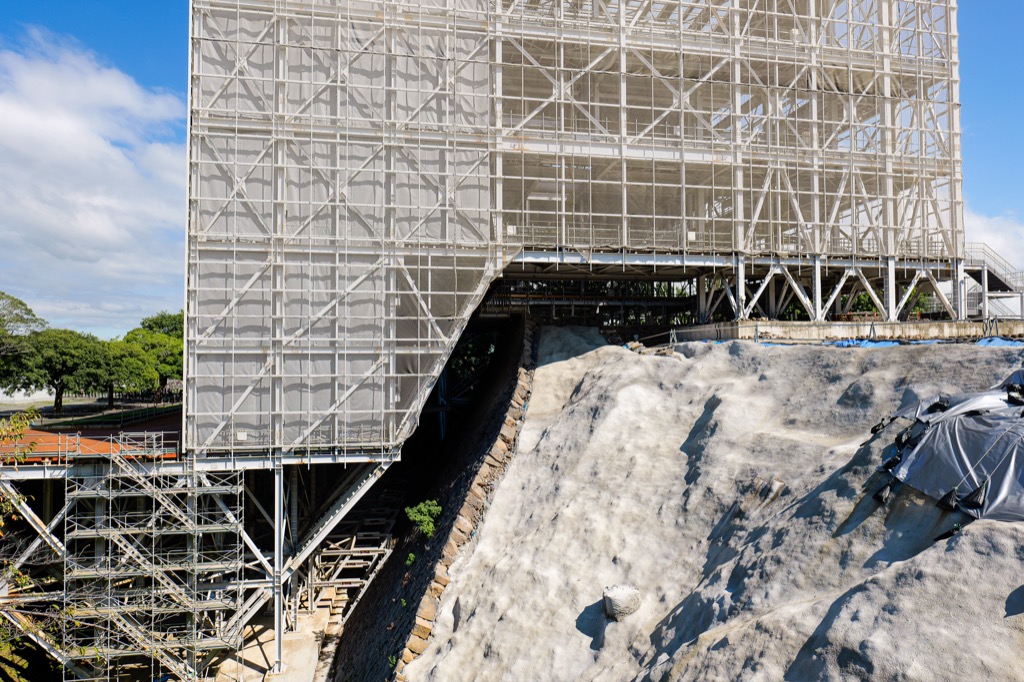
– Total length: about 800 m
– Height: elevated walkway roughly 6 m above ground
– Opening: phased opening from 2020, fully open at the end of 2025
– Access: weekdays south route only; Sat–Sun & holidays both south and north
From the elevated deck you look straight down onto neatly arranged, individually numbered stone pieces waiting to be replaced, with restored sections sitting next to sections still untouched. It is the clearest possible way to feel “ten years on, this is how far we have come and this is how much is left.” The visitor flow naturally runs south route → Great Keep → Kato Shrine → Ninomaru Plaza, so the geometry is easy on your feet.
Inside the six-floor main keep — what you actually see
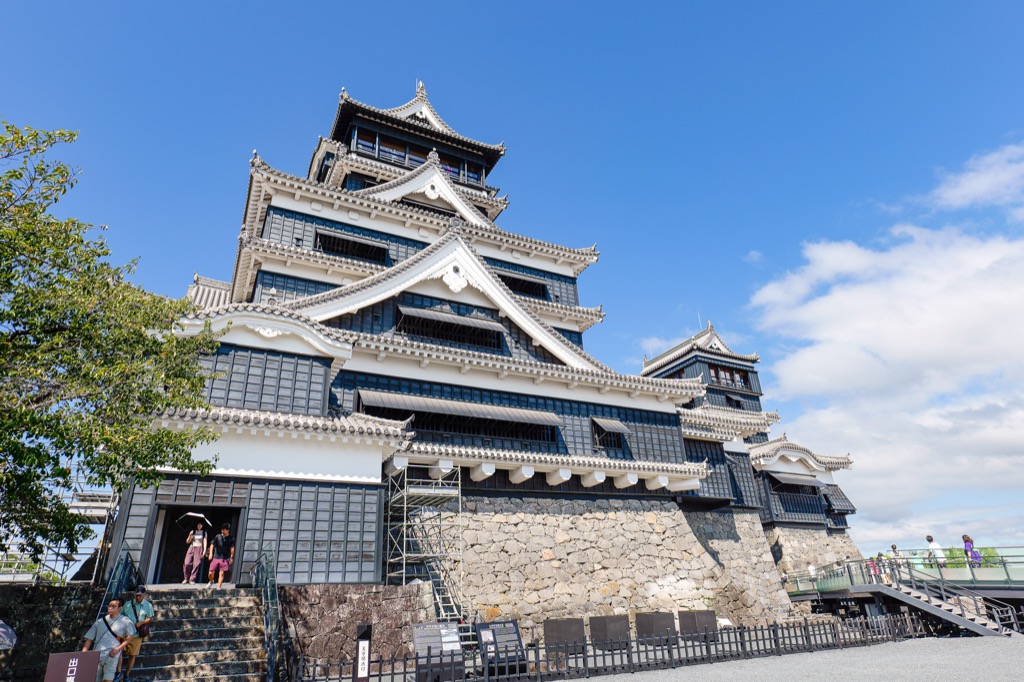
The main keep is three-tiered on the outside but six floors above ground plus one basement inside. You climb through time period by period, ending at a 6F observation deck overlooking Kumamoto city. Here is what waits on each floor.
| Floor | Theme | Main exhibits |
|---|---|---|
| Basement (Anagura) | Foundations | Edo-period kitchen space · original stone-wall structure at foundation level |
| 1F | “Kato era” | Kato Kiyomasa’s castle-building · Shirakawa river works · formation of the castle town |
| 2F | “Hosokawa era” | Hosokawa family rule · armor & weaponry · projection mapping on a castle-town model |
| 3F | “Modern era” | Meiji-era army control · Satsuma Rebellion and the loss of the original keep |
| 4F | “Contemporary era” | 2016 Kumamoto earthquake damage diorama · digital donor wall |
| 5F | Passage floor | Corridor up to the 6F observation deck |
| 6F | Observation deck | Views over Kumamoto city, Mount Aso and the active repair site · smartphone AR overlay of early-Meiji photos |
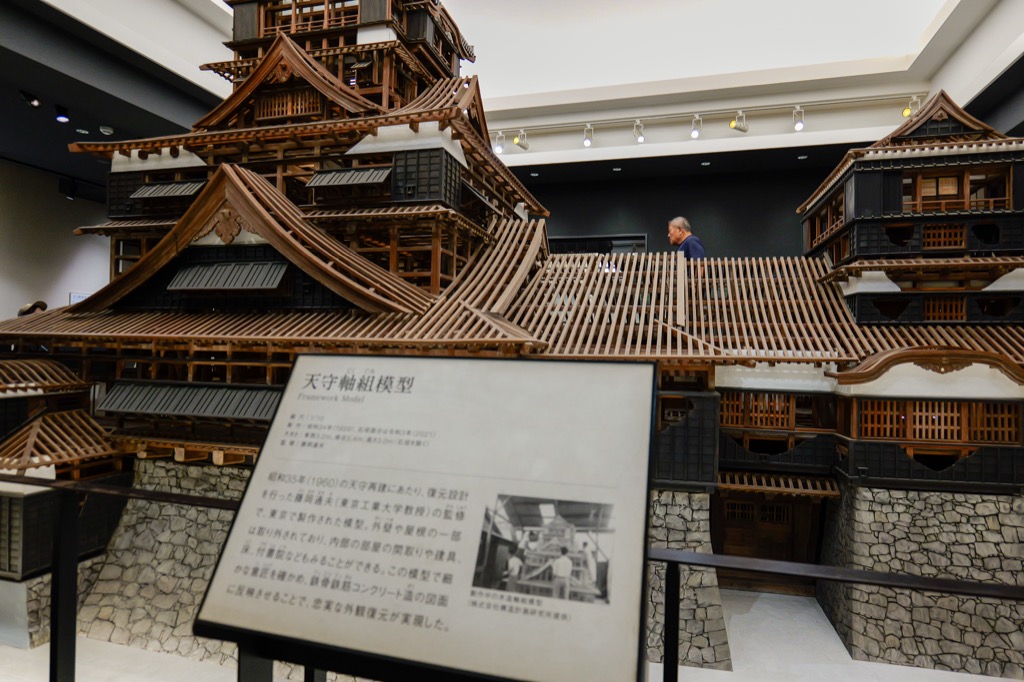
Here is a viewing tip. Climbing chronologically from 1F upward and meeting the earthquake story on 4F is the castle’s real narrative. “Kato Kiyomasa built it → the Hosokawa clan inherited it → it burned in the modern era → the contemporary earthquake and rebuild” — the whole place is essentially a castle broken and rebuilt more than once. After the 4F earthquake diorama, when you step out onto the 6F deck, every stone you see below suddenly reads differently.
On the 6F observation deck, launching the AR smartphone app lets you overlay early-Meiji black-and-white photos on today’s skyline. Photography lovers, this one is for you.
Kato Shrine — how to visit
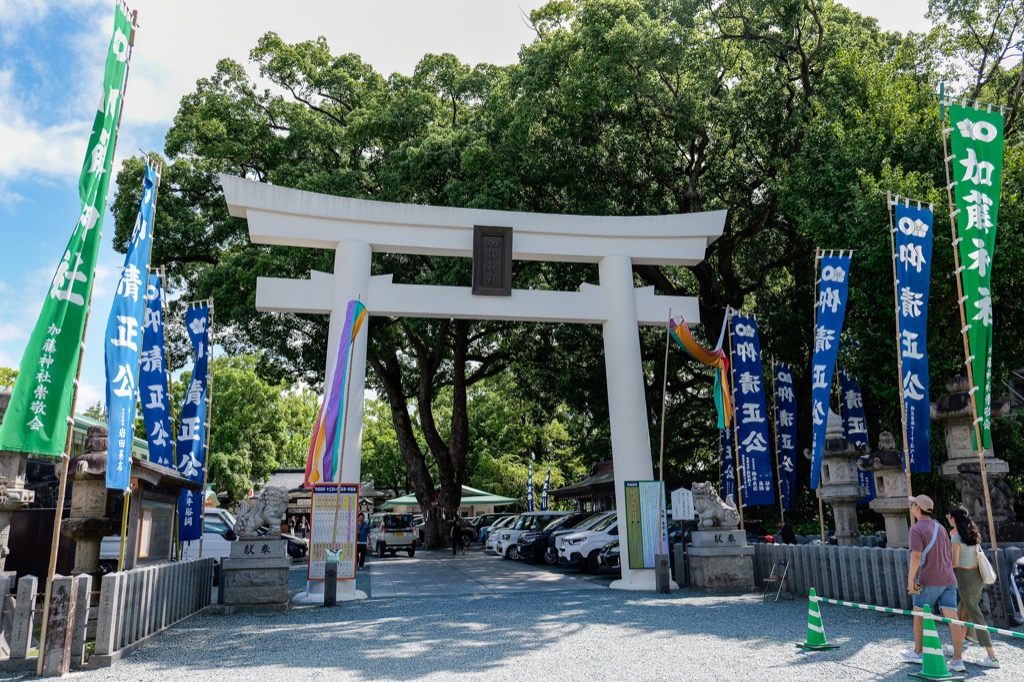
After the main keep, walk three minutes across to Kato Shrine, tucked right beside the Great Keep. The shrine is dedicated to Kato Kiyomasa, the daimyo who built Kumamoto Castle.
| Item | Details |
|---|---|
| Deity | Kato Kiyomasa (builder of Kumamoto Castle, first lord of Kumamoto Domain) |
| Main blessing | Shobu-un — fortune in contests, from Kiyomasa’s undefeated record |
| Secondary blessings | Academic success · road safety · family safety · business prosperity · safe childbirth |
| Visiting hours | Grounds open 24/7 (office & omamori sales 08:00–17:00) |
| Admission | Free |
A common question is whether Kato Shrine is more of a “family” or “couples” shrine. The short answer: it is an all-round shrine with shobu-un — fortune in contests — as its signature blessing. Prayers for exams, promotions, launching a business, sports matches — anything framed as a challenge or a match — sit at the core, with family safety, safe childbirth and business prosperity layered on top for group visitors.
Whether you come with family, as a couple, or on a solo trip, the shrine fits. If you want a single characterization: “a shrine for people who are up to something and want a boost.”
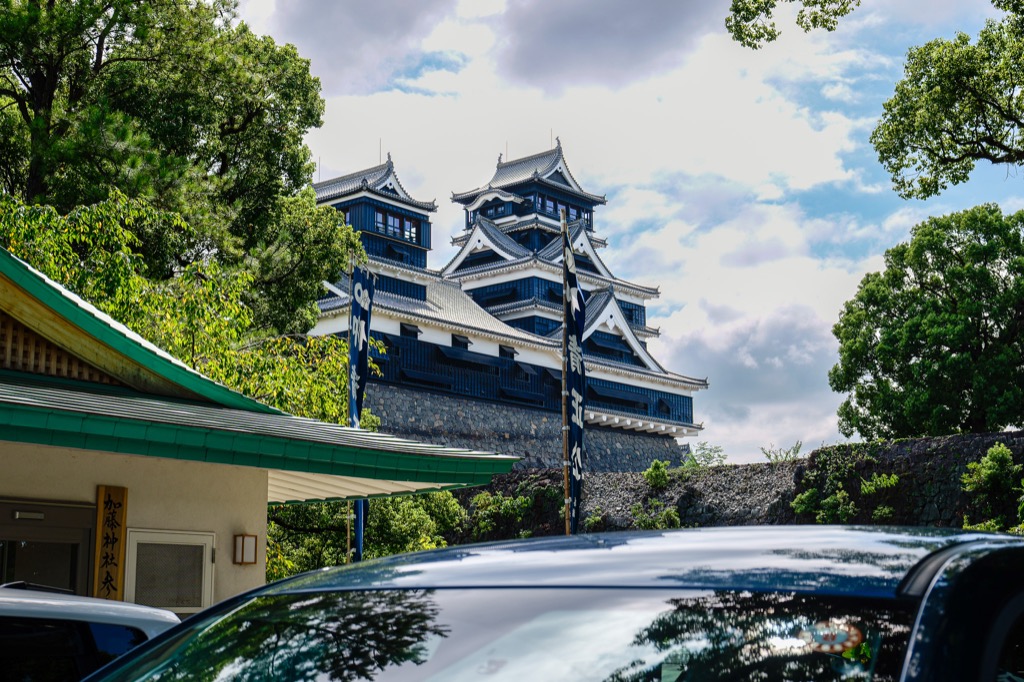
Before you leave the shrine, turn around for a moment. The closest, most dramatic angle on the Great Keep from inside the castle walls opens up right here. During cherry blossom season, this exact frame is one of the most-shared shots on Japanese photo communities.
Best walking route for couples and families — Ninomaru Plaza & Josaien
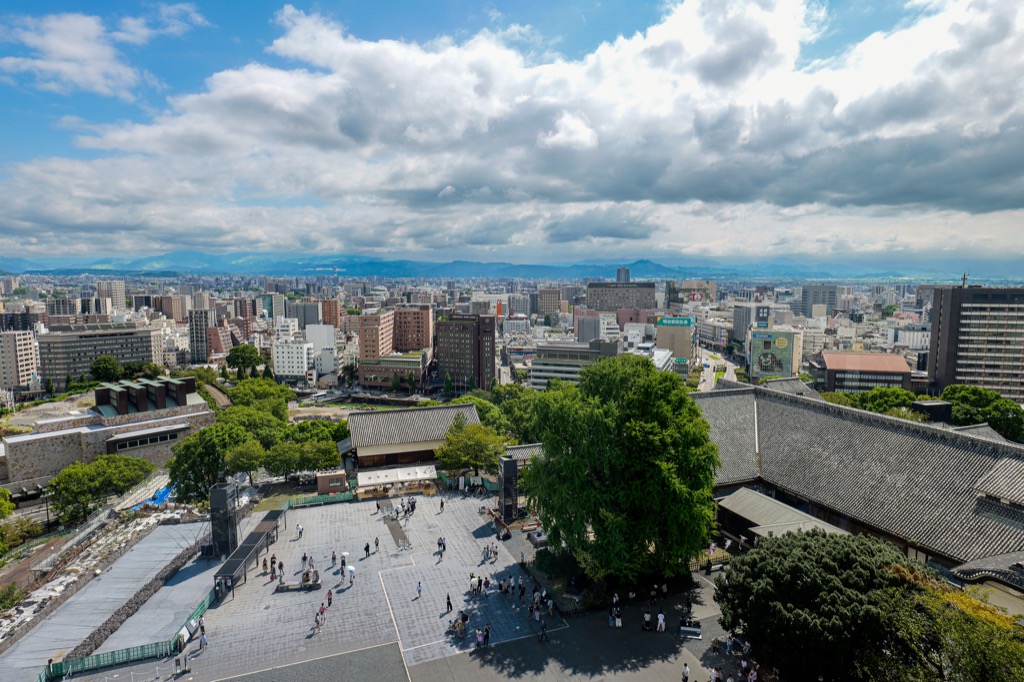
Once you are done with the keep and Kato Shrine, take the free outer areas at a walking pace. Two spots stand out: Ninomaru Plaza and Josaien (Sakuranobaba Josaien).
Ninomaru Plaza
A wide grass plaza on the castle’s west side, free to enter. It is the definitive photo spot for the full-height shot of the Great Keep. It is a famous cherry blossom spot in spring, and on any regular day it is an open lawn where kids can run around. Strollers roll easily through here, which is why it’s popular with families traveling with young children or parents — plenty of visitors also spread out a picnic and take a break.
Josaien (Sakuranobaba Josaien)
A tourism and community complex tucked below the south side of the castle. The lanes are styled after an Edo-era castle town and lined with Kumamoto regional restaurants, souvenir shops and dessert cafes. Walking around is free; the paid “Wakuwakuza” history experience hall is a separate ticket. This is the easiest place to slot in lunch or a coffee break after the castle.
“Great Keep (paid) → Kato Shrine (free) → Ninomaru Plaza (free) → Josaien (free + food)” is the classic half-day flow.
Travel tips — long weekends, photos, timing
Practical notes from the actual visit.
Weekends and long weekends
The Respect for the Aged Day weekend gets busy across the grounds, especially in front of the Great Keep and up on the 6F observation deck. Right after opening (09:00–10:00) or after 15:00 tend to be the quieter windows. On Saturdays, Sundays and public holidays both the south and north gates are open, so if you park at Ninomaru, use the north gate; if you park at Josaien underground, use the south gate — either combo shortens the walk.
Photo spots
– Ninomaru Plaza: the definitive full-height straight-on shot of the keep
– Kato Shrine grounds: closest upward angle to the Great Keep
– End of Fukko-no-Michi: top-down view of the stone-wall repair site
– Josaien lanes: portraits with an Edo castle-town backdrop
Time budget
– Quick visit (keep + Kato Shrine): 1.5 hours
– Standard route (+ Fukko-no-Michi + Ninomaru Plaza): 2.5 hours
– Relaxed route (+ meal & stroll at Josaien): half a day (3–4 hours)
What to wear
Slopes and stairs run throughout the grounds. Walking shoes are a must.
Continuing east
Many travelers pair Kumamoto Castle with an onward drive to Beppu or Yufuin the same day or the next. If that is your plan, our Oita rental car guide covers the road east in detail. For an itinerary framework across the region, see our Japan recommended model courses.
Frequently asked questions
Q1. How much is admission to Kumamoto Castle?
Admission is 800 JPY for high school students and older, 300 JPY for elementary and junior high students, and free for preschool children. Groups of 30 or more get a discount to 640 JPY and 240 JPY respectively. Ninomaru Plaza, Kato Shrine and the Josaien shopping street are all free to walk through.
Q2. What are the opening hours and closing days?
September through June: 09:00–17:00 (last admission to the main keep 16:30). July through August: 09:00–19:00. The castle is closed on December 29 and during severe weather. Ticket sales at the Ninomaru booth end at 16:00 year-round, so plan accordingly for a late afternoon arrival.
Q3. Where should I park at Kumamoto Castle?
The two main options are Ninomaru Parking (210 cars, west side) and the Josaien underground parking (58 cars, south side). Both charge 400 JPY for the first 2 hours and 200 JPY per additional hour as the baseline rate. Rates are subject to change, so please check the official notice before your visit. A free shuttle bus connects both lots with the south gate.
Q4. How many floors does the Kumamoto Castle main keep have?
The Great Keep (Dai-tenshu) looks like a three-tiered structure from the outside but has six floors above ground plus one basement inside. The exhibition path runs chronologically: basement → 1F Kato era → 2F Hosokawa era → 3F modern era → 4F contemporary (earthquake and reconstruction) → 6F observation.
Q5. Where can I see the earthquake exhibit?
The main earthquake exhibit is on the 4th floor “Contemporary” zone. It includes a scale model of the 2016 Kumamoto earthquake damage, videos of the reconstruction process, and a digital donor wall. Head up to the 6F observation deck afterward for a bird’s-eye view of the actual stone-wall repair work below. For a deeper look at the earthquake itself, see our Kumamoto earthquake travel guide.
Q6. What kind of shrine is Kato Shrine?
Kato Shrine is dedicated to Kato Kiyomasa, the daimyo who built Kumamoto Castle. Its main blessing is shobu-un (fortune in contests), inspired by Kiyomasa’s undefeated military record. Common prayers are for exams, promotions, launching a business or sports matches, plus secondary blessings like academic success, family safety, business prosperity and safe childbirth. It suits solo travelers, couples and families alike.
Q7. When can I use the Fukko-no-Michi special viewing path?
Only the south route is open on weekdays; both south and north routes open on Saturdays, Sundays and public holidays. The path opened in stages from 2020 and fully opened at the end of 2025. It runs about 800 m long at roughly 6 m above ground, letting you look down on the stone-wall repair site. A regular castle admission ticket covers access.
Q8. Can I reach Kumamoto Castle by public transport?
Yes. From JR Kumamoto Station, take the A-line tram (shiden) and get off at “Kumamotojo-mae / Shiyakusho-mae”. The ride takes about 14–20 minutes at a flat 180 JPY fare. The Shiromegurin sightseeing loop bus is another option. That said, a rental car is far more convenient if you want to combine Kumamoto with the wider Kyushu region. See our Fukuoka car rental guide for the most common Kyushu pick-up point.
Wrap-up — block out a half-day in your Kyushu drive for Kumamoto Castle
If we had to sum it up in one line:
“6-floor chronological keep walk + Fukko-no-Michi + Kato Shrine + Ninomaru Plaza = a half-day that captures the heart of Kyushu.”
Kumamoto Castle is not a place you go to see a “finished” castle — you go to see a castle actively being rebuilt in front of you. Come back in five years and the view will have shifted again. Being able to feel that arc under your feet, one step at a time, is the real draw here.
Quick checklist to keep in mind:
– Admission: 800 JPY (high school & up) · 300 JPY (elementary/junior high) · free (preschool)
– Hours: Sep–Jun 09:00–17:00 / Jul–Aug 09:00–19:00 · closed Dec 29
– Parking: Ninomaru (210) · Josaien (58) · 400 JPY for first 2 hours
– Keep structure: 6 floors above + 1 basement, chronological 1F → 4F → 6F flow
– Fukko-no-Michi: weekdays south only / weekends & holidays both routes
– Kato Shrine: shobu-un, free, best keep photo angle inside the walls
– Time budget: standard 2.5 hours / relaxed half-day
With a bit of margin in the schedule, Kumamoto Castle drops naturally into a Fukuoka → Yufuin → Kumamoto → Aso → Kurokawa Onsen Kyushu drive. When you’re mapping the trip out, our Japan recommended model courses and the Fukuoka car rental guide pair well with this one. If you’re stretching east to Beppu after Kumamoto, the Kyushu private charter guide is also worth a look for group travelers.
Book your Kyushu rental car easily with GO!GO!TOUR.
Plan your Kyushu rental car & self-drive trip
– Kumamoto compact (K-car) search
– Kumamoto small car search
– Kumamoto mid-size & wagon search
– Kumamoto minivan search
– Browse all rental car providers
– Find activities by category

Kumamoto Castle is not a drive-by stop — it earns a full half-day of your Kyushu itinerary.
Block that half-day out, walk the stone paths, and see the story of the castle unfold under your feet.