Kumamoto M7.1 Earthquake — Aeon Mall Collapse, Kyushu Shinkansen Suspended, What Travelers Need to Know Now
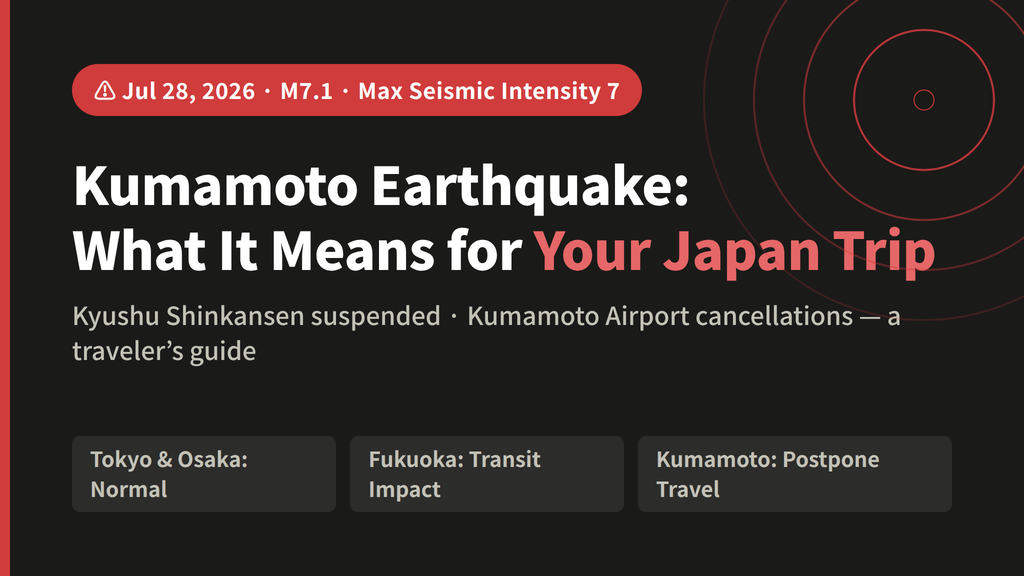
(Updated August 8, 2026) Quick Answer: On July 28, 2026 at 4:27 PM, an M7.1 earthquake with a maximum seismic intensity of shindo 7 struck Kumamoto Prefecture. Still avoid travel to Kumamoto, Aso, and Yatsushiro. The Kyushu Shinkansen is running again between Hakata and Kumamoto (since July 31), and a provisional service resumed between Shin-Minamata and Kagoshima-Chuo on August 7 (6 round trips a day) — but JR Kyushu says the Kumamoto ~ Shin-Minamata section is unlikely to reopen within August. Fukuoka and Nagasaki are fine to visit; Tokyo, Osaka, Kyoto, and Okinawa are unaffected and operating normally. JMA still advises caution for aftershocks of up to around shindo 5-upper — keep monitoring airline and JR Kyushu updates until departure.
This is the strongest quake to hit Kumamoto since the 2016 disaster exactly 10 years ago. The epicenter was located about 14 km south-southeast of Kumamoto City near Uki, with a very shallow hypocenter typical of a shallow inland earthquake. Extreme shaking caused the Aeon Mall Kumamoto explosion and partial collapse, the collapse of a large paper-mill chimney in Yatsushiro, and the stranding of Kyushu Shinkansen passengers.
This guide compiles what international travelers need right now: region-by-region travel viability, transport status, cancellation procedures, and on-the-ground safety essentials. Whether you have a trip booked to Kyushu, a transit connection through the region, or you are considering switching your summer destination, this article walks through regions, transport, safety, and alternative destinations in order.
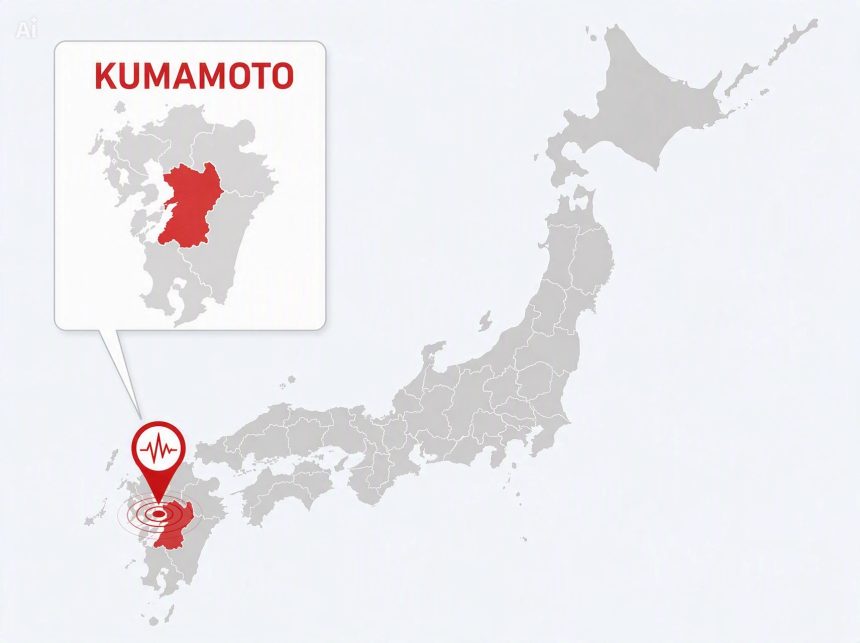
The impact zone is concentrated in central and southern Kyushu (Kumamoto, Yatsushiro, Aso, Amakusa). Fukuoka and points north, Shikoku, Honshu, and Okinawa are unaffected. Fukuoka’s knock-on transit issues have largely eased as rail service resumes, and Tokyo, Osaka, Nagoya, and Sapporo — the mainstays of free travel in Japan — remain fully bookable. If you are pivoting away from Kyushu, start with GO!GO!TOUR Japan rental car search to lock in availability by destination and dates before peak-summer inventory tightens further.
Kumamoto Earthquake at a Glance — Key Facts Table
The core facts, compressed into one table. If you read nothing else, this is enough to make an informed judgment.
| Item | Details | Traveler Note |
|---|---|---|
| Occurred | July 28, 2026 · 16:27 (JST) | Same region as the 2016 Kumamoto earthquake, 10 years on |
| Magnitude / Intensity | M7.1 / max shindo 7 | Highest tier on the JMA seismic scale |
| Epicenter | ~14 km SSE of Kumamoto City, near Uki | Shallow inland quake — severe surface shaking |
| Tsunami | Ariake Sea 1 m advisory → lifted | No tsunami warning in effect now |
| Aeon Mall Kumamoto | Explosion ~30 min after quake → 2nd floor collapse; 7 employees killed | METI: LP gas likely cause (Aug 5) · mall closed indefinitely |
| Human toll | 38 dead incl. suspected disaster-related deaths · 6,794 evacuees (Aug 7) | No injuries to international visitors reported |
| Kyushu Shinkansen | Hakata ~ Kumamoto and West Kyushu running normally; Shin-Minamata ~ Kagoshima-Chuo resumed Aug 7 (6 round trips/day); Kumamoto ~ Shin-Minamata still suspended | Kumamoto ~ Shin-Minamata unlikely to reopen within August (JR Kyushu) |
| Aso Kumamoto Airport | Operating normally — domestic and international flights | Some airport-bus connections still affected; check before travel |
| Power / Water | Power fully restored Aug 1 · water supply targeted for restoration by end of August | Confirm water supply with Kumamoto-area accommodations |
| Aftershock Risk | One-week special alert passed without a repeat shindo-7 event — JMA now advises caution for aftershocks up to around shindo 5-upper (Aug 4) | Aftershock activity is tapering but continuing |
| Tokyo / Osaka / Okinawa | Outside impact zone — fully operational | Honshu and Okinawa trips proceed as planned |
Earthquake Overview — Where, How Big, How Severe
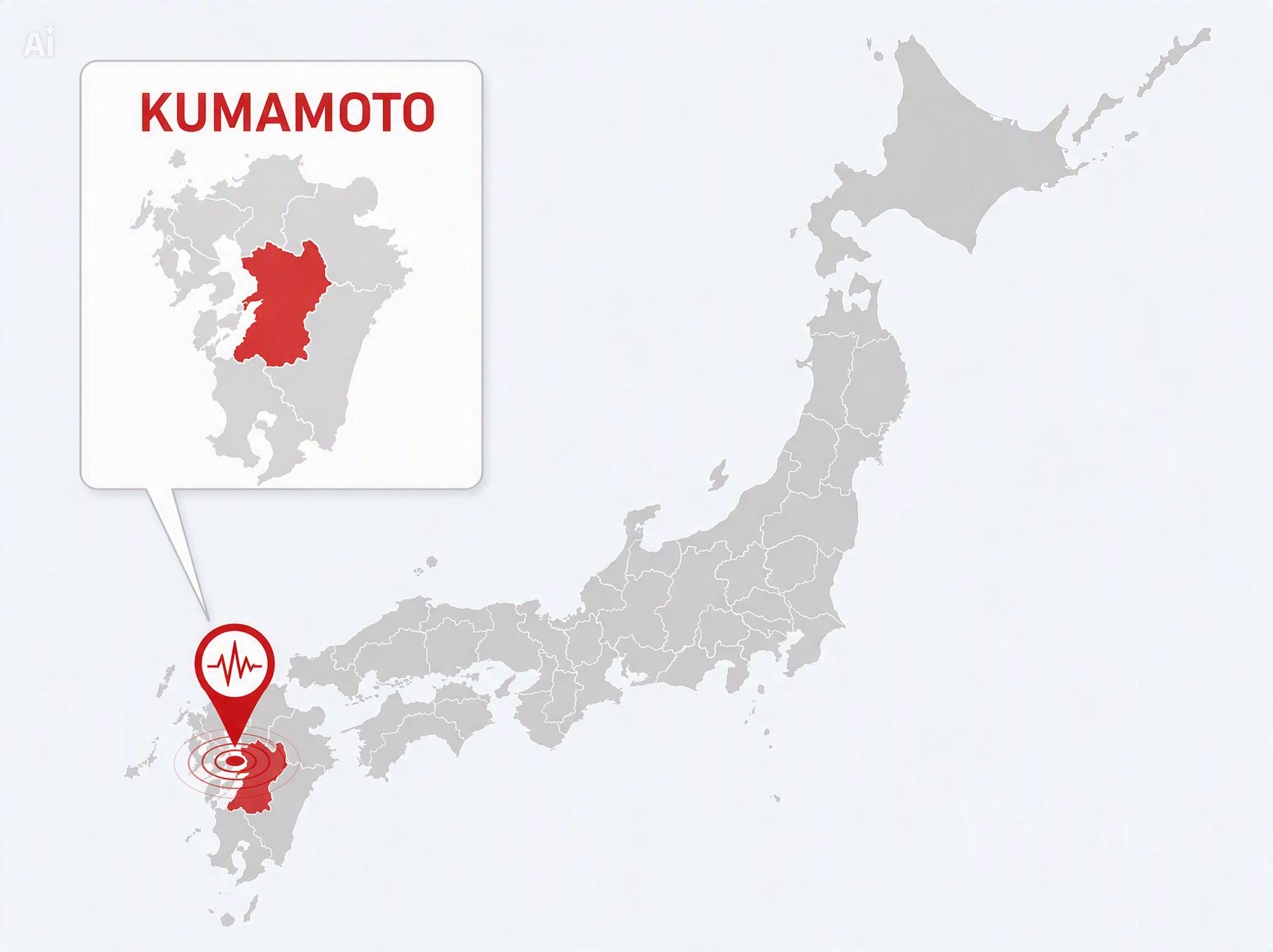
Per Japan Meteorological Agency (JMA) reports, the earthquake occurred at 16:27 on July 28, 2026 in southern Kumamoto Prefecture. Magnitude was M7.1 with a maximum intensity of shindo 7 — the highest level on Japan’s seismic scale. The epicenter was located about 14 km south-southeast of Kumamoto City near the town of Uki, and the very shallow hypocenter made surface shaking severe — a textbook shallow inland earthquake.
A tsunami advisory of up to 1 m along the Ariake Sea coast was issued immediately after the quake and lifted about three hours later. Since then, more than 100 aftershocks of intensity 4 or greater have been recorded. JMA has warned that a similar-magnitude earthquake could occur within one week and designated a special-alert zone. In 2016, the initial Kumamoto quake was followed by an even larger mainshock two days later — a precedent worth taking seriously. Fortunately, no similar-magnitude event occurred during the one-week alert window this time. On August 4, JMA eased its guidance, now asking people to stay alert for aftershocks of up to around shindo 5-upper for roughly another week. Aftershock activity is gradually tapering but has not stopped.
This is the strongest seismic event since the 2024 Noto Peninsula earthquake, approximately 2 years and 7 months ago. For Kyushu specifically, it is the first shindo-7 event since 2016.
Aeon Mall Kumamoto Collapse — What Happened 30 Minutes After the Quake
The most shocking news for travelers is the collapse of Aeon Mall Kumamoto (Kashima Town, Kumamoto Prefecture) — one of the largest general shopping complexes in Kumamoto and a familiar name to international visitors doing Kyushu road trips.
Here is the timeline:
- 16:27 — Kumamoto earthquake strikes; the Aeon Mall building shakes intensely.
- ~16:57 — Approximately 30 minutes after the quake, a loud “boom” is heard as an explosion occurs near the center of the building. Gray smoke and dust plume upward.
- Immediately following the explosion, part of the second floor collapses, with exterior walls falling. Customers and staff still inside are trapped.
- The final toll: 7 tenant-store employees died and 5 were slightly injured — they had initially evacuated but re-entered the building before safety checks were complete.
- On August 5, Japan’s Ministry of Economy, Trade and Industry (METI) announced that LP gas was the likely cause of the explosion, based on a joint on-site investigation with police and fire authorities; the exact leak path is still under investigation.
- Aeon has set up an independent investigation committee of outside experts — lawyers plus disaster-prevention, gas-equipment, and seismic-construction specialists.
Aeon says it “takes seriously” the fact that employees re-entered before safety confirmation was complete, and METI has asked LP-gas operators nationwide to run emergency equipment checks. Post-earthquake gas-line damage is a well-known secondary hazard, and this incident is a stark reminder that “the shaking stopped” does not mean “it’s safe.”
Traveler takeaway — Aeon Mall Kumamoto will be closed for the foreseeable future. If it was part of your Kumamoto shopping or dining itinerary, replan accordingly. While aftershock risk persists, avoid large commercial complexes and underground facilities in the affected region. The fact that the explosion occurred 30+ minutes after the quake is the most important lesson here.
Human and Infrastructure Impact — 38 Dead, Power Fully Restored
As of August 7, 2026:
- Fatalities: 38, including suspected disaster-related deaths (8 at the Yatsushiro paper mill and 7 at Aeon Mall Kumamoto).
- Evacuation centers: 126 shelters with 6,794 people — steadily declining from a peak above 10,000.
- Power outage: fully restored on August 1 (from a peak of roughly 61,800 households down to zero).
- Water outage: emergency restoration ongoing with water trucks in rotation — the government aims to restore running water by the end of August.
- Government response: PM Takaichi has emphasized “push-type” aid delivery, with roughly 4,600 Self-Defense Force personnel deployed for rescue and relief.
No injuries to international visitors have been reported so far. Most summer travelers in Kyushu are based in Fukuoka, Yufuin, or Beppu — well removed from the epicenter — and reports indicate they are safe. That said, Fukuoka and Yufuin still experienced shindo 4–5 shaking, and travelers unfamiliar with earthquakes have reported significant emotional impact.
Kyushu Shinkansen Status — Must-Know Transit Info for Travelers
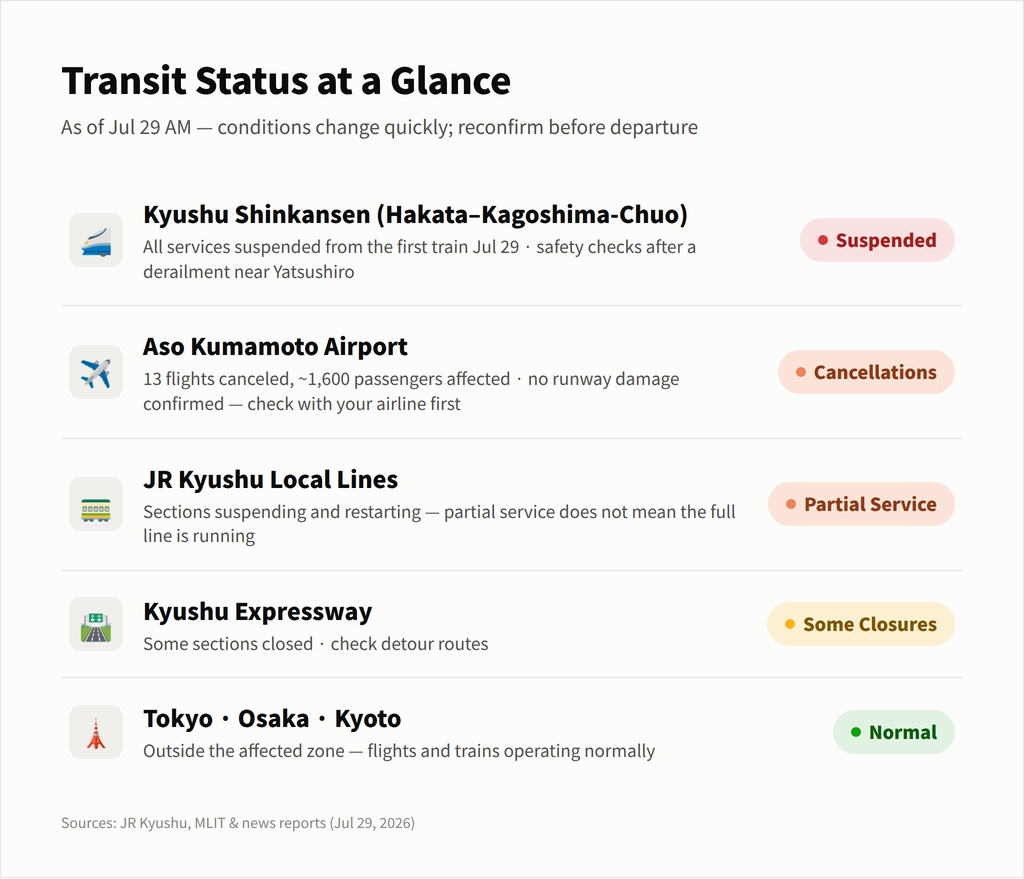
The Kyushu Shinkansen was fully suspended immediately after the quake, but service has been coming back section by section. JR Kyushu’s status summary:
| Line | Section | Status as of August 8 |
|---|---|---|
| Kyushu Shinkansen | Hakata ~ Kumamoto | Resumed July 31 · normal service |
| Kyushu Shinkansen | Kumamoto ~ Shin-Minamata | Still suspended — JR Kyushu says reopening within August is unlikely; a date will be announced during August |
| Kyushu Shinkansen | Shin-Minamata ~ Kagoshima-Chuo | Resumed August 7 on a provisional timetable through August 16 — 6 round trips/day (Tsubame), stopping only at Shin-Minamata, Izumi, Sendai, and Kagoshima-Chuo; non-reserved seating except the Green Car |
| West Kyushu Shinkansen | Takeo-Onsen ~ Nagasaki | Resumed around 19:00 on July 28 after safety checks |
| Sanyo Shinkansen | Shin-Osaka ~ Hakata | Normal service (outside impact zone) |
| Conventional lines | 17 lines across 9 operators in Kyushu | North of Kumamoto running again (some reduced schedules) · Kagoshima Line Kumamoto~Uto and the Misumi Line resumed August 2; Uto~Yatsushiro still suspended. Hisatsu Orange Railway: Sendai~Minamata resumed August 5, Yatsushiro~Minamata suspended (substitute buses from around August 10) |
A key incident is the passenger-stranding event. At the moment of the quake, four Kyushu Shinkansen trains were in operation, and one stopped between Shin-Yatsushiro and Shin-Minamata with approximately 180 passengers on board; a derailment also occurred near Yatsushiro. All passengers were safely evacuated, but track damage in the Kumamoto ~ Shin-Minamata section — including rail fractures — was severe, which is why JR Kyushu says that section is unlikely to reopen within August.
Traveler tip — Hakata → Kumamoto is now possible by Shinkansen, but the classic Kyushu north-to-south route (Hakata → Kumamoto → Kagoshima) is still broken at the Kumamoto ~ Shin-Minamata gap. Kagoshima is best reached by direct flight (or via the very limited Shin-Minamata provisional service). Otherwise, base your trip on Fukuoka and Nagasaki, or pivot east via the Sanyo Shinkansen toward Hiroshima, Osaka, and Kyoto. From Fukuoka westward to Nagasaki, the West Kyushu Shinkansen is running normally.
Airport and Highway Status — Aso Kumamoto Airport Operating Normally, Kyushu Expressway Fully Open by Late August
Aso Kumamoto Airport temporarily closed its runway after the quake, but it is now back to normal operations on both domestic and international flights (Amakusa Airport is also operating normally). ANA is running temporary extra flights on the Fukuoka–Kagoshima and Fukuoka–Miyazaki routes to help cover the Shinkansen gap. Some airport-bus and long-distance bus routes are still suspended or reduced, so check the airport’s official site before you travel.
Highway status is worse:
- Kyushu Expressway — The Mashiki-Kumamoto Airport IC to Matsubase IC section has reopened. The Matsubase IC ~ Ebino IC section remains closed due to bridge and road-surface damage, with reopening expected in late August (NEXCO West).
- Minami-Kyushu / Kyushu-Chuo Expressways — Sections including Yatsushiro JCT–Hinagu IC and Kashima JCT–Mashiki tollgate remain closed.
- National routes — Ground subsidence and rockfall sections scattered throughout. Voluntary avoidance recommended toward Kumamoto and Aso.
If you planned a Kyushu road trip, a realistic pivot is to focus on Fukuoka and Nagasaki — the northwestern Kyushu region. Avoid entering the Kumamoto, Aso, Yatsushiro, and Amakusa areas.
Region-by-Region Travel Judgment — Where to Go, Where to Avoid
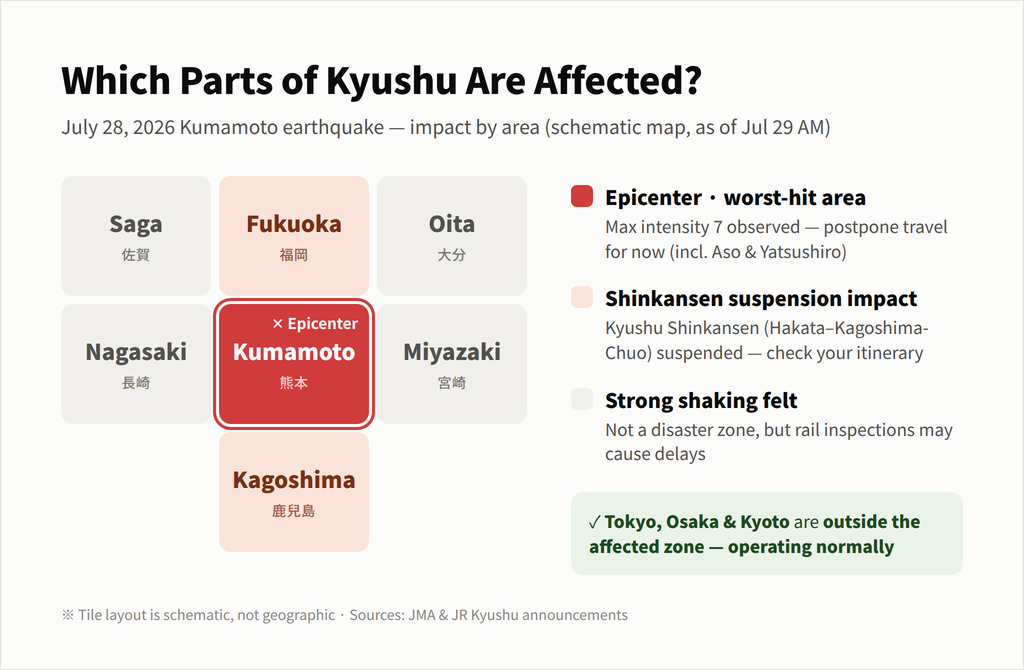
The most common question — “Is it safe to travel to Japan right now?” — answered region by region.
| Region | Current Status | Travel Verdict |
|---|---|---|
| Kumamoto / Aso / Yatsushiro | Disaster zone, aftershock and secondary hazard risk | Avoid · cancel or postpone |
| Fukuoka / Kitakyushu | No direct damage, some Shinkansen and rail knock-on | OK but rework transit plans |
| Nagasaki / Saga | West Kyushu Shinkansen resumed, normal operation | OK · Hakata transit fine |
| Oita (Beppu / Yufuin) | Some conventional-line delays, onsen and lodging normal | OK but verify transit |
| Kagoshima / Miyazaki | Shin-Minamata ~ Kagoshima-Chuo provisional service (6 round trips/day) has slightly improved rail access | Flying direct is still the most reliable option |
| Tokyo / Osaka / Kyoto | Outside impact zone · fully normal | Travel as planned |
| Okinawa | No impact · international flights operating normally | Travel as planned (safe alternative) |
Bottom line: if Kumamoto or Aso was your destination, cancel or postpone. Other Kyushu regions (Fukuoka, Nagasaki, Yufuin) are viable with rework. Tokyo, Osaka, and Okinawa proceed as planned. Since peak summer season means tight availability for pivots, decide sooner rather than later.
Cancellation and Rebooking — Airlines, Accommodations, Tour Operators
During large-scale disasters in Japan, airlines and lodging providers typically operate fee-waived cancellation and change policies. Confirm the latest terms with each provider:
- Airlines flying into Aso Kumamoto Airport — Most major carriers (Korean Air, JAL, ANA, low-cost carriers) are rolling out fee-waivers. Check the airline’s official “Emergency Notice” banner for the fastest information.
- Fukuoka-bound flights — Outside the impact zone, so generally operating normally. Personal-reason cancellations follow standard rules.
- Accommodations (hotels, ryokans, Airbnb) — Disaster-relief exceptions are common but vary by property — contact them directly. Also check booking-platform (Booking.com, Agoda, Rakuten Travel) emergency notices.
- Package tour operators — Most major operators have announced Kyushu-tour cancellation and refund exceptions. Confirm case-by-case with customer support.
- Travel insurance — Verify whether your policy covers flight cancellation, itinerary changes, and natural-disaster exclusions. If purchasing a new policy, mind the effective-date rules.
Practical tip — When requesting a cancellation or change, explicitly cite the “earthquake disaster-relief policy” and keep records (call recordings, email screenshots). These will be decisive if refund disputes arise.
If an Earthquake Hits During Your Trip — 5 Field-Tested Rules
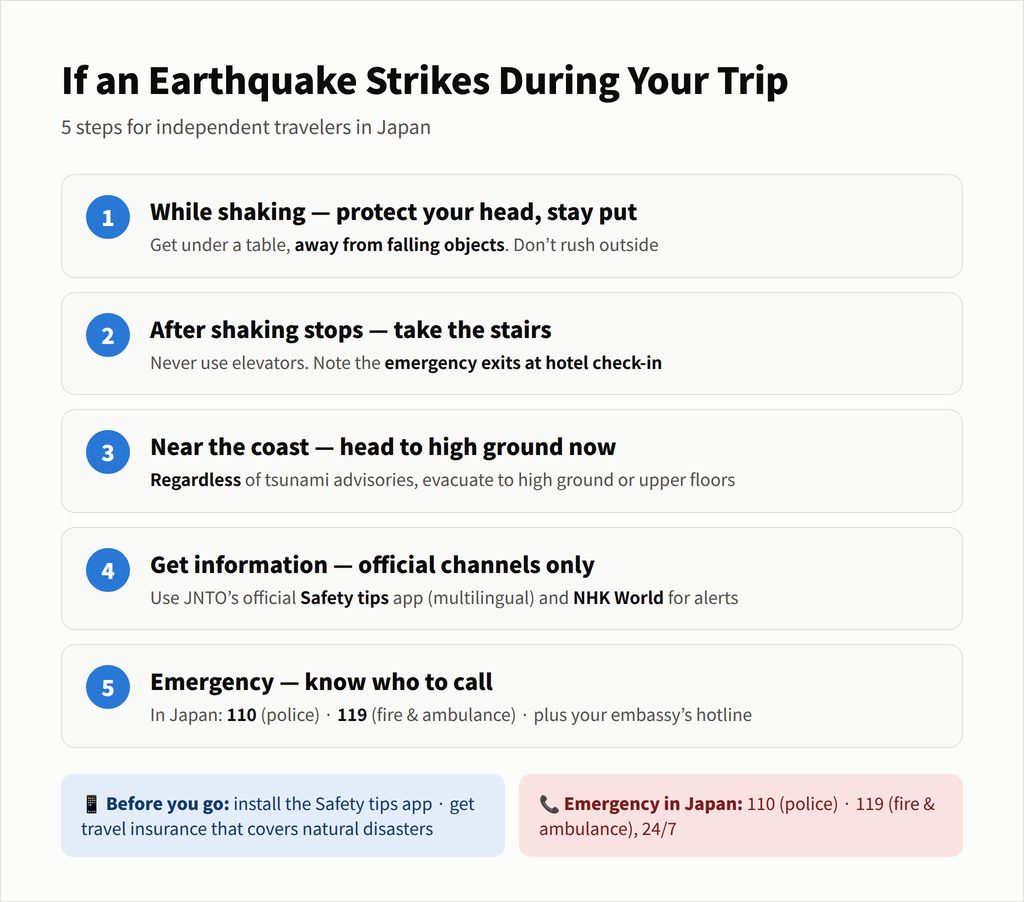
The fact that the Aeon Mall explosion occurred 30 minutes after the quake is instructive: “the shaking stopped” is not the same as “it’s over.” Remember these five rules.
- During shaking — protect your head. Take cover under a table or desk, away from anything that can fall. Avoid glass windows and signage. “Running outside” is more dangerous (falling exterior walls, glass).
- After shaking stops — move carefully. Large commercial complexes and underground facilities carry gas leak and secondary explosion risk — exit quickly. Never use elevators; take stairs.
- If near the coast — head to high ground immediately, regardless of tsunami advisories. Do not wait for confirmation. Aim for at least 10 m above sea level.
- At hotels or ryokans — verify emergency exit locations at check-in. Look at the evacuation map behind your room door on day one. Keep slippers and a flashlight bedside.
- Aftershock preparedness — stay alert for 24–72 hours. Aftershocks continue after major quakes, so minimize entry into vulnerable buildings, mountain hikes, and coastal exposure. Especially while JMA continues to advise caution about aftershocks.
Essential Info and Apps — Earthquake Traveler Checklist
Having reliable channels for real-time disaster info makes a significant psychological difference during travel in Japan. At minimum, prepare these:
- Safety tips (official Japan Tourism Agency app, English + 14 languages) — Real-time push notifications for earthquake, tsunami, and heavy-rain warnings. Free on Google Play and App Store.
- NHK World Japan (app · YouTube Live) — 24-hour English streaming of disaster coverage. The fastest way to get official announcements accurately.
- Japan Meteorological Agency (JMA) — jma.go.jp — Original source for earthquake, tsunami, and volcano information (English version available).
- Japan Visitor Hotline — 050-3816-2787 · 24/7 · English, Chinese, Korean support. First point of contact for tourism-related emergencies.
- Your country’s embassy or consulate in Japan — Register with your embassy’s traveler-notification program (e.g. US STEP, UK Locate) before departure.
- Photo copies of passport and travel insurance certificate — Save to cloud storage. Critical if physical copies are lost.
If you are traveling anywhere in Kyushu, install Safety tips right now and reconfirm your travel insurance’s “natural disaster” coverage.
If you don’t yet have travel insurance in place, check GO!GO!TOUR travel insurance coupon guide for discounted policies that include earthquake and natural-disaster coverage. Verify your policy status before departure.
Free Travel in Japan — Regions and Routes Unaffected by the Quake
The most common follow-up question from travelers canceling or postponing Kyushu trips is: “Where should I go instead?” Below are impact-free regions that remain excellent options for peak-summer free travel in Japan.
| Region | Why | Practical Note |
|---|---|---|
| Tokyo and surrounding | Fully normal · Shinkansen and airports unaffected | Disney, Mt. Fuji, Hakone, Nikko all accessible |
| Osaka / Kyoto / Nara | Fully normal · Sanyo Shinkansen operating | USJ, Osaka Castle, Kiyomizu-dera all normal |
| Nagoya / Chubu | Fully normal · Tokaido Shinkansen operating | Legoland, Shirakawa-go, Ise Shrine easily reached |
| Hokkaido (Sapporo / Otaru) | No impact · international flights normal | Peak lavender season in Furano and Biei |
| Okinawa main island | No impact · 700+ km southwest of the epicenter | Peak marine activity and diving season |
Geographically separated from the earthquake, these regions offer travel alternatives with no compromise on safety. When reallocating your canceled Kyushu ticket, use “which alternative preserves the vibe of my planned trip” as the selection criterion: cities and shopping → Tokyo or Osaka; nature and cool weather → Hokkaido; sea and marine activities → Okinawa.
Free travel in Japan gains enormously from cross-region rental car use. City interiors are easy by train, but day trips (Tokyo → Hakone/Nikko, Osaka → Nara/Wakayama, Sapporo → Furano/Biei, Naha → northern Okinawa and Churaumi) work vastly better with a car. Browse Japan rental cars by region on GO!GO!TOUR and lock in your vehicle alongside your rebooked flights.
Wrap-Up — Postpone Uncertain Trips, Pivot Toward Safe Destinations
The M7.1 Kumamoto earthquake is a major disruption to peak-summer Japan travel, but the impact is concentrated in central and southern Kyushu — everywhere else remains normal. What travelers need now is calm judgment based on accurate information, not blanket cancellation or reckless persistence.
The essentials, one more time:
- Kumamoto / Aso / Yatsushiro — Avoid, cancel or postpone · keep watching aftershock and recovery updates
- Fukuoka / Nagasaki / Oita — Travel possible; Hakata ~ Kumamoto and West Kyushu Shinkansen normal, but Kumamoto ~ Shin-Minamata unlikely to reopen within August · check JR Kyushu updates
- Tokyo / Osaka / Nagoya / Hokkaido / Okinawa — Free travel in Japan proceeds as planned
- Apps and contacts — Safety tips, Japan Visitor Hotline (050-3816-2787), reconfirm travel insurance
- On-the-ground — Avoid large commercial and underground facilities for 30 min after shaking; stay alert for aftershocks 24–72 hours
If you cancel your Kyushu plans, Tokyo, Osaka, Nagoya, Hokkaido, and Okinawa are all practical free-travel alternatives. When rebooking flights, plan rental cars and ground transport at the same time — that’s the peak-season success tip.
Japan Free Travel Rental Car — Search by Region and Dates
- Japan rental car search on GO!GO!TOUR — Compare and book by region, vehicle class, and dates in one place.
Quake-Free Alternative Regions
- Tokyo and surrounding — Disney, Mt. Fuji, Hakone, Nikko summer day-trip routes
- Osaka / Kyoto / Nara — USJ, Osaka Castle, Kiyomizu-dera; Sanyo Shinkansen normal
- Nagoya / Chubu — Legoland, Shirakawa-go, Ise Shrine; Tokaido Shinkansen normal
- Hokkaido (Sapporo / Otaru) — Peak lavender season in Furano and Biei
- Okinawa main island — Churaumi Aquarium, marine activities; entirely unaffected
Japan Free Travel — Pre-Departure Checklist
- Travel insurance with “earthquake / natural disaster” coverage — coupon guide — essential check before departure
- Install Safety tips (English) and NHK World apps
- Save Japan Visitor Hotline 050-3816-2787 to favorites
- Passport photocopy and emergency contacts saved to cloud
With aftershocks continuing, keep checking your government’s travel advisory site, airline emergency notices, and JR Kyushu updates until the moment you depart. On the ground, follow Japanese authorities’ evacuation guidance. Traveler safety is always the top priority.