One eSIM, 109 Countries: The Worldwide Travel Connectivity Guide for 2026
You used to need a different SIM for every country. A Japanese SIM for Tokyo, a Thai SIM for Bangkok, a U.S. carrier add-on for Hawaii. Each one a separate purchase, a separate activation, a separate piece of plastic to keep track of — and each one with its own surprise fees. A single worldwide eSIM changes all of that.
In 2026, there is a much simpler answer: one worldwide eSIM that follows you around the globe. GO!GO!TOUR eSIM covers 109 countries — from a weekend in Seoul to a month backpacking through Southeast Asia to a beach week in Hawaii — using the same brand, the same app-free install, and the same friendly 365-day support team.
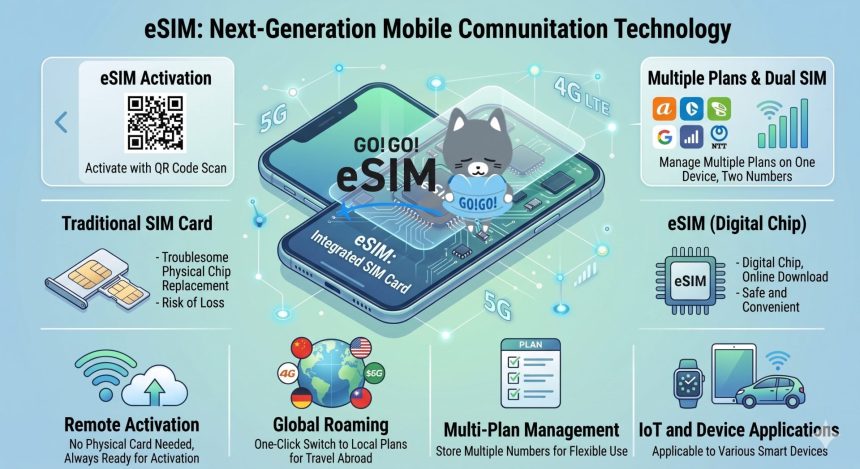
Worldwide eSIM in One Picture — How It Actually Works
If you’ve never used an eSIM before, the diagram above sums up the whole idea in one frame. Eight things to take away from it:
- QR-code activation — scan the code in the email we send, and the eSIM installs itself onto your phone. No SIM card to mail. No counter to visit.
- Digital chip, not a physical one — your phone already has an “eSIM” chip built in (every iPhone XS or newer, Galaxy S20+, Pixel 4+). The profile is downloaded onto it.
- Dual SIM — your home SIM keeps your home number active; the eSIM handles data abroad. You can run both at the same time.
- Multiple plans on one device — store several country plans on the same phone and switch between them with one tap.
- Remote activation — buy and install from anywhere with internet. Activate only when you land.
- Global roaming — one provider, 109 countries, no per-country SIM hunt.
- No more lost SIM cards — nothing to drop, nothing to swap in a public bathroom at the airport.
- Same tech your smartwatch and connected car use — eSIM isn’t a travel gimmick, it’s the same standard already powering Apple Watch, Pixel Watch, and the latest BMW / Tesla connected cars.
That’s the entire concept. The rest of this guide is just which plan, how much, how to set it up, and what it looks like in real travel.

iPhone, Android, old or new — if your phone supports a worldwide eSIM (most do, from 2018 onward), you can be online in any of those 109 countries within minutes of landing. No counter queues, no pocket WiFi rentals, no fumbling with a SIM ejector tool over the airplane tray table.
Why a Worldwide eSIM Beats Every Other Option
If you travel internationally more than once a year, the math is brutal. Roaming on your home carrier can cost USD 10–15 per day. Pocket WiFi rentals add up to USD 40–60 per week, plus the hassle of carrying and charging a second device. Buying a fresh physical SIM in every country means lost SIM cards, lost home numbers, and frantic vending-machine purchases at midnight.
| Option | Home carrier roaming | Pocket WiFi rental | Local physical SIM | GO!GO!TOUR eSIM |
|---|---|---|---|---|
| Cost (5 days) | USD 50–75 | USD 35–50 | USD 15–25 per country | From JPY 1,980 (~USD 13) |
| Setup before flight | Call your carrier | Reserve & pick up | Vending machine on arrival | QR scan from home |
| Works across borders | Yes (extra fees) | Per-country rental | One country only | 109 countries, one plan tier |
| Extra device to carry | No | Yes (router) | No | No |
| Home number stays active | Yes | Yes | SIM swap required | Yes (dual-SIM) |
| App install required | No | No | No | No |
The eSIM column wins on almost every row. The one place it loses — sharing with a group of four — is solved by everyone in the group buying their own eSIM, which still works out cheaper than one pocket WiFi rental for the whole trip.

That little SIM tray and ejector pin in the photo above? With an eSIM, you never touch them again. No risk of dropping a SIM down an airport seat crack. No bag pocket dedicated to “my home SIM, somewhere safe.” One profile installed digitally — done.
109 Countries Covered by Your Worldwide eSIM
GO!GO!TOUR eSIM doesn’t just cover a handful of popular tourist destinations — it spans 109 countries across every continent. Here is a flavor of what travelers reach for most often:
| Region | Popular destinations | Typical use case |
|---|---|---|
| East Asia | Japan, Korea, Taiwan, Hong Kong | City tourism, food trips, Shinkansen / KTX |
| Southeast Asia | Thailand, Vietnam, Singapore, Indonesia, Philippines | Beach getaways, backpacker circuits |
| U.S. & Pacific | Hawaii, U.S. mainland, Guam, Saipan | Honeymoons, family vacations |
| Europe | UK, France, Italy, Spain, Germany, Netherlands | Multi-country rail trips |
| Oceania | Australia, New Zealand | Road trips, working holidays |
| Multi-country roaming | Asia roaming, Europe roaming, Global | One plan crossing borders without re-buying |
The starting daily price across most regions is JPY 80 per day — about USD 0.55, less than a vending-machine coffee. Plans scale up by data volume (1 GB / 3 GB / 5 GB / 10 GB / unlimited) and duration (1, 3, 5, 7, 10, 15, 30 days). Pick the combination that matches your trip, and you are done.
Why GO!GO!TOUR eSIM Stands Out from Competitors
The eSIM market is crowded — Airalo, Holafly, Nomad, Ubigi, and dozens of regional players all want your money. After running the numbers across multiple trips, here is why GO!GO!TOUR eSIM earns the recommendation:
- Best-in-class pricing. Side-by-side test: Japan 5 GB / 5 days at JPY 1,980, versus Competitor A’s JPY 2,060 and Competitor B’s JPY 2,210. Same data, same speed tier, lower price.
- No companion app required. Some big-name competitors force you to install and stay logged into a dedicated app for the eSIM to function. GO!GO!TOUR eSIM installs as a native system profile — your phone treats it like any other carrier line.
- 5G / 4G LTE quality. Same partner networks as the major players. Real-world speedtests in Tokyo, Seoul, and Bangkok routinely clear 80–150 Mbps down.
- Multi-channel support, 365 days a year. Phone, chat, and email — none of this “office hours” nonsense. If your eSIM hiccups at 2 AM Vietnam time, someone is there.
- True multi-language brand. The site and support run in English, Japanese, Korean, Traditional Chinese, and Thai — so you get help in whatever language you’re most comfortable in.
- Zero hidden fees. Checkout price = final price. No admin charge, no SIM swap fee, no return shipping, no auto-renewal trap.
Will My Phone Work? Device Compatibility
The single most important pre-purchase check: does your phone actually support eSIM? The good news is that almost every flagship released since 2018 does.
| Brand | eSIM-compatible models |
|---|---|
| Apple | iPhone XS / XR and newer (XS, 11, 12, 13, 14, 15, 16, SE 2nd/3rd gen). U.S. iPhone 14/15/16 are eSIM-only. |
| Samsung Galaxy | S20, S21, S22, S23, S24 series. Note 20. Fold 2 and up. Flip 3 and up. |
| Google Pixel | Pixel 4 and newer (4, 4a 5G, 5, 6, 7, 8, 9 series). |
| Others | Recent flagships from Sony Xperia, Oppo Find, Huawei P series (region-dependent), Honor Magic, etc. |
Quick check on iPhone: Settings → General → About → scroll to “Available SIM” or “EID.” If you see an EID number, you’re good. On Android: Settings → About phone → IMEI → look for “IMEI (eSIM).”
Also confirm your phone is carrier-unlocked. If you bought it on a U.S. carrier contract, it may be locked to that carrier and reject foreign eSIMs. Most newer phones unlock automatically once you finish paying for them — your carrier can confirm.
Setting Up Your Worldwide eSIM — 4 Steps, Under 10 Minutes
The whole process runs through your phone’s built-in settings. No app, no SIM tray gymnastics, no calling a carrier hotline.
- Verify device compatibility (see the table above).
- Buy your plan at en.gogo-tour.com/esim/. Within minutes, an email with your QR code and instructions lands in your inbox.
- Scan the QR code from a desktop or second device.
iPhone: Settings → Cellular → Add eSIM → Use QR Code.
Android: Settings → Network & Internet → SIMs → Add eSIM.
The profile installs in about 60 seconds. Label it something obvious like “Travel.” - Activate on arrival. When you land, switch the new line to your primary “Cellular Data” line and enable data roaming for it. Your home SIM stays active for calls and SMS — you don’t lose your phone number.
Pro tip: install before you fly, activate after you land. That way you arrive ready to go, but you don’t burn data while still on home WiFi.
Which Worldwide eSIM Plan Should You Choose?
Pick by trip length and how heavy a data user you are:
| Trip length | Light use (maps + chat) |
Average tourist (maps + social + photos) |
Heavy user (video + work) |
|---|---|---|---|
| 3 days | 1 GB | 3 GB | 5 GB |
| 5 days | 3 GB | 5 GB | 10 GB |
| 7 days | 5 GB | 10 GB | 15 GB |
| 10–14 days | 10 GB | 15 GB | 20 GB+ |
| Multi-country (2+) | Pick the regional or Asia roaming plan rather than per-country plans | ||
Running out mid-trip isn’t a disaster — you can top up with another plan from the same dashboard — but it’s cleaner to buy a tier above your guess. The price difference is rarely more than a single restaurant meal.
A Day in Japan — Why You’ll Be Glad You Have Data
The best way to understand what an eSIM really gives you is to picture a single travel day. Here is one — set in Okinawa, but the same beats apply anywhere in the 109-country list.

Morning. You step out of your hotel into a wide boulevard like this one in Naha. Google Maps tells you the nearest monorail station, real-time train times, and walking directions. None of that works on hotel-WiFi alone.

Mid-morning. You pass a beautiful new building — modern lines, Okinawan red-tile accents. A quick reverse-image search tells you it’s a craft and cultural complex, opens at 11, free entry. You add it to your day’s pin list.

Stumbling into a hidden shop. Down a side street you find a tiny store with traditional red Ryukyu roof tiles and a shisa guardian on the eaves. The sign is hand-painted in Japanese — but Google Translate’s camera mode tells you in a second that this is a 50-year-old miso and pickle shop, and the reviews say their cucumber tsukemono is legendary. You buy two.

Lunchtime hunt. The market down the road has trays of fresh reef fish on ice — red snapper, parrotfish, every color in the Okinawan sea. The fishmonger offers to send your pick upstairs to be cooked. You look up the upstairs restaurant on Tabelog (3.7 stars), check the menu translation, and head up.

Twenty minutes later, your fish arrives — whole, sizzling in a cast-iron skillet with a clear broth, garnished with a slice of lemon. You snap a photo for Instagram, post directly, no buffering. The kind of moment that defines a trip.

Dinner planning. Late afternoon, you start looking at sashimi spots for dinner. Real-time review photos like this one — fat slices of salmon and tuna on shiso leaves, a perfect mound of fresh wasabi — make the decision for you. Reservation booked through the restaurant’s online form. Done.

Late-night izakaya detour. On the walk back you spot a side-street izakaya stacked with bacon-wrapped skewers — bacon and asparagus, bacon and tomato, bacon and quail egg. No English menu, no problem. Translate, point, order, eat. Three drinks in, you ask Google Maps for the fastest way back to your hotel and it routes you through a quieter street you’d have never found on your own.

Tomorrow’s plan. Back at the hotel, you scroll a food blog about the best Okinawan soba in town — pork belly, fish cake, beni-shoga ginger. Tomorrow’s lunch sorted. You set a reminder in Google Maps and fall asleep.
Every single one of those moments — finding the building, translating the sign, picking the restaurant, posting the photo, getting home — would have been clunky or impossible without reliable data in your pocket. That is what an eSIM gives you. Not just connectivity — agency.
Where You’ll Use It — Real Scenarios Across Borders
The “worldwide” part isn’t marketing fluff. Here are situations where having one eSIM across multiple countries saves your day:
Japan → Korea, same trip. Many travelers pair Tokyo with a weekend in Seoul. Instead of buying two separate plans, grab the Asia roaming plan and your data follows you across the Korea Strait without re-buying anything.
Bangkok layover. A 14-hour layover at Suvarnabhumi turns into an actual city day-trip — but only if you can grab Grab, translate menus, and check museum hours from the moment you exit the gate. eSIM on, plane on the tarmac, problem solved.
Hawaii beach week. Your home U.S. plan probably already covers Hawaii, but tourist traffic at the big resorts crushes coverage. A Hawaii eSIM on a different partner network often gives faster, less congested data — and you keep your home plan untouched for the rest of the year.
Europe rail trip. Vienna → Prague → Berlin in five days? A single Europe roaming plan beats juggling Austrian, Czech, and German SIMs. Train Wi-Fi is unreliable; your eSIM isn’t.
Family group, shared trip. Mom, dad, two kids each on their own eSIM is still cheaper — and lets each person navigate independently — than renting one pocket WiFi the whole group has to stay near.
Surprise extension. Decided to tack on three more days at the end of the trip? Top up another plan from your phone’s browser in 60 seconds. No counter visit, no shipping address.
Top FAQs Before You Buy
Can I keep my home phone number active?
Yes. eSIM runs as a second line alongside your physical SIM (or another eSIM, on dual-eSIM phones). Calls and SMS to your home number keep arriving; data routes through GO!GO!TOUR eSIM.
Do I get a local phone number for receiving SMS / calls?
No — GO!GO!TOUR eSIM is a data-only product. For two-factor authentication, restaurant reservations, or hotel callbacks, use your home number, WhatsApp, LINE, or KakaoTalk.
Does it support hotspot / tethering?
Tethering support depends on the specific plan. Check the plan detail page or contact GO!GO!TOUR eSIM support before purchase if you need to share data with a laptop or second device.
What if my eSIM doesn’t activate?
Don’t delete the profile. Once deleted, the same QR code usually can’t be reinstalled. Instead, contact GO!GO!TOUR eSIM via chat or email — they can troubleshoot or reissue.
Does the validity start at purchase or first use?
At first activation on a supported network. So you can buy a 5-day plan a week before your trip and only “start” it when you land.
What happens after the plan expires?
Data stops, but the eSIM profile stays on your phone. You can top up with another plan against the same profile, or remove it and reinstall a new one later. No auto-renewal, no penalties.
Can one eSIM cover several family members?
No — each person needs their own eSIM on their own phone. But you can buy multiple plans under one order, get multiple QR codes, and distribute them.
Pairing Your eSIM with the Rest of the Trip
An eSIM is the cheapest brick in your travel stack, but it makes every other brick work better. Our usual recommendation for travelers heading to Japan (and especially Okinawa, where we’re based):
- eSIM — install before you fly, activate on landing
- Rental car — pre-book to skip the counter chaos. Our Okinawa rental car booking includes English-speaking support, English navigation, and airport pickup
- Marine activities — reserve snorkeling, diving, or SUP slots on our activity booking page — popular dates fill up months ahead in summer
- Restaurant & spot guides — our Okinawa travel info site covers izakayas, beaches, hidden lookouts, and seasonal events from our writers on the ground
That’s the entire toolkit. Phone, wheels, water, and food — all bookable from one brand, all backed by English support.
Quick Pre-Trip Checklist
- ✅ Confirm your phone supports eSIM and is carrier-unlocked
- ✅ Buy your GO!GO!TOUR eSIM plan at least 24 hours before departure
- ✅ Install the eSIM profile on home WiFi (label it “Travel,” don’t delete)
- ✅ Save the activation email — you may need the QR again if you reset your phone
- ✅ Land, switch data to your travel line, switch home line to “voice only”
- ✅ For multi-country trips, choose a regional plan rather than per-country plans
Wrapping Up — Your Worldwide eSIM for Every Border
The world is large, but your connection plan doesn’t have to be complicated. With one GO!GO!TOUR worldwide eSIM account you can land in 109 countries — Tokyo, Seoul, Bangkok, Honolulu, Rome, Sydney — and be online before baggage claim. From JPY 80 per day for the entry tier and JPY 1,980 for a standard 5 GB / 5-day plan, it’s the smallest line item in your travel budget and arguably the highest-leverage.
Install before you fly. Activate when you land. Stop worrying about connectivity and start enjoying the trip.

Plan the Whole Trip with GO!GO!TOUR
From the data on your phone to the wheels on the road and the boat you climb aboard — GO!GO!TOUR handles the lot, in English, for travelers heading anywhere from Okinawa to the other side of the planet.
- 📱 GO!GO!TOUR eSIM — 109 countries, plans from JPY 80/day, QR install, no app required
- 🚗 Okinawa Rental Car — English navigation, airport pickup, full English support
- 🐠 Okinawa Marine Activities — snorkeling, diving, SUP, parasailing booked in minutes
- 🍴 Okinawa Travel Guides — restaurant deep-dives and spot reviews from our writers on the ground
One brand, one site, the whole trip sorted — wherever in the world you’re headed.