Fushimi Inari Taisha — Endless Vermilion Torii Climbing a Sacred Mountain, Free and Open 24 Hours
If Kyoto had to be represented by a single scene, it would probably be the vermilion torii tunnel at Fushimi Inari Taisha (伏見稲荷大社). The bright red gates climbing the wooded slope of Mount Inari, thousands of them, in that iconic corridor called Senbon Torii (“Thousand Vermilion Torii”) — it’s the image that leads almost every travel article about Japan. It’s also the most photogenic shrine in Kyoto, and one of the best-kept secrets is that it’s completely free and open 24 hours a day.
Unlike Kiyomizu-dera or Kinkaku-ji with their gates and opening hours, Fushimi Inari can be visited at 5 AM or 10 PM. That single fact changes everything about how you plan the visit. This English guide covers admission and access, the story of the 711 CE founding by the Hata clan, why foxes are the shrine’s symbol, the walking route through the torii tunnel, the Okusha Hohaisho and the Omokaru Ishi weight-lifting oracle, the full Mount Inari hike, and how to pair Fushimi Inari with the rest of Kyoto in one smart day. First-person, no brochure spin.
👉 Planning to see Kyoto plus Osaka, Nara, or Kobe in the same trip? A rental car makes the whole Kansai region one connected day. GO!GO!TOUR Kansai rental car offers English support and pickup near the main JR terminals.
Quick Facts at a Glance
| Item | Details |
|---|---|
| Official name | 伏見稲荷大社 (Fushimi Inari Taisha) |
| Location | 京都府京都市伏見区深草藪之内町68 (Fushimi Ward, Kyoto) |
| Main deity | Uka-no-Mitama-no-Okami and 4 associated deities — collectively “Inari Okami” |
| Founded | 711 CE (Nara period) — established by the Hata clan (a family of continental immigrants) |
| Rank | Head shrine of ~30,000 Inari shrines across Japan |
| Admission | Free — no ticket, no gate |
| Opening hours | Open 24 hours — walk the torii anytime (amulet counter is 8:30 – 16:30) |
| Recommended time | 60 – 90 minutes for main hall + Okusha / 2 – 3 hours for the full mountain hike |
| Access | JR Nara Line “Inari” Station — walk out of the ticket gate directly to the shrine entrance |
A Shrine Founded in 711 CE by an Immigrant Clan
The story of Fushimi Inari Taisha begins in the early Nara period, 711 CE. Hata no Iroguchi, a member of the influential Hata clan (descendants of continental immigrants from the Korean peninsula), fired an arrow at a mochi rice cake for target practice. According to legend, the mochi transformed into a white bird and flew to the peak of Mount Inari, where rice began to grow spontaneously. The name “Inari” comes from the Japanese phrase “ine ga naru” — “rice grows”.
The main deity Uka-no-Mitama-no-Okami was originally worshipped as the god of rice and food. Over centuries, the domain of blessings expanded: from agriculture to commerce, industry, and business prosperity. By the Edo period, merchants and craftsmen across Japan had adopted Inari worship, which is why today roughly 30,000 Inari shrines exist across Japan. Fushimi Inari Taisha, as the head shrine of them all, draws over 2.5 million worshippers during the New Year period each year — one of the highest counts of any shrine in Japan.
The approach street leading up to the shrine is packed with fox-themed everything: fox masks, fox-face ice cream cups, fox omamori (amulets), fox-shaped rice crackers. Foxes are not the deity of Inari themselves — they’re the deity’s messengers — but this cultural saturation on the approach street is a big part of the Fushimi Inari experience.
How to Get to Fushimi Inari — Zero-Minute Walk from the JR Station
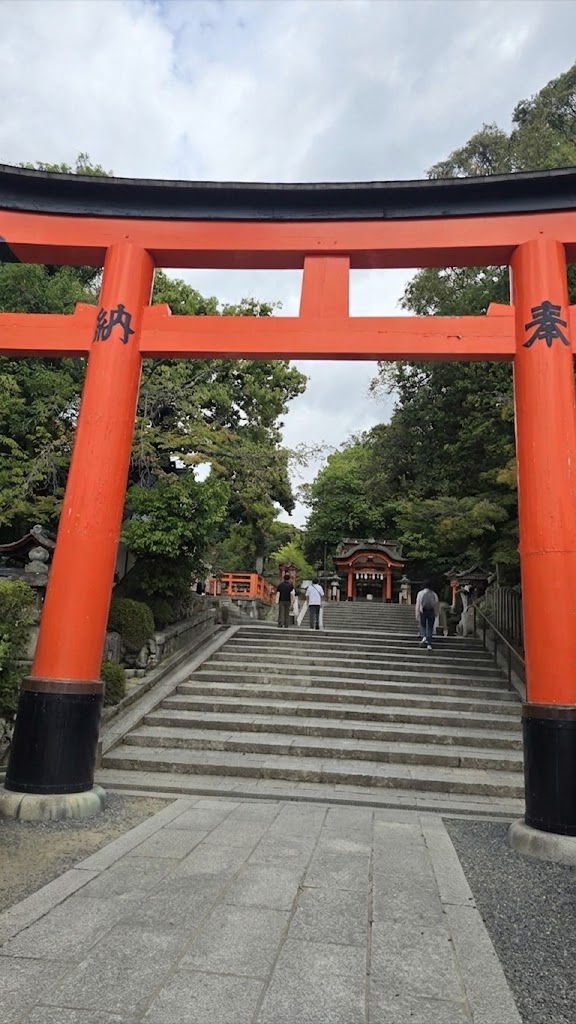
One reason Fushimi Inari is so popular internationally is that it’s the easiest major Kyoto sight to reach. Walk out of the JR station’s ticket gate and the main torii is right in front of you — no other Kyoto landmark is this accessible.
| From | Best route | Time | Notes |
|---|---|---|---|
| Kyoto Station | JR Nara Line to “Inari” — 0-minute walk | About 5 – 7 minutes | ¥150 one way. Ticket gate opens right to the main torii |
| Gion / Shijo | Keihan Main Line to “Fushimi-Inari” + 5-min walk | About 15 minutes | Alternative Keihan route |
| Kiyomizu-dera | Bus + Keihan Main Line transfer | About 30 minutes | Natural afternoon connection |
| Osaka (Yodoyabashi) | Keihan Main Line Limited Express to “Fushimi-Inari” | About 50 minutes | Easy day trip from Osaka |
| Kansai Airport (KIX) | Haruka Express to Kyoto + JR Nara Line | About 90 minutes | Doable en route from the airport |
The JR route (Kyoto Station → Inari, 5 minutes, ¥150) is the standard because the walk from the ticket gate is effectively zero. Even if you have a tight itinerary, you can slot Fushimi Inari in at 6 AM or 9 PM and it barely costs you time.
For a full-day Kyoto sweep — Fushimi Inari + Kiyomizu-dera + Kinkaku-ji + Arashiyama — the transit adds up fast. A rental car from Osaka cuts the between-stop transit significantly and works especially well for families and seniors.
Senbon Torii — Actually About 10,000 Gates, and Still Growing
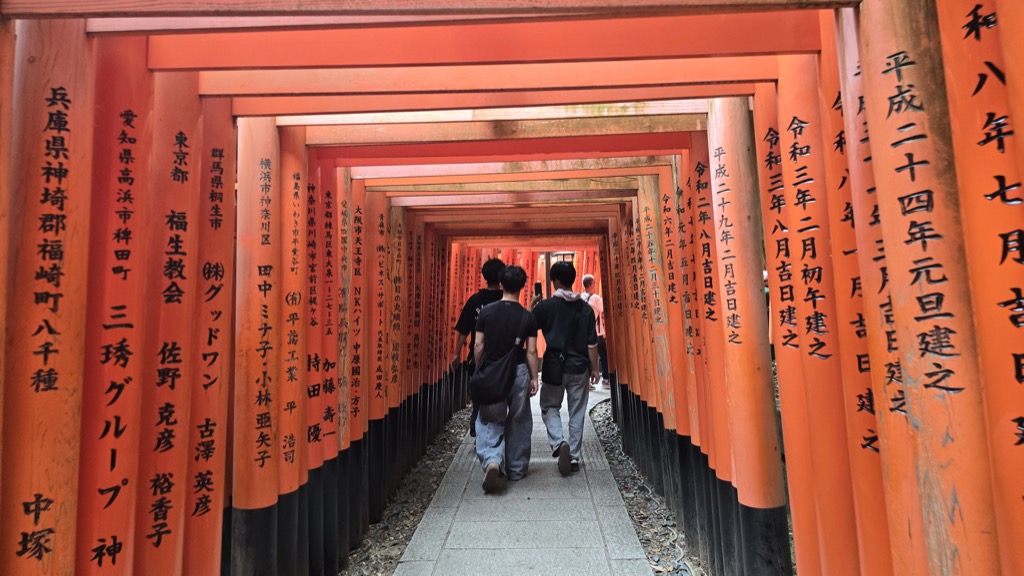
After the main hall, walk further up the slope and the Senbon Torii tunnel opens up. The name literally means “one thousand torii” — but the actual count of vermilion torii scattered across the shrine grounds is closer to 10,000, and it grows each year as new ones are dedicated. “Senbon” here means “many” rather than a literal 1,000.
Each torii was donated by an individual or company as a thanks-offering for a granted wish. On the back of every gate you’ll find the donor’s name and dedication date painted in black. Walking uphill you see only the bright vermilion fronts; walking back down, you see the black-lettered reverses. Doing the loop both ways is the only way to see the full picture. Donation fees range from a few hundred thousand yen for small torii to well over a million yen for the largest — and spotting the corporate names on the biggest gates is part of the fun.
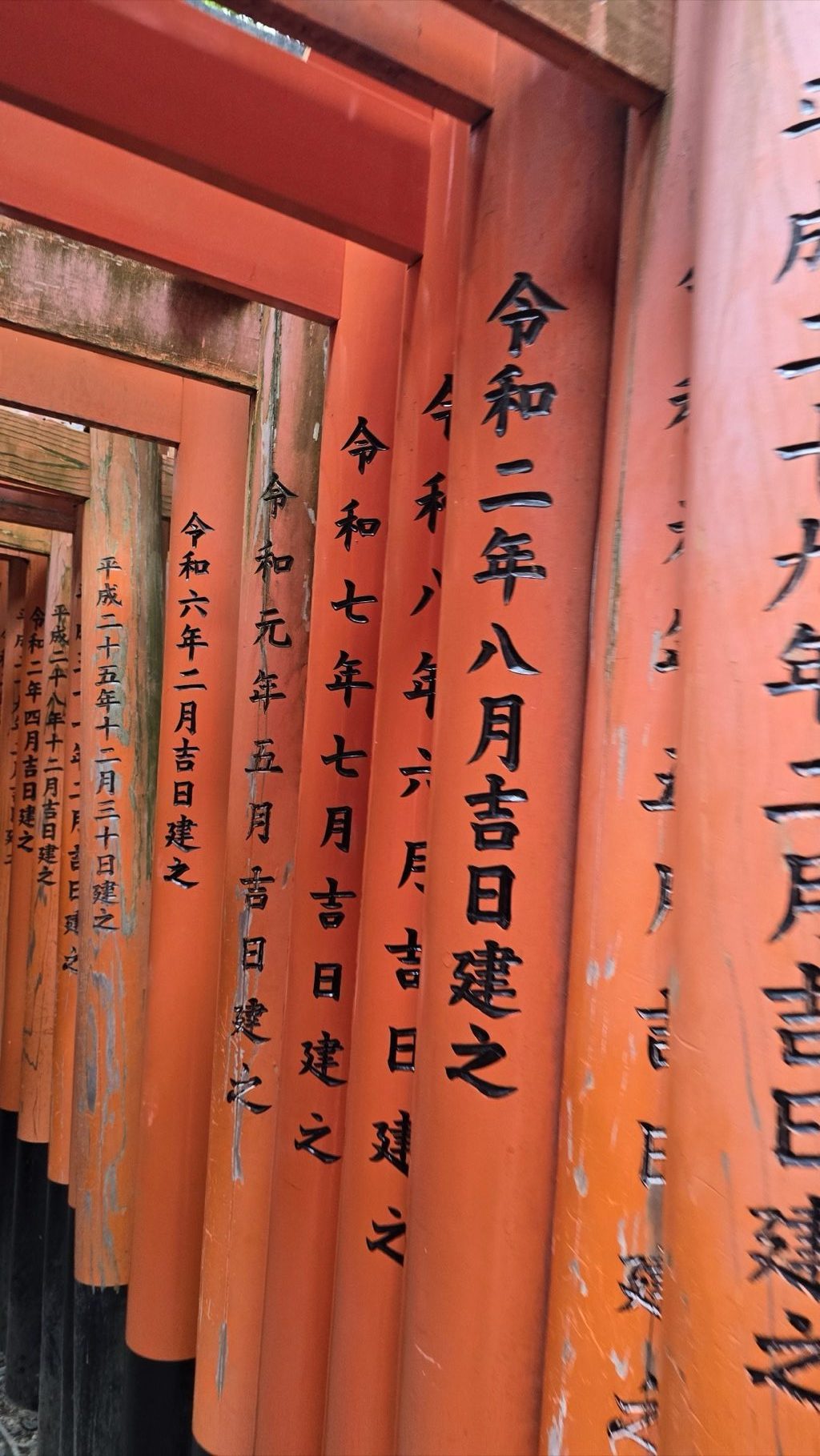
The vermilion color is deeply symbolic. In Shinto belief it represents vitality, the sun, and abundance, and it’s also thought to ward off evil. The pigment used historically has natural preservative qualities, which is why the wooden gates hold their brilliance for years. A well-known photo spot is the Y-shaped fork where the tunnel splits into two parallel paths — following the Japanese convention, go up the left path and come back down the right.
Why Foxes? — Kitsune Are the Divine Messengers, Not the Deity

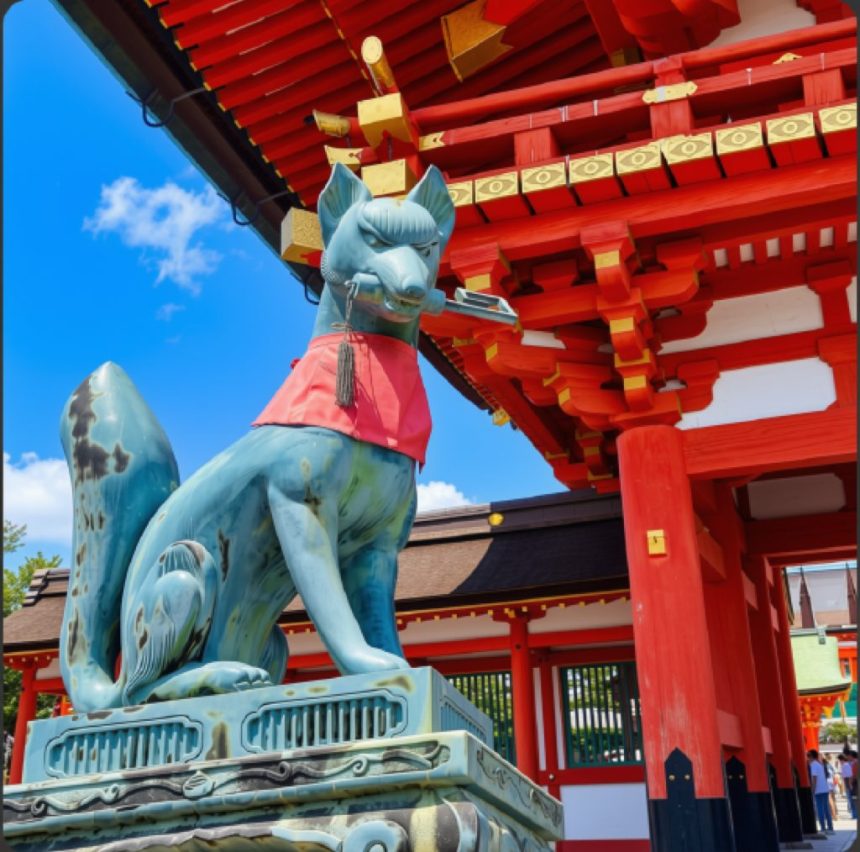
Every visitor notices it: instead of the guardian dog-lion statues (komainu) common at most Japanese shrines, Fushimi Inari has guardian foxes (komagitsune). The important distinction — foxes are not the deity of Inari themselves; they are the deity’s messengers (shinshi).
The connection between foxes and the rice deity comes from farming folklore. Foxes hunted the field mice that fed on rice, so they were seen as protectors of the harvest. Another folk explanation notes that a fox’s bushy tail resembles a ripe head of rice. Both theories have been passed down for centuries.
Look at the fox statues carefully — each one holds a different object in its mouth, and each object carries meaning:
- 🌾 Rice sheaf (ine) — symbol of grain and the harvest
- 🗝️ Key (kagi) — the key to the granary; wealth accumulation
- 💎 Wish-fulfilling jewel (tama) — the spirit of Inari itself
- 📜 Scroll (makimono) — knowledge and wisdom
The red bibs tied around the foxes’ necks are offerings — worshippers place them there as expressions of gratitude, and the shrine treats them as marks of dedication.
Main Hall and Romon Gate — Toyotomi’s Vermilion Legacy
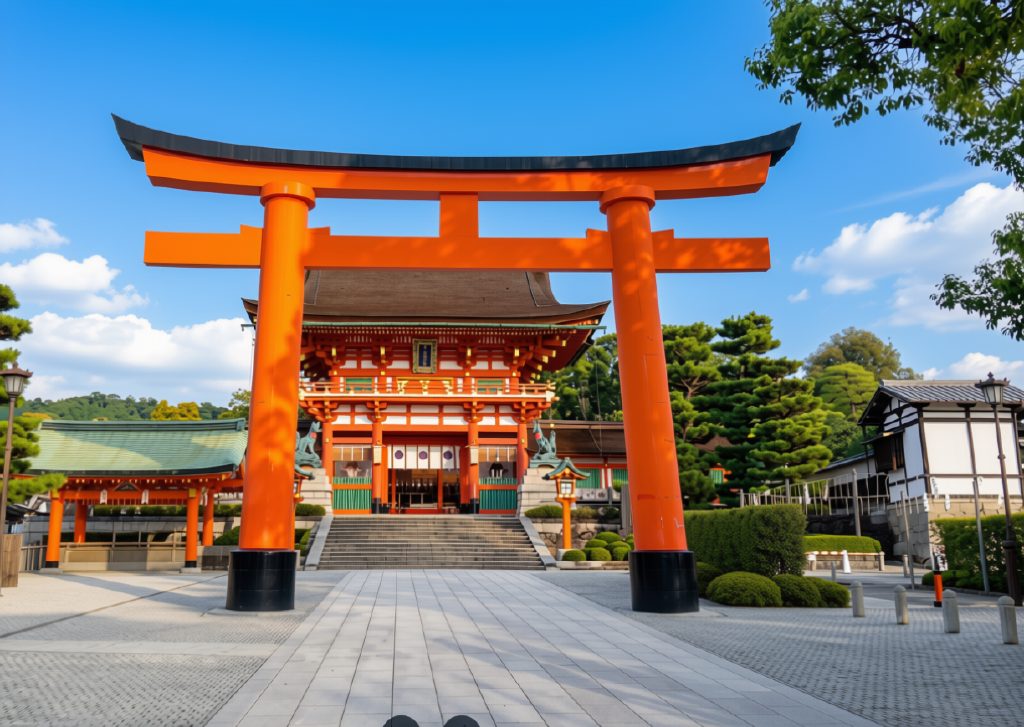
Just inside the main torii, the Romon Gate greets you in blazing vermilion. This structure was donated by Toyotomi Hideyoshi in 1589 to pray for the recovery of his mother’s illness. It’s one of the largest shrine gates of its kind in Japan and immediately signals the scale of Fushimi Inari as a taisha (grand shrine).
The Main Hall (Honden) beyond it was rebuilt in 1499 after being destroyed in the Onin War, and is now a designated Important Cultural Property. Its unique architectural style — a five-bay flowing-roof design called Inari-zukuri — is used only in Inari shrines and gives the hall its distinctive silhouette.
Standard Shinto worship etiquette is: purify hands and mouth at the water pavilion (chozuya), approach the main hall, toss a coin in the offering box, ring the bell, then perform two bows, two claps, silent prayer, one final bow. The 5-yen coin is traditionally popular because “5 yen” (go-en) sounds like the word for “good connection” (go-en).
Okusha Hohaisho and Omokaru Ishi — Where Most Visitors Turn Around
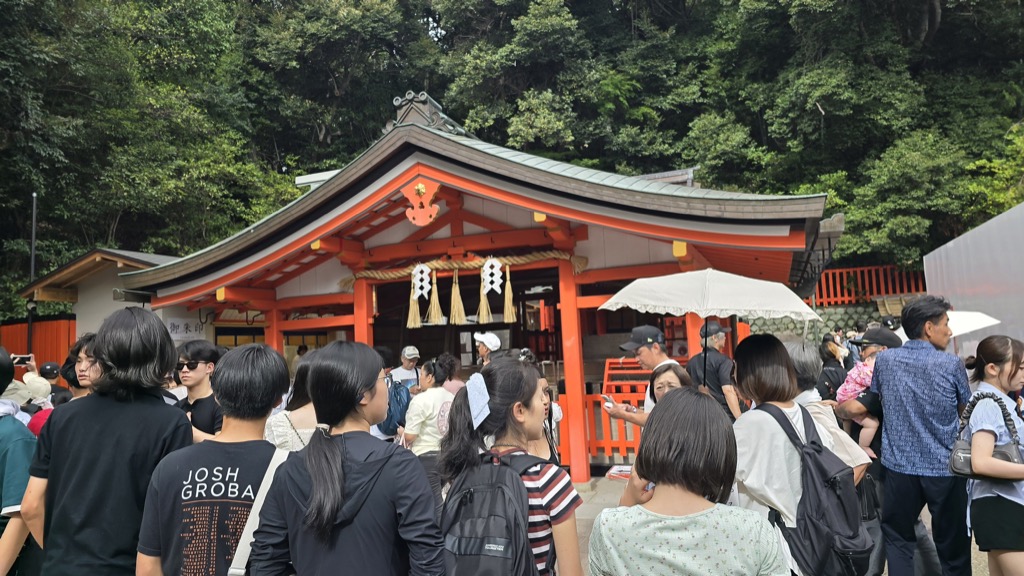
Walk 5 – 10 minutes up through the Senbon Torii and you’ll reach the Okusha Hohaisho — the “worship hall for the inner shrine.” The actual inner shrine sits on the peak of Mount Inari, but here you can worship in that direction without climbing the mountain. Most visitors turn around at this point, and continuing past here into the full mountain hike is optional based on time and energy.
At Okusha Hohaisho, look for the fox-face ema (wooden prayer plaques). Visitors draw their own fox faces on the blank plaques and hang them on the wall of dedications — the resulting mosaic of creative fox faces from travelers worldwide is genuinely charming and a great souvenir.
Omokaru Ishi — The Weight-Lifting Oracle Stone
Just past Okusha Hohaisho, look for a pair of stone lanterns. On top of each sits a round oracle stone called Omokaru Ishi (heavy-or-light stone). Make a wish silently, then lift the stone. If it feels lighter than expected, your wish will come true; if it feels heavier, it will be difficult. It’s a unique piece of Shinto ritual that you’ll only find at Fushimi Inari.
The Mount Inari Hike — The Full Shrine Experience
If you have the time and energy, climb Mount Inari beyond Okusha Hohaisho. The trail continues upward with more torii the whole way, and the sense of a sacred mountain gradually reveals itself as the crowds thin out and the sound of the city fades.
- To the summit — About 60 – 90 minutes one way from the main hall
- Round trip — 2 – 3 hours
- Elevation gain — About 233 meters (main hall to Ichi-no-Mine, the summit)
- Route — Okusha Hohaisho → Kumataka-sha → Mitsutsuji → Yotsutsuji → Ichi-no-Mine (summit)
- Yotsutsuji — Mid-mountain viewpoint with a panoramic view of Kyoto. A perfect turn-back point if you’re short on time
- Tea houses — A few small tea houses along the route sell udon, soba, and cold drinks — a welcome break
Wear real walking shoes. The trail is stone-paved but genuinely uphill, and the summer humidity can be tough. Bring water; vending machines are sparse. Spring and autumn are the best seasons. Do not attempt the full hike at night — the upper stretches are dark and unstaffed.
Approach Street Food — Fushimi Inari’s Unique Bites
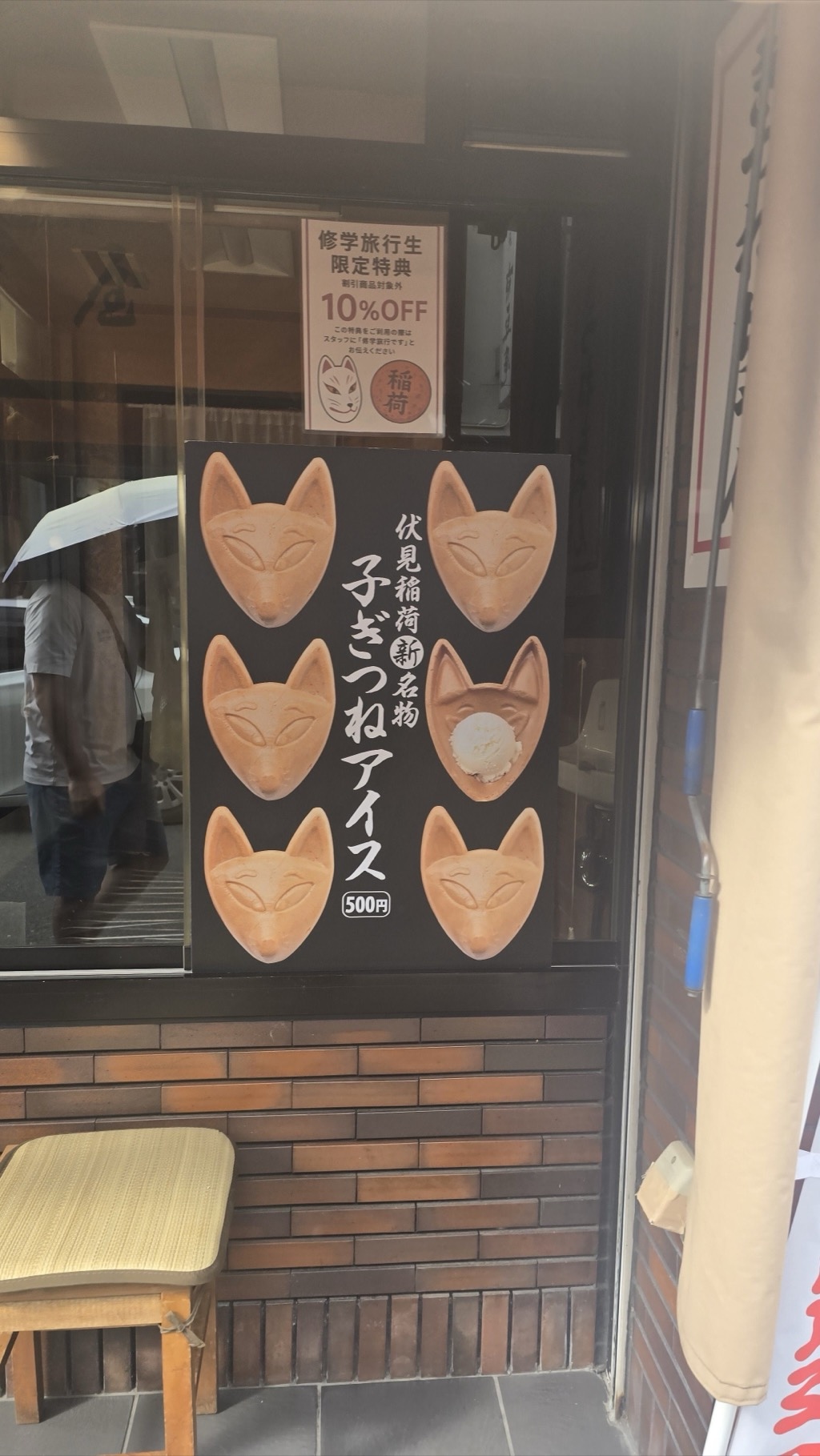
The street between JR Inari Station and the main shrine is dense with Fushimi Inari-specific food and souvenirs, most of them tied to the fox motif.
- 🦊 Kogitsune Ice (fox-face ice cream) — ¥500. Ice cream served in a molded fox-face cup. Instagram catnip
- 🍚 Inari sushi — Sweet-savory fried tofu pouches filled with vinegared rice. The signature dish of Inari shrines, and this is the Inari shrine
- 🐦 Grilled sparrow (suzume no marunayaki) — A traditional Fushimi Inari specialty rooted in folklore (foxes were said to catch sparrows that ate the rice). Now served at only a handful of remaining shops — a rare taste of old Japanese food culture
- 🍡 Dango and mochi — Simple snacks for the walk
- 🎨 Fox masks, plush toys, omamori — Full range of fox merchandise across dozens of shops
The grilled sparrow is a bit of a shock for foreign visitors, but it’s a genuine piece of Fushimi Inari’s cultural heritage — worth trying at least once if you’re interested in traditional Japanese food. Look for the shops with “すずめ” (suzume) on the signboards.
Best Time to Visit
- Quietest hours — 6 – 8 AM or after 8 PM. The 24-hour opening is a rare advantage — you can literally have the torii tunnel to yourself if you show up early
- Best photo light — Morning sun filtering through the torii between 8 – 10 AM; golden hour before sunset
- Night visits — The torii are lit by ground lanterns, creating an almost surreal atmosphere. A unique benefit of the 24-hour opening
- Spring (March – April) — Cherry blossoms line the approach
- Summer (June – August) — The mountain hike is tough in Kyoto’s humidity. Hydrate
- Autumn (October – November) — Mount Inari’s foliage burns red against the vermilion torii
- New Year (January 1 – 3) — Over 2.5 million visitors flood the shrine. Best avoided unless you specifically want that atmosphere
Pair Fushimi Inari With the Rest of Kyoto
Because the base visit (main hall + Okusha Hohaisho) is only 60 – 90 minutes, Fushimi Inari fits neatly into a broader Kyoto day:
- Kiyomizu-dera — 30 minutes by bus or Keihan train. The wooden stage on Higashiyama
- Kinkaku-ji (Golden Pavilion) — 50 minutes by subway + bus. Northwestern Kyoto’s gold-leafed masterpiece
- Tofuku-ji Temple — One stop on the JR Nara Line. Famous for autumn maples
- Uji — 20 minutes on the JR Nara Line. Byodo-in Phoenix Hall and Uji tea culture
- Arashiyama Bamboo Grove — 50 minutes by subway + Randen tram. Classic afternoon spot
The gold-standard one-day route: “Early morning 6 AM: Fushimi Inari (empty torii shots) → Morning: Kiyomizu-dera + Sannenzaka + Gion → Lunch → Afternoon: Kinkaku-ji + Arashiyama”. Starting at Fushimi Inari before sunrise is the single best move in a Kyoto trip — it’s the only way to get that iconic torii photo without other people in the frame.
FAQ — Quick Answers for First-Time Visitors
Q. Is there an admission fee at Fushimi Inari Taisha?
No. Fushimi Inari is completely free to enter, including the main hall, Okusha Hohaisho, and the full Senbon Torii tunnel.
Q. What are the opening hours?
Open 24 hours, every day of the year. The amulet counter runs 8:30 – 16:30 — visit during that window if you want an omamori or goshuin (temple stamp).
Q. How do I get there?
From Kyoto Station take the JR Nara Line to “Inari” (¥150, about 5 minutes). Exit the ticket gate and the main torii is directly in front of you.
Q. Are there really 1,000 torii?
“Senbon” (thousand) is a poetic way of saying “many.” The actual count on the grounds is approximately 10,000 torii, and new ones are added each year as donations continue.
Q. Why are there foxes everywhere?
Foxes are the divine messengers (shinshi) of Inari, not the deity itself. In folklore, foxes protected rice fields by hunting the mice that ate the grain, which made them associated with the god of rice.
Q. Can I visit at night?
Yes — the shrine is open 24 hours. The torii tunnel lit at night is a magical, quieter experience. However, do not attempt the full mountain hike after dark. Stay near the main hall and Okusha Hohaisho for evening visits.
Q. How hard is the mountain hike?
Moderate. The 233-meter elevation gain over 2 – 3 hours round-trip is on paved stone steps, but it’s a real climb. Bring water and wear proper shoes. The Yotsutsuji mid-mountain viewpoint is a good turn-back option if you’re short on time.
Q. Is the shrine wheelchair or stroller accessible?
The main hall visit (up to the Romon Gate area) is manageable on paved ground. Beyond the Senbon Torii, however, the terrain becomes stone-stepped and difficult. If your goal is just the main hall visit, it’s doable.
Q. What should I eat on the approach street?
Inari sushi is the classic (this is the temple’s namesake dish). Kogitsune Ice (¥500 fox-face ice cream) is the Instagram winner. For adventurous eaters, the traditional grilled sparrow is served at a few remaining old shops — a rare piece of Japanese food heritage.
Wrap-Up — Walk Through the Vermilion Tunnel and Feel Japan for Real
Thanks for reading. This guide walked you through Fushimi Inari Taisha’s free admission and 24-hour opening, the Senbon Torii tunnel and its 10,000 gates, the fox symbolism, the Okusha Hohaisho and Omokaru Ishi weight-lifting oracle, the full Mount Inari hike, and how to pair Fushimi Inari with the rest of Kyoto. Between the free entry, the 24-hour opening, and the sheer visual impact of the torii tunnel — this is the shrine that gives you the “I’m really in Japan” moment on any Kyoto trip.
The best move is to arrive at 6 AM before the crowds, walk the empty torii tunnel with a camera, and use the rest of the day for Kiyomizu-dera, Kinkaku-ji, or Arashiyama. A Kansai rental car cuts the cross-city transit dramatically for a day like this.
Quick checklist before you go:
- Admission free, open 24 hours — early morning and night visits are possible
- From Kyoto Station: JR Nara Line to “Inari” (¥150, 5 minutes, zero-minute walk from the ticket gate)
- Best crowd-free window: 6 – 8 AM
- Wear real walking shoes if you plan to hike Mount Inari
- Try the Omokaru Ishi weight-lifting oracle at Okusha Hohaisho
- Taste inari sushi and Kogitsune Ice on the approach street
- Amulet counter runs 8:30 – 16:30 — time it right if you want souvenirs
Explore Kyoto and Kansai the easy way — GO!GO!TOUR car options with English support.
A single Kyoto day covering Fushimi Inari, Kiyomizu-dera, Kinkaku-ji, and Arashiyama is a serious transit challenge on public transport. A rental car cuts the travel time significantly and gives you more temple time and less map time. GO!GO!TOUR handles the whole booking process in English.
🚗 GO!GO!TOUR Osaka / Kansai rental car — pickup near JR terminals

The vermilion tunnel and the sacred mountain — see you in Kyoto ⛩️🦊