- Diving in Okinawa — no certification needed to reach 12 metres
- Snorkelling, discover scuba or fun dive — which one are you booking?
- What diving in Okinawa costs
- 13 Okinawa dive sites, area by area
- When to go — water temperature month by month
- Six rules to know before you dive
- FAQ
- Wrap-up — pick the water first, then work out what time you leave
Diving in Okinawa — no certification needed to reach 12 metres
There are three ways to get in the water in Okinawa. Snorkelling keeps you on the surface. Discover scuba diving takes you down to a maximum of 12 metres with an instructor beside you and no certification card required. Fun diving goes below 18 metres and is open only to certified divers. The first two need nothing but a swimsuit and a free half-day.
Prices sit in three clear bands: ¥4,000–8,000 for snorkelling, ¥8,000–20,000 for a discover scuba dive, and ¥15,000–25,000 for a guided fun dive. Add roughly ¥2,000–5,000 if the site is reached by boat.
The best water is between April and November, when the sea sits at 24–28°C. Winter still holds 21–22°C, so Okinawa is a genuinely year-round destination — and from December to March the visibility is the best it gets all year.
One practical note before the sites. The Blue Cave in Onna, Sunabe in Chatan and Kouri Island are all spread along the coast one to two hours’ drive from Naha, and you will be carrying wet gear and a change of clothes. A rental car is what makes a multi-site trip possible.
Got your dive dates? Sort the driving first
Snorkelling, discover scuba or fun dive — which one are you booking?
Settle this before you open any dive shop’s booking page. Certification, depth and minimum age all differ, and choosing here cuts the shortlist down immediately.
| Snorkelling | Discover scuba | Fun diving | |
|---|---|---|---|
| Certification | None | None | PADI OW / AOW |
| Maximum depth | Surface | 12 m | 18 m and below |
| Minimum age | 5 and up | 10 and up | 10 and up (shop’s call) |
| Guide ratio | 1 to 4–6 | 1 to 1–2 | 1 to 4 |
Snorkelling — you do not need to be able to swim
You wear a buoyancy vest, a mask and a snorkel, and float on the surface looking down. It is the least physically demanding option and non-swimmers can take part. Most shops accept children from age five.
What you give up is depth. That matters less than you would expect in Okinawa, where visibility runs 20–30 metres — coral heads and schooling reef fish read clearly from the surface. For a trip with grandparents or small children, this is the right starting point.
Discover scuba diving — 12 metres, no licence
You carry a tank and actually descend, but no certification card is required. An instructor stays with you for the entire dive and handles your buoyancy, so your only job is getting comfortable breathing underwater. The depth limit is fixed at 12 metres.
The difference from snorkelling is the sound and the scale. Looking down through the surface is not the same as dropping to the fish’s own level. With one instructor to one or two guests, the ratio is also why most first-timers feel settled within a few minutes.
Fun diving — for certified divers
Open to holders of PADI Open Water or Advanced Open Water and equivalents. You follow a guide past 18 metres, then have room to explore. The terrain sites — Dream Hole, the Devil’s Palace — are only accessible this way. Bring your certification card and logbook; shops will ask for both.
What diving in Okinawa costs
- Snorkelling — ¥4,000–8,000. Mask, snorkel, buoyancy vest and a guide are normally included.
- Discover scuba — ¥8,000–20,000. Covers tank, wetsuit, BCD and regulator rental, insurance and the instructor. Some shops include underwater photos.
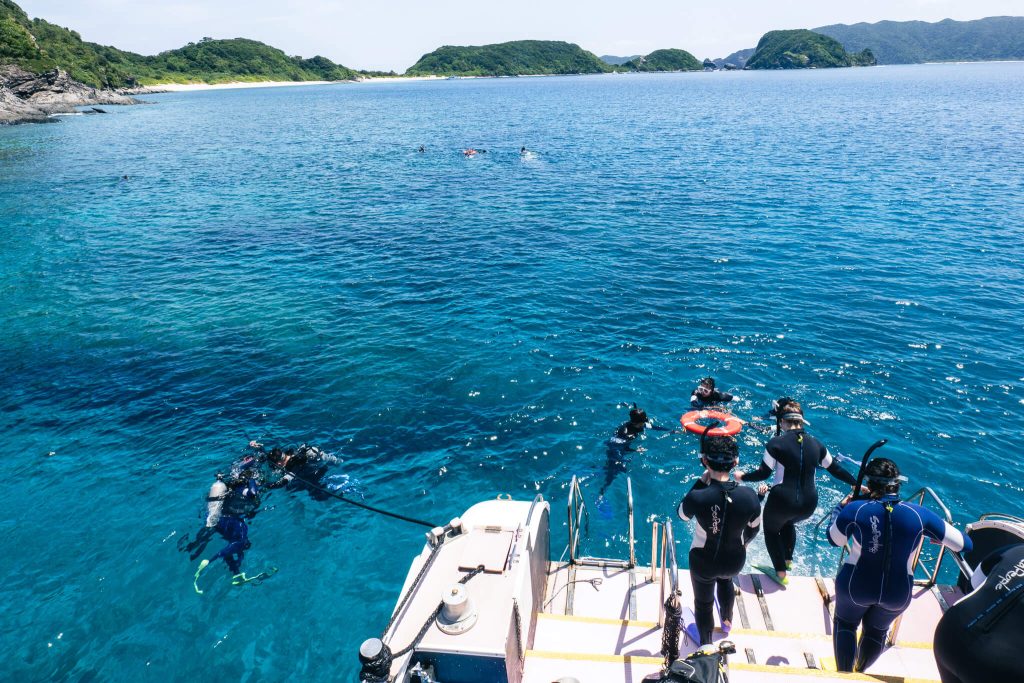
- Fun diving — ¥15,000–25,000. Boat trips out to Kerama or Manza sit at the top of that range.
Sites are reached either by shore entry, walking in from the beach, or by boat entry out to an offshore mooring. Boat access usually adds ¥2,000–5,000, so check whether the advertised price already includes it before you book.
What to bring
Wetsuits, masks and tanks come from the shop. You only need four things of your own.
- Swimwear, towel and a change of clothes. Swimwear goes under the wetsuit, so wearing it from your hotel saves time at check-in.
- Motion sickness tablets if you are on a boat dive — take them about 30 minutes before departure.
- Reef-safe sun protection, sunglasses and a hat for the time you spend back on land.
- Documents. Certification card and logbook for fun diving; photo ID speeds up the paperwork for everything else.
13 Okinawa dive sites, area by area
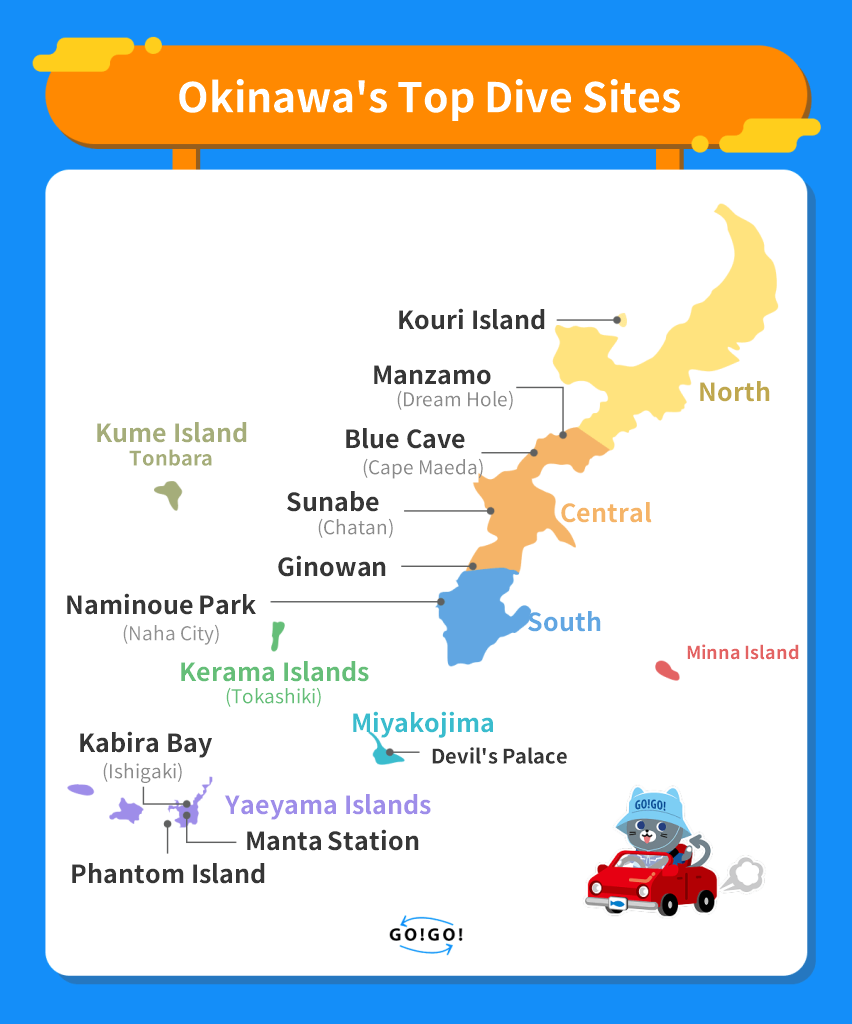
Okinawa’s sites split neatly in two: the mainland coast, which you drive to, and the outer islands, which need a ferry or a short flight. The mainland gives you flexibility; the islands give you the scenery people book flights for.
Central mainland — four sites within driving distance
- Blue Cave (Cape Maeda, Onna). Light entering a half-enclosed sea cave bounces off the white sand floor and turns the interior a glowing blue. Okinawa’s single most famous site, and an easy one — you drift in with the current. Snorkelling / discover scuba · Difficulty ★☆☆☆☆. Entry routes and prices are covered in our dedicated Blue Cave guide.
- Sunabe (Chatan). A shore-entry site right beside American Village, which makes it the easiest of all to reach. Calm water, wide coral fields and dense schools of reef fish. Snorkelling / discover scuba · ★☆☆☆☆
- Dream Hole (off Manzamo). A vertical cave dropping away beneath the famous elephant-trunk cliff. Descend, look back up, and shafts of light column down through the opening. The terrain is complex, so AOW certification is required. Fun diving · ★★★★☆
- Ginowan. On the boundary between Naha and the central coast, which is exactly why it stays quieter than the headline sites. Well-preserved reef and a high density of fish. Snorkelling / discover scuba / fun diving · ★★☆☆☆
Northern mainland — two family-friendly drives
- Minna Island. Fifteen minutes by boat from Toguchi Port, and shaped like a croissant from the air. Visibility reaches 30 metres, and everything from snorkelling to banana boats happens in one place. Beach snorkelling / boat discover dives · ★☆☆☆☆. Ferry times and parking are in our Minna Island snorkelling guide.
- Kouri Island. Connected to the mainland by bridge, so it is island water without a boat. Conditions are usually gentle and the shallows are full of small fish and tide-pool life — a straightforward half-day that pairs with the drive across Kouri Bridge. Beach snorkelling · ★☆☆☆☆
Naha city — Naminoue Umisora Park
The beach below the cliffs of Naminoue Shrine, about 10 minutes by car from Kokusai-dori and walkable from Kencho-mae monorail station. It is the closest entry point to the city in all of Okinawa, which makes it the one you slot into an arrival afternoon or a last free morning. Snorkelling / discover scuba · ★☆☆☆☆
Kerama Islands (Tokashiki) — 35 minutes by ferry from Naha
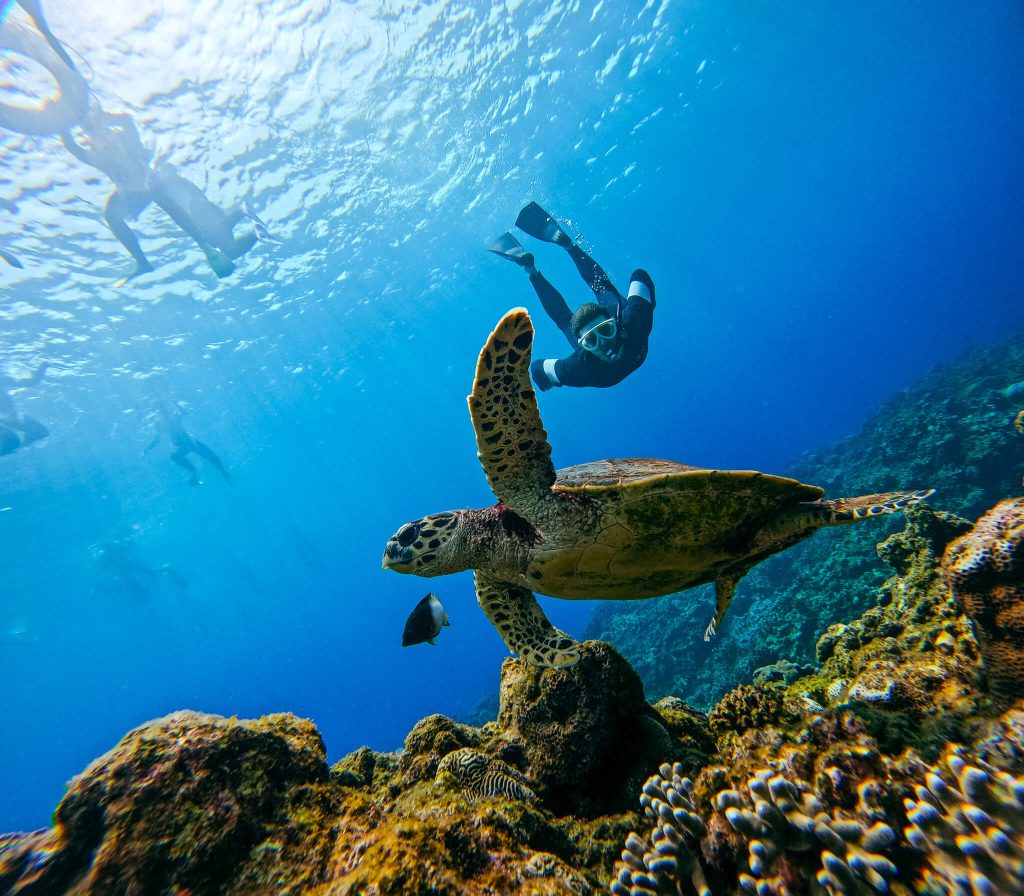
The water around the Keramas carries almost no suspended matter, which is what produces the deep, luminous blue known as Kerama Blue. Tokashiki is the largest island in the group and the quickest to reach — roughly 35 minutes by high-speed ferry from Naha’s Tomari Port.
More than 200 coral species grow in the surrounding water, turtle encounters are common, and from December to March humpback whales move through the same channels. Few places in Japan give you that range in one location. Boat snorkelling / discover scuba / fun diving · ★★☆☆☆
Kume Island — two sites for big animals
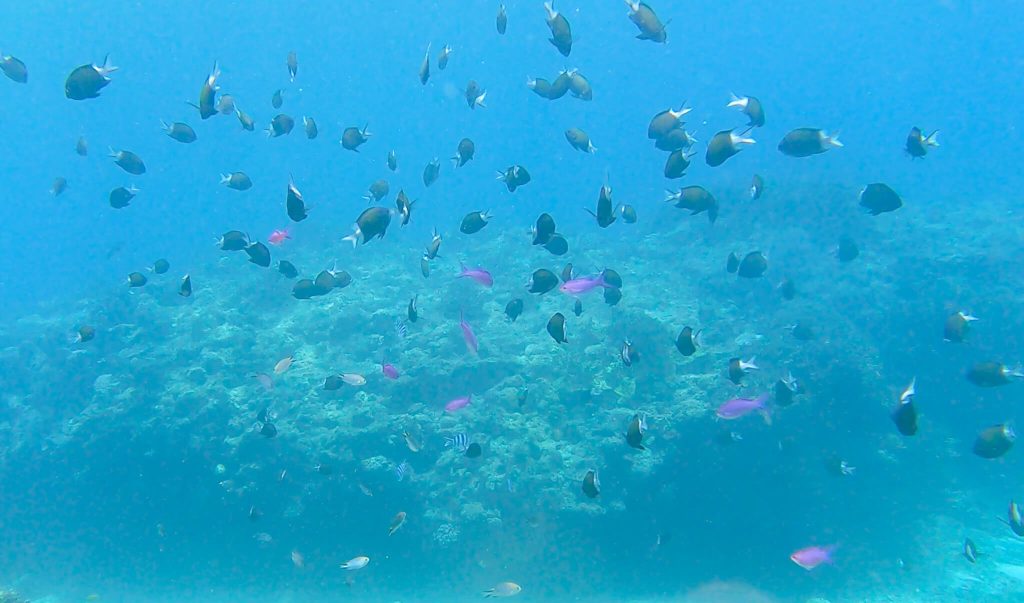
Thirty minutes by air from Naha, or about three hours by ferry. Dramatic underwater topography pulls in large marine life, and the island stays far quieter than the mainland.
- Manta Station. Wild manta rays are usually a matter of luck. This site is the exception — a cleaning station where mantas appear year-round. It is relatively shallow with gentle current, so even newly certified divers have a realistic chance of watching one glide overhead. Fun diving · ★★★☆☆
- Tonbara. A pinnacle where currents collide, and firmly an advanced site. The reward is the traffic it attracts: giant trevally and barracuda circling the rock in silver walls. Fun diving · ★★★★☆
Yaeyama Islands — two sites worth island-hopping for
- Off Kabira Bay (Ishigaki). The bay itself holds three stars in the Michelin Green Guide, and offshore lies one of the largest blue coral colonies in the northern hemisphere. From July to October manta rays gather outside the bay, close enough that snorkellers often see them. Boat snorkelling / discover scuba / fun diving · ★★☆☆☆
- Phantom Island (Hamajima). A white sandbar between Kohama and Taketomi that only surfaces at low tide and disappears again as the water rises. The surrounding shallows are calm, so the standard plan is a half-day trip: land on the sandbar, then snorkel the reef beside it. Half-day island hopping · ★☆☆☆☆
Miyakojima — the Devil’s Palace
Miyakojima is the terrain diver’s island: submerged caves, vertical chimneys and enormous sea caverns cut through the limestone. The Devil’s Palace is the best known — squeeze through a narrow rock passage and the chamber beyond is lit by beams falling through cracks in the ceiling. It is among the most demanding sites in Okinawa and shops will ask about your logged experience. Fun diving · ★★★★★
Chaining several sites together? A car is the fastest way
When to go — water temperature month by month
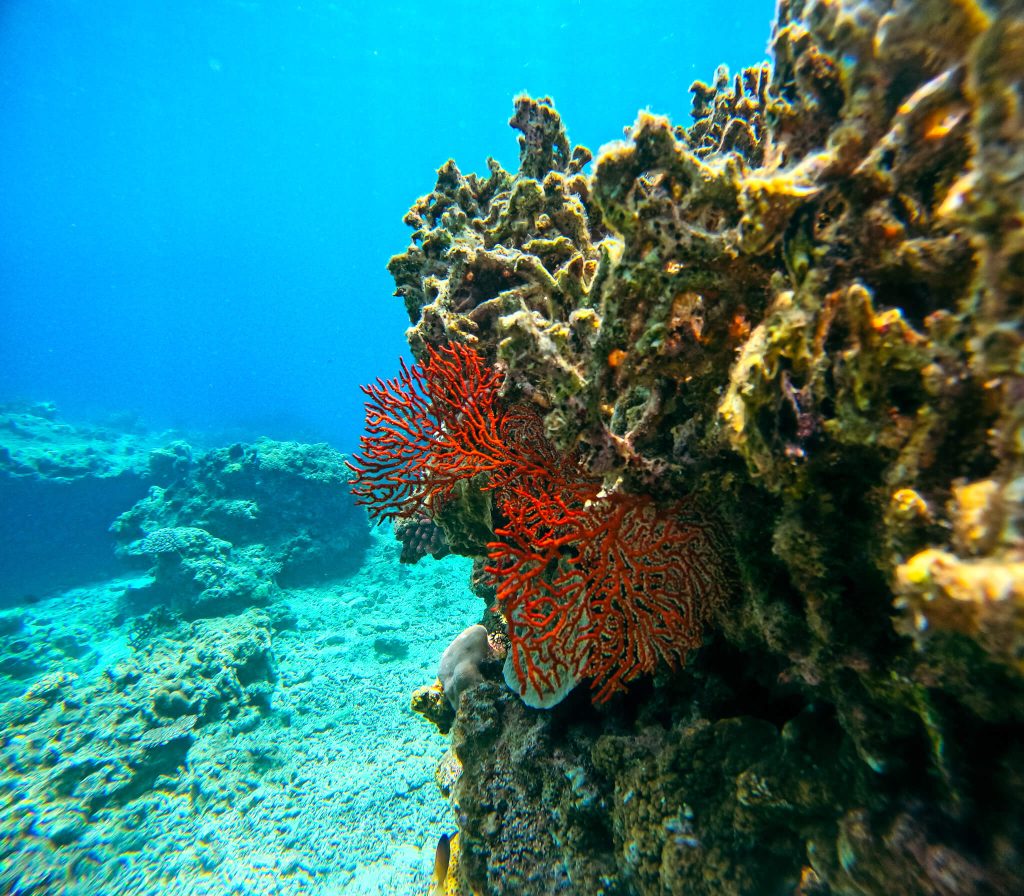
You can dive in Okinawa in any month, but conditions differ sharply across the year. If this is your first time, April to July and September to October are the safest bets.
April to November — 24–28°C and the main season
The Kuroshio current keeps the surrounding sea warm and stable through these months, and a standard wetsuit is all you need. Two periods inside that window deserve attention.
- May–June, the rainy season. Showers become frequent, but rain itself barely affects underwater visibility. What cancels a dive is swell and wind, not rainfall — if the sea is flat, the trip runs as planned.
- August–October, typhoon season. The water is at its warmest and the reef at its most active, yet an approaching typhoon shuts down all marine activity. Booking in this window means reading the shop’s cancellation and rescheduling terms first; that is your real insurance.
December to March — colder air, the year’s best visibility
North-easterly winds make it feel cold on land, but the water holds 21–22°C and a thicker wetsuit handles it. Plankton levels drop, so visibility improves on the summer months.
This is also humpback whale season in Okinawan waters, which means diving and whale watching fit into the same itinerary. Snorkellers feel the wind chill far more than divers do, though — if you plan to stay on the surface, aim for May to October instead.
| Months | Air / water | Conditions | Beginner-friendly |
|---|---|---|---|
| Jan–Feb | 16–19°C / 21–22°C | Windy with bigger swell; peak visibility and whale season | ★★ |
| Mar–Apr | 18–22°C / 22–24°C | Sea settling down; a good time to try discover scuba | ★★★★ |
| May–Jun | 23–27°C / 24–26°C | Rainy season; swell can force a same-day decision | ★★★ |
| Jul–Aug | 28–32°C / 27–28°C | Warmest water of the year; excellent unless a typhoon lands | ★★★★ |
| Sep–Oct | 25–29°C / 26–28°C | End of typhoon season; quieter, and island boats are easier to book | ★★★★ |
| Nov–Dec | 18–24°C / 22–24°C | Stable sea, cooler air, whale season begins | ★★★ |
Six rules to know before you dive
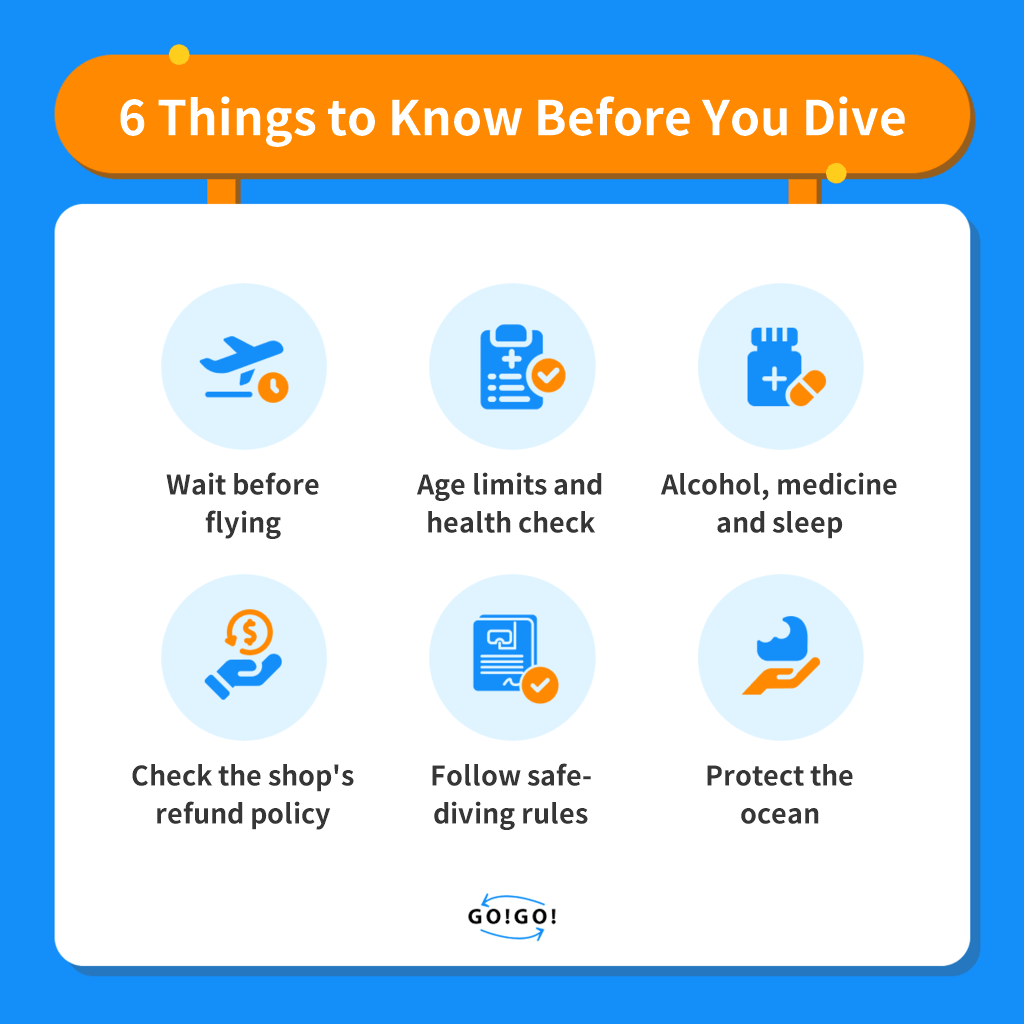
1. Leave enough time before your flight
This is the one first-timers miss. After any dive on a tank — discover scuba included — wait 18 to 24 hours before boarding a plane. Nitrogen absorbed during the dive expands into bubbles at cabin altitude, and that is what causes decompression sickness.
In practical terms, you cannot dive on your departure day. On a five-day trip, the last possible dive is the afternoon of day three. Snorkelling carries no such restriction.
2. Age limits and your condition on the day
Snorkelling starts at age five, and some shops run family programmes from as young as one. Tank dives — discover scuba and fun diving alike — start at ten, because of equipment weight and the ability to equalise.
You will be asked to complete a health declaration at the shop. Cardiovascular conditions, a history of pneumothorax, pregnancy, a heavy cold with blocked sinuses and recent major surgery all rule out participation. Answer honestly — the form exists for your safety, not the shop’s paperwork.
3. Alcohol, medication and sleep
- No alcohol for 8 hours before diving. It accelerates dehydration and raises the risk of cramp and disorientation underwater.
- No cold medicine for 12 hours. Decongestants and antihistamines interfere with the eustachian tubes, which can make equalising impossible and, at worst, damage an eardrum.
- Sleep the night before. Fatigue is directly linked to panic and discomfort at depth.
4. Follow the safe-diving basics
- Do what the guide signals. Okinawa’s underwater topography is complex and currents shift; never move forward, back or up on your own judgement.
- Never dive alone. Stick to the buddy system and keep your partner and guide in sight at all times.
- Ascend slowly. A fast ascent expands nitrogen bubbles in the body and can cause decompression sickness or lung barotrauma. Coming up from depth, make a safety stop of at least three minutes at five metres.
5. Read the cancellation policy before you pay
Typhoons are frequent from summer into autumn, particularly August to October. If a shop calls off a trip because of sea conditions, the standard remedy is a full refund or a free reschedule.
Cancelling for your own reasons is a different matter and usually follows a sliding scale — free up to eight days out, a rising percentage inside seven days, and 100% on the day. Terms vary by operator, so read them at the point of booking.
6. Dive lightly on the reef
- Do not touch or stand on coral, and do not chase or handle marine life.
- Do not feed the fish — bread and pellets disrupt the local balance.
- Choose your sunscreen carefully. Chemical filters such as oxybenzone contribute to coral bleaching. Use a product labelled reef-safe, or skip it altogether and cover up with a rash guard or wetsuit, which works better anyway.
FAQ
Q. Do I need a diving certification in Okinawa?
Not for snorkelling or discover scuba diving. A discover scuba dive takes you to 12 metres with an instructor alongside you the whole time and no card required. Only fun diving below 18 metres requires PADI Open Water or Advanced Open Water certification.
Q. How much does diving in Okinawa cost?
Snorkelling is ¥4,000–8,000, discover scuba ¥8,000–20,000 and guided fun diving ¥15,000–25,000. Boat access to an offshore site adds roughly ¥2,000–5,000 on top.
Q. How long after diving can I fly?
Wait 18 to 24 hours after any dive on a tank. Nitrogen absorbed underwater expands at cabin altitude and can cause decompression sickness, so you cannot dive on your departure day. Snorkelling has no waiting period.
Q. Can I dive in Okinawa if I cannot swim?
Yes for snorkelling — you wear a buoyancy vest and float on the surface. Discover scuba is also possible because the instructor manages your buoyancy, but tell the shop when you book if putting your face in the water makes you uncomfortable.
Q. What is the minimum age for children?
Five for snorkelling, with some shops running family programmes from age one. Ten for discover scuba and fun diving, because of the weight of the equipment and the need to equalise.
Q. Which Okinawa dive sites suit beginners?
The Blue Cave at Cape Maeda, Sunabe in Chatan, Naminoue Umisora Park in Naha, Minna Island and Kouri Island. All have gentle conditions, the lowest difficulty rating, and are reachable by car from Naha.
Q. Do dives run in the rain?
Usually yes. Rain has very little effect on underwater visibility; swell and wind are what cancel a trip. All marine activity stops when a typhoon approaches.
Q. Is winter diving in Okinawa worth it?
Yes. The water holds 21–22°C from December to March and a thicker wetsuit is enough. Plankton levels fall, so visibility is the best of the year, and it coincides with humpback whale season.
Wrap-up — pick the water first, then work out what time you leave
Diving in Okinawa comes down to two questions: do you hold a certification card, and how far are you willing to travel? Without a card, the Blue Cave, Sunabe and Naminoue are all open to you. With one, Kerama, Kume and Miyakojima come into range.
What connects the two is transport. The sites are scattered along the mainland coast and across island ports, and you will be moving wet gear between them — which is why almost every itinerary in this guide assumes a car.
GO!GO!TOUR compares the national chains and Okinawa’s local operators on one screen, with an English interface and live chat support. Pickup and return at Naha Airport is standard, and some partners handle out-of-hours collection — useful when a boat dive meets at 07:30.
Five reasons travellers book with GO!GO!TOUR
- Live chat with a real person — English support 09:00–18:00 Japan time, so questions get answered before you fly.
- A fleet that actually fits — multiple vetted local operators, from kei cars to 8-seat minivans.
- Flexible pickup and return — partners that handle out-of-hours collection, which matters for early boat departures and late arrivals.
- Delivery and collection — paid hotel pickup and return available on selected plans.
- One platform for the whole trip — marine activities, accommodation and eSIM can be booked alongside the car.
Book your Okinawa rental car and get to the water
Okinawa rental cars by vehicle type
- Kei cars — two people travelling light, easy on narrow coastal roads
- Compact cars — 2–3 people, Aqua / Yaris class
- Mid-size and wagons — room for wet bags and a cool box
- Minivans and 8-seaters — dive groups of six to eight
- All rental partners — compare every operator side by side
Plan the rest of your Okinawa trip
- Find activities by category — snorkelling, glass-bottom boats and more
- Okinawa model course — a driving route to build your dive days around
- Japan eSIM — activates on arrival, so you can find the meeting point on the map
- Discount coupons — check current promotions before you book

※ Prices, water temperatures and participation conditions in this article are general guidance at the time of writing and vary by operator, season and sea state. Age limits and cancellation terms are set by the shop you book with. — GO!GO!TOUR Editorial Team