- Renting a car in Fukuoka — the short answer before the long one
- Why Kyushu is a driving region, not a train region
- Documents you must bring to drive in Japan
- 7 Fukuoka rental platforms compared
- What a Fukuoka rental actually costs
- Pick your car by luggage, not by seat count
- Insurance — read the excess, not the brochure
- 4 rules that catch first-time drivers in Japan
- How the pickup works, step by step
- Where to pick the car up — three options
- FAQ — Fukuoka car rental quick answers
- Wrap-up — a Kyushu trip is built around the car, not the timetable
Renting a car in Fukuoka — the short answer before the long one
To rent a car in Fukuoka you need three things in your hand at the counter: an International Driving Permit issued under the 1949 Geneva Convention, your home country driving licence, and your passport — originals only, no photos, no scans. Add a credit card in the main driver’s name, and you can drive out of Fukuoka Airport within about 40 minutes of landing.
Everything after that is a budgeting question. A 5-seat compact SUV runs roughly ¥7,500–9,500 per day in low season and ¥11,000–13,500 in peak weeks, and the gap between the cheapest and most expensive operator in Fukuoka is wide enough to pay for a night in Yufuin.
This guide compares seven rental platforms serving Fukuoka and Kyushu, then walks through cost, car size, insurance, and the four rules that catch first-time drivers in Japan.
Why Kyushu is a driving region, not a train region
Kyushu is mountainous and its best scenery is scattered. Kurokawa Onsen, the Mount Aso caldera rim, the Takachiho gorge — these are places where the bus runs a handful of times a day, or where the connection involves two transfers and a 30-minute wait in between.
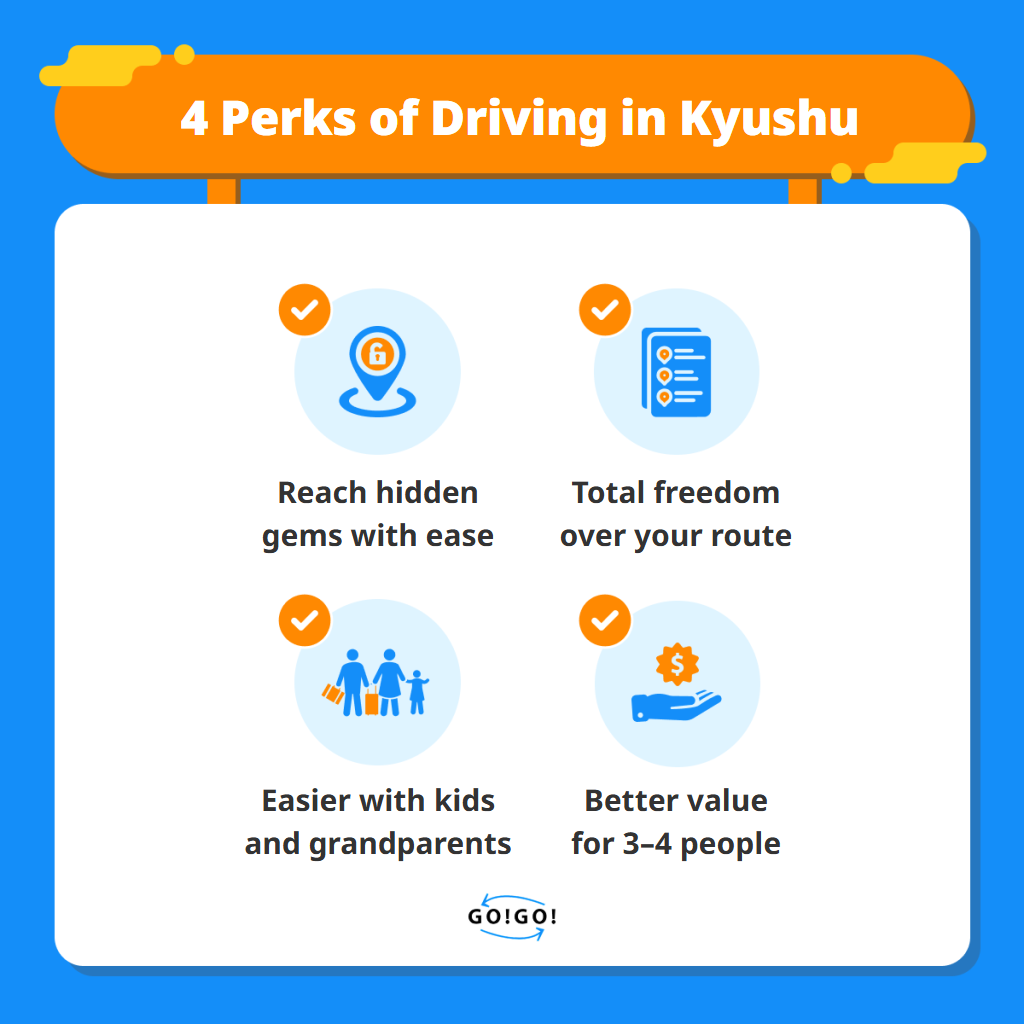
- Hidden spots become reachable. The scenic stops that make a Kyushu trip memorable are exactly the ones public transport serves worst. A car turns a half-day logistics puzzle into a 90-minute drive.
- Your schedule stops being someone else’s. No limited express to catch, no last bus to worry about. Stay an extra hour in Yufuin, pull over at a roadside market for seasonal fruit — the itinerary bends around you instead of the other way around.
- Far easier with kids or older parents. Family trips lose their energy on station stairs and platform transfers with luggage in tow. In a car, everyone sits down once and rests until the next stop.
- Cheaper from three people up. Once you are 3–4 travellers, limited express and Shinkansen fares stack up fast. Splitting one daily rental rate, fuel, and tolls usually beats buying individual rail passes.
Handy if you are still shaping the route: our Fukuoka model course lays out how far you can realistically get in two or three days.
Documents you must bring to drive in Japan
This is where most overseas bookings fall apart at the counter, so it is worth being precise. The minimum driving age in Japan is 18, and Japan does not accept a foreign licence on its own.
- International Driving Permit (Geneva 1949). Japan only recognises IDPs issued under the 1949 Geneva Convention — the booklet-style permit. IDPs issued under the 1926, 1968 or Vienna conventions are not valid here. Apply in your home country before you fly; most IDPs are valid for one year.
- Your home country driving licence. The IDP is only a translation instrument — it has no standing without the original licence beside it.
- A special case: countries that do not issue Geneva-1949 IDPs. Switzerland, Germany, France, Belgium, Monaco, Slovenia, Estonia and Taiwan instead require an official Japanese translation of the home licence, issued by JAF or an authorised body. An IDP from these countries will be refused.
- Passport. Used to confirm your entry status and match your details against the booking.
- Booking confirmation. Printed or on your phone — it speeds up the counter check considerably.
- A credit card in the main driver’s name. Needed for on-site charges, optional equipment and toll settlement. A card in a travel companion’s name will not be accepted for the main driver.
Every document has to be the original. Counter staff in Japan will not accept a photograph or a photocopy, and there is no way to fix a missing IDP once you have landed.
Book your Fukuoka rental car with GO!GO!TOUR and start the Kyushu drive right
7 Fukuoka rental platforms compared
Rather than reading seven brand pages, start from the axis that actually decides your booking: price band, branch coverage across Kyushu, and whether you can be understood at the counter.
| Operator | Price / day | Best for |
|---|---|---|
| GO!GO!TOUR | ¥5,000 – 20,000 | Comparing local Kyushu operators in one place; 7–8 seaters |
| TOYOTA Rent a Car | ¥15,000 – 30,000 | Newest fleet, 85+ Kyushu branches, easy one-way |
| ORIX Rent a Car | ¥8,000 – 30,000 | Widest model range, JAL / ANA mileage |
| Nippon Rent-A-Car | ¥10,000 – 25,000 | Multilingual navigation, meticulous vehicle prep |
| NISSAN Rent a Car | ¥8,000 – 30,000 | Cheap child seats (about ¥550), family travel |
| Times CAR RENTAL | ¥9,000 – 30,000 | Discount hunting; free one-way within 20 km |
| Budget Rent a Car | ¥6,000 – 25,000 | Booking 30–60 days out for early-bird rates |
Ranges cover everything from a kei car to a full-size minivan; the actual quote depends on model, season and rental length.
1. GO!GO!TOUR
A Japan rental-car comparison and booking platform built for overseas travellers, with a deep bench of vetted local operators in Fukuoka and across Kyushu. Because it aggregates independent Kyushu garages rather than only the national chains, the price band starts considerably lower — and English support runs through chat, so a question about your booking does not turn into a phone call in Japanese.
The filters are the part road-trippers actually use: cars under five years old, operators that handle pickup and return outside business hours, and hotel delivery or hotel return. Several partners also support Web Check-in, so your paperwork is done before you land and the counter step shrinks to a signature. For 7–8 seaters the pricing advantage over the national chains is at its widest, which matters for families and friend groups.
- Strengths: English chat support, large-capacity vehicles, multiple local operators compared side by side, Web Check-in at selected partners
- Price: approx. ¥5,000 – 20,000 / day depending on model
- Hours: depend on the pickup branch; some partners support out-of-hours pickup and return
- Booking: online, no membership registration required
- One-way rental: supported
- Fukuoka rental cars on GO!GO!TOUR
2. TOYOTA Rent a Car
Run directly by Toyota, with more than 85 branches across Kyushu — the densest network of the group, which makes cross-prefecture one-way rentals (pick up in Fukuoka, drop off in Kumamoto) genuinely painless. The fleet is large and new, service is standardised, and the insurance products are comprehensive. If it is your first time driving on the left, this is the low-risk choice.
- Strengths: manufacturer-operated, broad branch network, wide model selection
- Price: approx. ¥15,000 – 30,000 / day
- Hours: 08:00 – 20:00 (JST)
- Booking: official website
- One-way rental: supported
- Official site
3. ORIX Rent a Car
One of Japan’s three largest rental brands, with 70+ Kyushu branches and pricing a notch below Toyota. Its real edge is model variety — hybrids, crossovers and full-size vans all sit in the same fleet. ORIX also partners with both Japanese flag carriers, so a rental can earn JAL or ANA miles at checkout.
- Strengths: broad model range, airline mileage accrual
- Price: approx. ¥8,000 – 30,000 / day
- Hours: 08:00 – 20:00 (JST)
- Booking: official website
- One-way rental: supported
- Official site

(Illustrative image / magnific)
4. Nippon Rent-A-Car
Known domestically for vehicle preparation and interior cleanliness — every car is inspected before handover. Cars carry newer multilingual navigation, and services aimed at overseas drivers, such as ETC card rental, are standard. Around 50 branches across Kyushu, including convenient desks at Fukuoka Airport and major stations.
- Strengths: multilingual service and navigation, thorough Japanese-style handover
- Price: approx. ¥10,000 – 25,000 / day
- Hours: 08:00 – 20:00 (JST)
- Booking: official website
- One-way rental: supported
- Official site
5. NISSAN Rent a Car
A NISSAN-centred chain with plenty of smaller branches spread around Kyushu. Cabin space and ride comfort are strong points, and the detail that matters for family travel: child seats cost about ¥550 to add, noticeably cheaper than several competitors. Over a week-long trip with two children, that alone is a meal out.
- Strengths: varied models, manufacturer fleet, family-friendly add-on pricing
- Price: approx. ¥8,000 – 30,000 / day
- Hours: 08:00 – 20:00 (JST)
- Booking: official website
- One-way rental: supported
- Official site
6. Times CAR RENTAL
Backed by Times, Japan’s best-known parking operator, and priced aggressively for a major chain. Seasonal and early-bird promotions appear regularly on the official site and partner platforms, and one-way drop-off within 20 km inside the same prefecture carries no fee — useful if you want to collect at the airport and return downtown.
- Strengths: frequent discounts, app-based quick pickup and return for members
- Price: approx. ¥9,000 – 30,000 / day
- Hours: 08:00 – 19:00 (JST)
- Booking: official website
- One-way rental: supported
- Official site

(Illustrative image / magnific)
7. Budget Rent a Car
The international brand operates in Japan under a franchise model, with 40+ Kyushu locations. Booking 30–60 days ahead usually unlocks an early-bird rate, which is where the value sits. One caveat: counter staff often work in English or through a translation device, so have your booking and licence documents open on your phone to keep the check-in moving.
- Strengths: accessible pricing, early-bird discounts
- Price: approx. ¥6,000 – 25,000 / day
- Hours: 08:00 – 20:00 (JST)
- Booking: official website
- One-way rental: supported
- Official site
Want the full operator list rather than seven highlights? Browse every rental partner we work with and compare them side by side.
What a Fukuoka rental actually costs
Base rates move with the season and with car size. Using the most-booked category — a 5-seat compact SUV — as the benchmark:
- Low season (April–May, October–November): roughly ¥7,500 – 9,500 per day
- Peak (summer holidays, New Year, long weekends): ¥11,000 – 13,500 per day and up
Then there are the line items that do not appear in the headline rate:
- ETC card rental — about ¥330. Japanese expressway tolling is almost fully automated. Renting the card at pickup lets you use ETC lanes instead of stopping to pay cash, and some stretches carry automatic late-night or weekend discounts.
- Kyushu Expressway Pass (KEP). An unlimited-toll pass sold to overseas visitors. If your route crosses several prefectures — say, north Kyushu down to Kagoshima — it saves a meaningful amount. For a simple Fukuoka–Kumamoto or Fukuoka–Yufuin return trip, paying by ETC usually works out cheaper.
- One-way drop-off fee. Picking up at Fukuoka Airport and returning at Kagoshima Airport triggers a repositioning charge scaled to the distance between branches — anywhere from a few thousand to over ten thousand yen.
Pick your car by luggage, not by seat count
Japanese cabins and boots are smaller than the equivalent class at home, so choosing on seat count alone is how people end up with a suitcase riding in the back seat. Count your cases instead:
- Kei / compact (Toyota Yaris, Honda Fit) — comfortable for 2 adults. The boot takes roughly one 28-inch case plus one cabin bag; anything more starts eating the rear seat.
- Crossover SUV (Toyota Yaris Cross, Nissan Kicks) — 2–3 adults or a small family. Deeper boot: two 28-inch cases plus a cabin bag fit without rearranging.
- 7-seater / minivan (Nissan Serena, Toyota Alphard) — 4–6 adults. Fold the third row and four to five 28-inch cases plus a folding stroller go in easily, with room to stretch out on longer drives.
Browse by size: kei cars · compacts · mid-size and wagons · minivans.
Insurance — read the excess, not the brochure
Japanese rental insurance comes in two layers: what is already included, and what you buy on top. Skipping the second layer is what turns a scraped bumper into a five-figure yen bill.
- Statutory basic cover is included in every rental rate and provides third-party injury and property cover. But in an incident the driver still pays an excess of ¥50,000 – 100,000 out of pocket.
- CDW (collision damage waiver) costs roughly ¥1,100 – 1,430 per day. With CDW, that ¥50,000–100,000 excess is picked up by the insurer instead of you.
- NOC (non-operation charge) and full-cover plans. If the car needs repair or deep cleaning and cannot be rented out, the operator charges a business-loss fee of about ¥20,000 – 50,000. CDW alone does not waive NOC — only a full-cover or “RAP”-style plan does. On a long Kyushu drive, that upgrade is the cheapest peace of mind on the invoice.
Compare Fukuoka rental cars and insurance options in one place
4 rules that catch first-time drivers in Japan
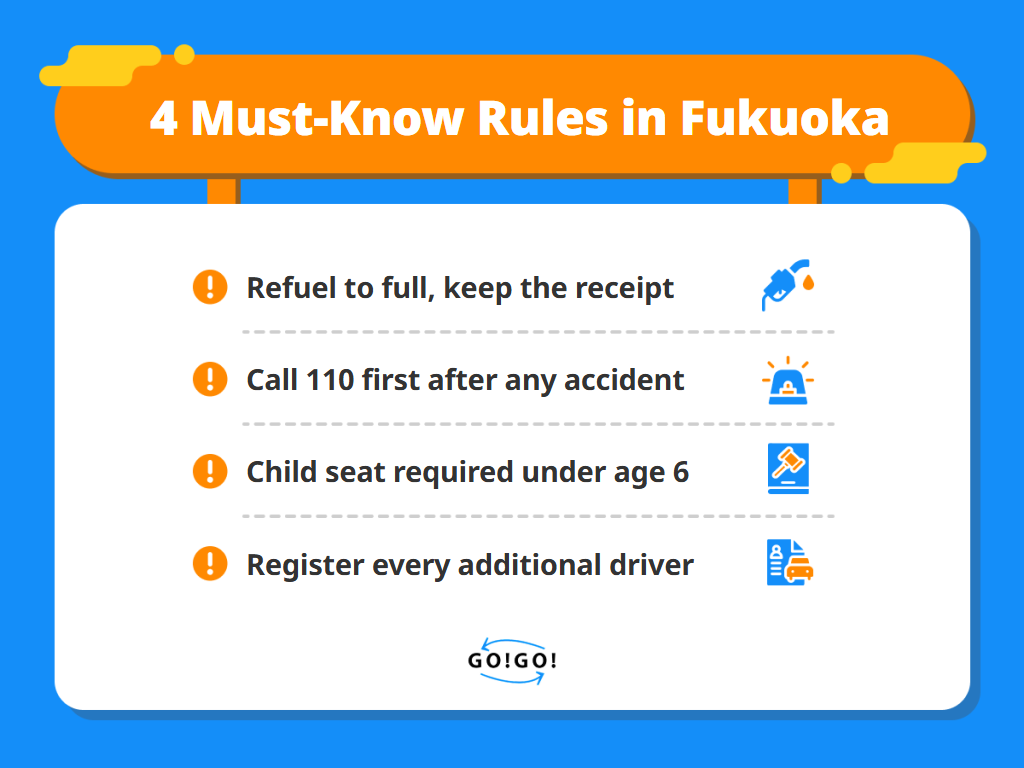
- Return the tank full and keep the receipt. Cars are handed over full, so refuel at a station near the branch before returning (most models take Regular unleaded). Hold on to the fuel receipt — staff will ask to see it at drop-off.
- Call 110 after any incident, however minor. Even a scraped guardrail or a chipped bumper in a car park needs a police report and a call to the operator. Without the police accident certificate, neither your CDW nor your NOC cover pays out, and the full repair and business-loss bill lands on you.
- Child seats are mandatory under age 6. Japanese law requires an approved child seat for any passenger under six. Add it when you book — showing up and hoping the branch has a spare is how pickups get cancelled.
- Register every additional driver. If friends or family plan to share the wheel, all of them must be present at the counter with their documents and be registered as additional drivers. An accident involving an unregistered driver voids the insurance entirely.
How the pickup works, step by step
- Book online. Fix your dates and pickup/return branches, then choose the car by group size and suitcase count. Add CDW and NOC cover at this stage, plus a child seat if you are travelling with young children.
- Check in at the branch. After landing at Fukuoka Airport or arriving at Hakata Station, head to the rental desk, or follow your voucher to the shuttle for a nearby depot. Have the passport, home licence, IDP (or official Japanese translation) and credit card ready for every registered driver.
- Walk around the car. With the staff member, check existing scratches and dents, and photograph or film them. Confirm the navigation language setting and that the ETC reader works before signing the handover sheet.
- Drive off. Japan drives on the left. At a red 「止まれ」 sign you must come to a complete stop before proceeding, and pedestrians always have priority at crossings.
- Refuel and return. Fill up near the branch and keep the receipt. Staff check the condition, fuel level and settle the ETC tolls; after that, a shuttle takes you back to the airport or station.
Where to pick the car up — three options
- Fukuoka Airport (default choice). Clear customs, collect your bags, collect the car. Best if you plan to head straight out to Yufuin, Kumamoto or Nagasaki. As Kyushu’s main gateway, expect queues at peak arrival times and heavier traffic around the airport.
- Hakata Station / Tenjin. If your first day or two is Fukuoka city — shopping, the yatai food stalls — use the subway for those days and collect the car on day three when you head out of town. Skipping two nights of ¥1,500–2,000 downtown hotel parking plus the rental days is real money, and you avoid city traffic while jet-lagged.
- Regional airports (Kumamoto, Oita). If you are flying directly into another Kyushu prefecture, these smaller airports clear quickly and the rental desks rarely have a queue — you are on the road within minutes.
FAQ — Fukuoka car rental quick answers
Q. What do I need to rent a car in Fukuoka?
A Geneva-1949 International Driving Permit, your home country driving licence, your passport, a booking confirmation, and a credit card in the main driver’s name — all originals. The minimum driving age in Japan is 18. Travellers from Switzerland, Germany, France, Belgium, Monaco, Slovenia, Estonia and Taiwan bring an official Japanese translation of their licence instead of an IDP.
Q. How much does a rental car cost per day in Fukuoka?
A 5-seat compact SUV is roughly ¥7,500–9,500 per day in low season (April–May, October–November) and ¥11,000–13,500 or more during summer holidays, New Year and long weekends. Across all operators and car sizes, daily rates in Fukuoka span about ¥5,000 to ¥30,000.
Q. Do I need the Kyushu Expressway Pass (KEP)?
Only if you are covering long distances across several prefectures — north Kyushu down to Kagoshima, for example. For a Fukuoka–Kumamoto or Fukuoka–Yufuin round trip, paying tolls with a rented ETC card (about ¥330) is normally cheaper.
Q. Can I pick up in Fukuoka and return somewhere else?
Yes — all seven operators listed here support one-way rentals. A repositioning fee applies, scaled to the distance between branches, from a few thousand yen to over ten thousand. Times CAR RENTAL waives it for drop-offs within 20 km inside the same prefecture.
Q. Is CDW enough, or do I need the full-cover plan?
CDW (about ¥1,100–1,430 per day) waives the ¥50,000–100,000 damage excess, but it does not waive the NOC business-loss charge of ¥20,000–50,000. If you want zero exposure, take the full-cover or “RAP”-style plan that includes NOC.
Q. What car size do I need for four people with luggage?
A crossover SUV handles two 28-inch cases plus a cabin bag for two or three adults. Four adults with a full case each should book a 7-seater or minivan, where folding the third row frees space for four to five large cases.
Q. Should I rent from Fukuoka Airport or Hakata Station?
Take the airport if you are driving straight out of the city on arrival day. Take Hakata Station or Tenjin if your first days are spent in central Fukuoka — you avoid ¥1,500–2,000 per night in downtown parking and skip city traffic on the day you land.
Q. What do I do if I scratch the car?
Call 110 immediately, even for a minor scrape or a solo incident, then contact the rental operator. The police accident certificate is what makes your CDW and NOC cover valid; without it, the repair and business-loss costs fall entirely on you.
Wrap-up — a Kyushu trip is built around the car, not the timetable
Hokkaido and Okinawa have long been Japan’s classic self-drive regions, and Kyushu has quietly joined them. Morning mist over Yufuin, the Aso caldera rim, the run south to Kagoshima with Sakurajima on the horizon — all of it opens up once you are not waiting for the next bus.
GO!GO!TOUR is built for travellers doing exactly that: an English interface and live chat support, hotel pickup around Fukuoka Airport and the city, and Web Check-in so the counter step is a formality rather than a queue.
✨ Five reasons travellers book with GO!GO!TOUR
- Live chat with a real person — support in English during Japanese business hours, so booking questions get answered before you fly.
- A fleet that actually fits — multiple vetted local operators covering everything from 4 to 8 seats.
- Flexible pickup and return times — partners that handle out-of-hours collection, which matters on a late arrival.
- Delivery and collection — paid hotel pickup and return, or a hotel shuttle, available on selected plans.
- One platform for the whole trip — private transfers, accommodation and eSIM can be booked alongside the car.
Book your Fukuoka rental car and plan the Kyushu drive with GO!GO!TOUR
Fukuoka rental cars by vehicle type
- Kei cars — narrow streets and tight car parks, cheapest to run
- Compact cars — 2–3 people, Aqua / Yaris class
- Mid-size and wagons — 4–5 people with real luggage space
- Minivans and 8-seaters — families and friend groups of 6–8
- All rental partners — compare every operator side by side
Plan the rest of your Kyushu trip
- Fukuoka model course — a ready-made route to adapt
- Find activities by category — experiences to slot into the drive
- Japan eSIM — activates on arrival, works with maps and translation apps
- Discount coupons — check current promotions before you book

※ Prices, opening hours and terms in this article reflect information handled by GO!GO!TOUR at the time of writing, and vary by season, model and operator. Confirm the final quote on the booking page. — GO!GO!TOUR Editorial Team