Adding a Second Driver in Japan — Free at Every Major Agency, But Skip the Paperwork and Your Insurance Disappears
If you are planning to rent a car in Japan and take turns driving with a friend, family member, or partner, the first question is usually the same: “Do I have to pay extra?”
Here is the short answer — every major Japanese rental car chain (Times, ORIX, Toyota Rent-a-Car, Nippon, Nissan, OTS) registers additional drivers for free. No per-day fee, no per-driver surcharge. That is the polar opposite of what most travelers are used to in the US, Europe, or Hawaii, where “additional driver” is a per-day billing line, or global brands like Hertz Japan that still charge for it.
The catch is this: “free” only applies if you actually register at the counter. Drive without your name on the rental slip and the moment something happens, your voluntary insurance, CDW (Collision Damage Waiver), and NOC (Non-Operation Charge) waiver all become completely void. You pay for the repair, the lost-revenue charge, and any liability to a third party out of pocket.
At GOGO TOUR (our brand), we handle bookings for Okinawa rental cars, Fukuoka rental cars, and Hokkaido rental cars across Japan, and this is one of the most common pre-trip questions we receive. This guide walks through the policies of each major agency, the exact documents international travelers need, the counter registration procedure, and — most importantly — what actually happens if you skip it.
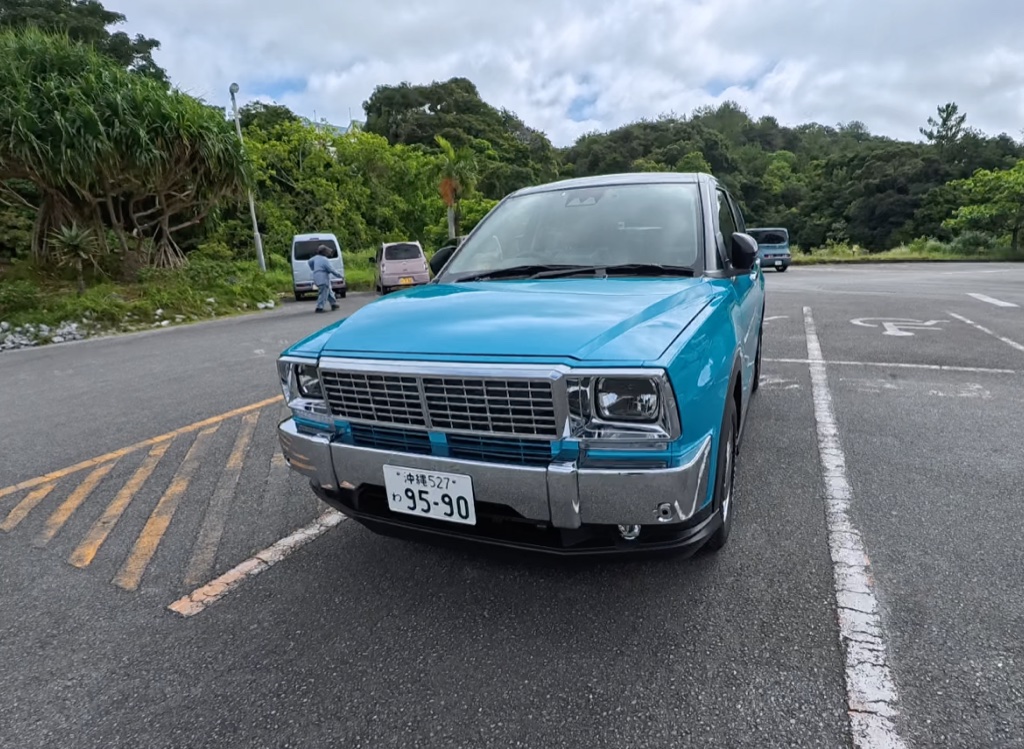
The One-Line Summary — Free, No Hard Cap, All Drivers Must Show Up
Adding a second (or third, or fourth) driver at any major Japanese rental agency is free. There is no published maximum in most cases. The one non-negotiable rule: every intended driver must appear at the counter in person with their original license.
Those three points cover 95% of real-world situations. What follows below is the fine print — agency-by-agency comparison, the document trap that catches most international visitors, and the post-accident consequences if you cut corners.
Agency-by-Agency Policy Comparison
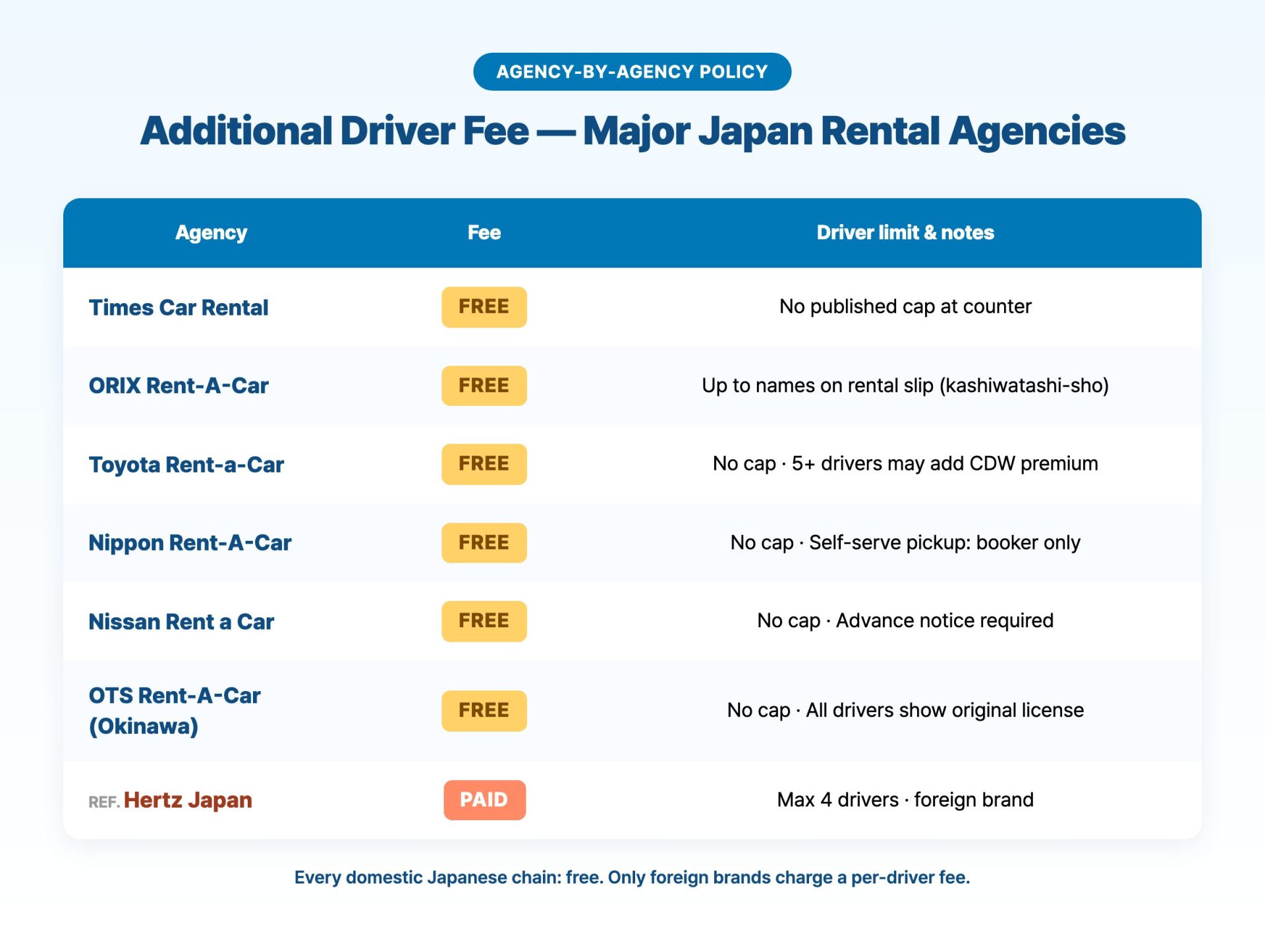
Here is how Japan’s six largest domestic chains stack up, plus Hertz Japan as a foreign-brand comparison point.
| Agency | Fee | Driver limit | When / where to register | If a driver cannot come |
|---|---|---|---|---|
| Times Car Rental | Free | No published cap at the counter | Day of pickup, in-store, all drivers show original license | Representative brings color copy of both sides of the license |
| ORIX Rent-A-Car | Free | Up to whatever fits on the rental slip (kashiwatashi-sho) | Contract holder + all drivers must appear at both pickup and return | Secondary driver license check “not strictly required” — booker takes responsibility for validity |
| Toyota Rent-a-Car | Free | No cap. But 5+ drivers may trigger extra CDW premium | Counter with originals. Web pre-registration available | Representative brings clear color photocopy (phone screen not accepted) |
| Nippon Rent-A-Car | Free | No published cap | All drivers appear, sign the driver field on the rental slip | Name-only entry accepted case-by-case. Self-serve pickup: booker only |
| Nissan Rent a Car | Free | No published cap | Advance notification to the branch is mandatory | Same-day no-show: license photocopy accepted |
| OTS Rent-A-Car (Okinawa) | Free (confirm at booking) | No published cap | All intended drivers show originals before departure | All-drivers-present policy |
| Reference · Hertz Japan (foreign brand) | Paid (rate varies) | Max 4 drivers (1 if under 25) | Counter | Under-25 pays additional young-driver surcharge |
You can see the pattern immediately: every domestic Japanese chain we work with registers additional drivers for free, while Hertz Japan — as a global brand — still applies per-driver charges and a hard cap of four. If you ever see an “additional driver fee” on a Japan rental invoice, it is almost always from a foreign brand or a young-driver surcharge (under 25), not from the additional-driver line itself.
Most agencies also don’t publish a numerical cap. Practically speaking, you can add as many drivers as fit on the paper rental slip (called the kashiwatashi-sho, 貸渡証). Only Toyota mentions a possible additional CDW premium beyond five drivers — a niche case for large family or group rentals.
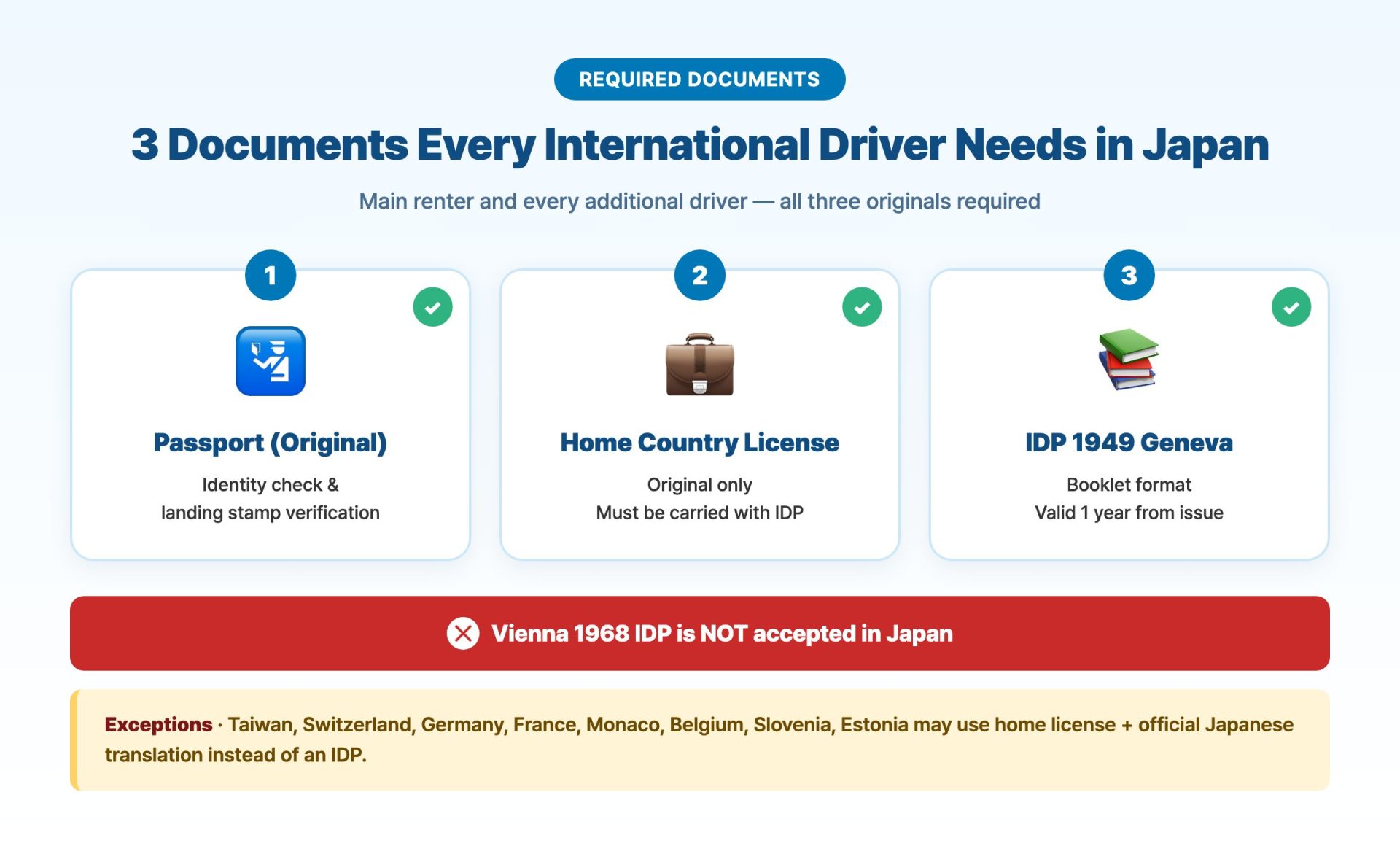
Required Documents — The 3-Item Set for International Travelers
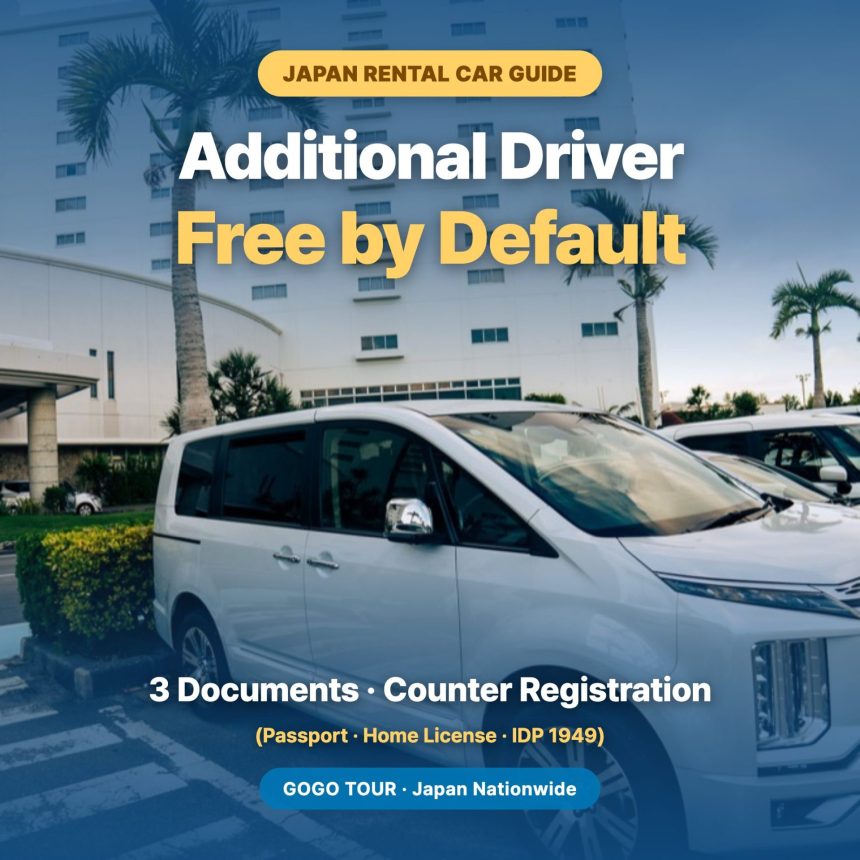
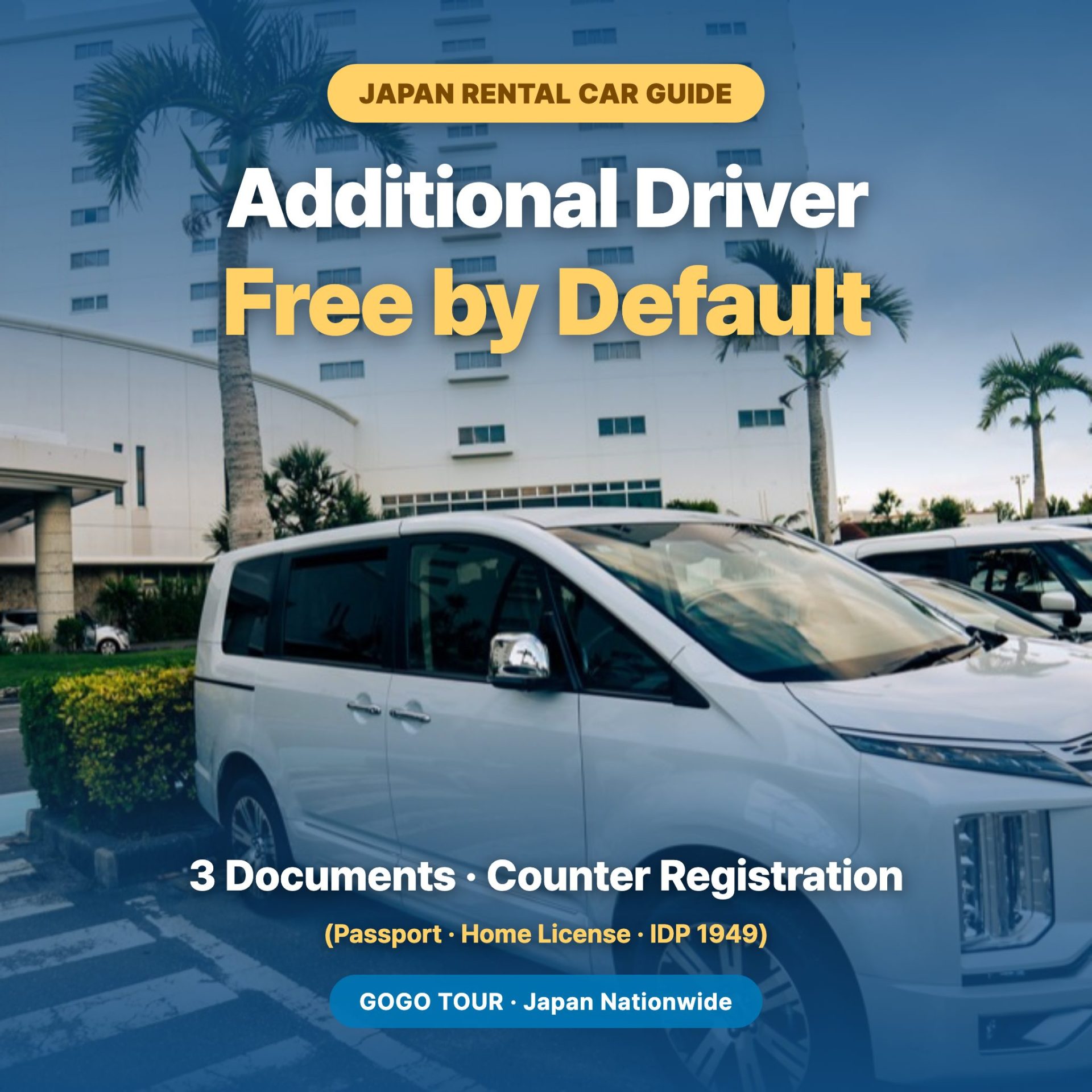
Japanese residents only need their original license. International travelers — from the US, Europe, Southeast Asia, or anywhere else — need three items, all of them, no exceptions. This applies equally to the main renter and to every additional driver.
- Original passport — for identity confirmation and the landing stamp check
- Original driver’s license from your home country — must be carried alongside the IDP
- International Driving Permit (IDP) based on the 1949 Geneva Convention — the booklet format, valid one year from issue
Miss any one of the three and the counter can (and often does) refuse the rental. Below are the four traps international travelers most often fall into.
Trap 1 — Only the 1949 Geneva Convention IDP is valid in Japan. This is the single biggest catch. Japan accepts only IDPs issued under the 1949 Geneva Convention. The 1968 Vienna Convention IDP — which is what many European countries issue by default — is not accepted. If your country only issues Vienna-format IDPs (for example, some travelers from Vietnam or certain other jurisdictions), you cannot drive in Japan on that document.
Trap 2 — A small group of countries can use a Japanese translation instead. Nationals of Taiwan, Switzerland, Germany, France, Monaco, Belgium, Slovenia, and Estonia can drive in Japan with their home license + an official Japanese translation (issued by JAF or their embassy) + passport, in lieu of an IDP. If you are from these countries, get the translation before you fly — it is not something you can arrange at the rental counter.
Trap 3 — The name spelling must match across all three documents. The English name printed on your IDP must match your passport character-for-character. Middle names, hyphens, marriage name changes, missing middle initials — any mismatch can invalidate the IDP at the counter. Check both documents side-by-side before you leave home.
Trap 4 — Photocopies have zero legal value. Originals only. A photo on your phone, a printed scan, or a laminated copy will be refused. This applies to the passport, the home license, and the IDP.
Bonus trap — Auto-gate entry with no landing stamp. Airports like Narita, Haneda, Kansai, and Naha now default to automated immigration gates, and travelers often exit without a landing sticker in their passport. Times Car Rental explicitly states: “Without a landing permission sticker or stamp, we cannot confirm your entry date and cannot release the vehicle.” When using the auto-gate, always request a landing stamp at the side counter — a 30-second detour that prevents a full rental refusal at the depot.
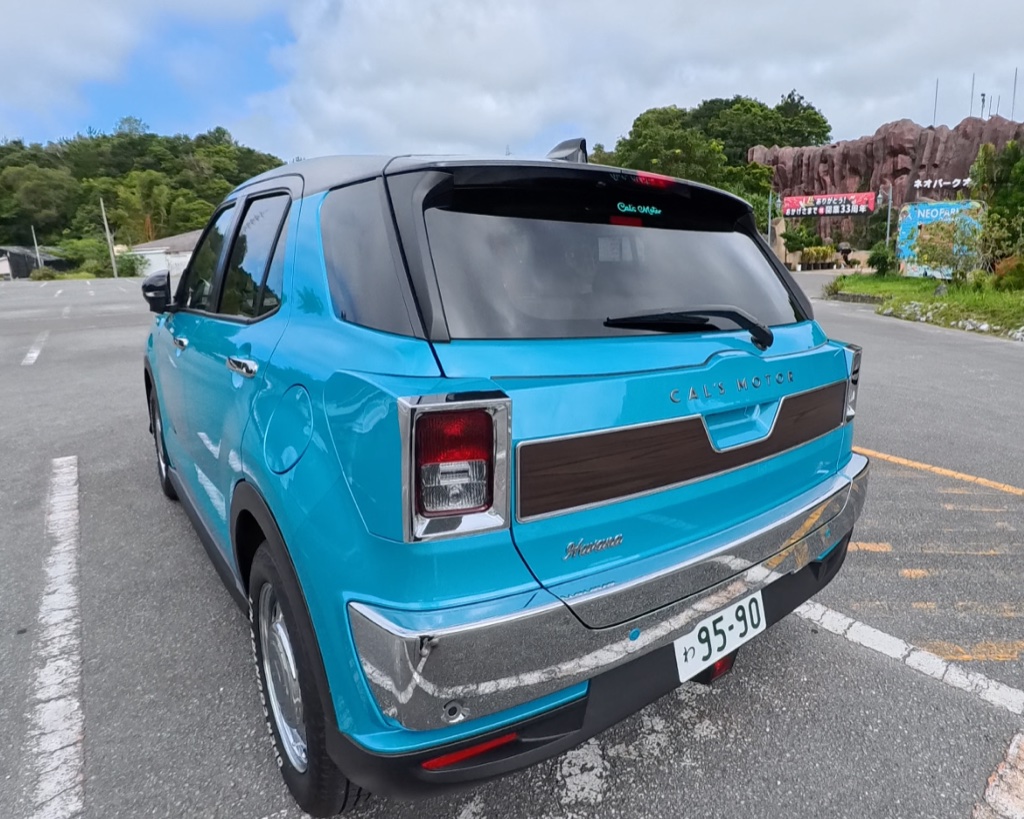
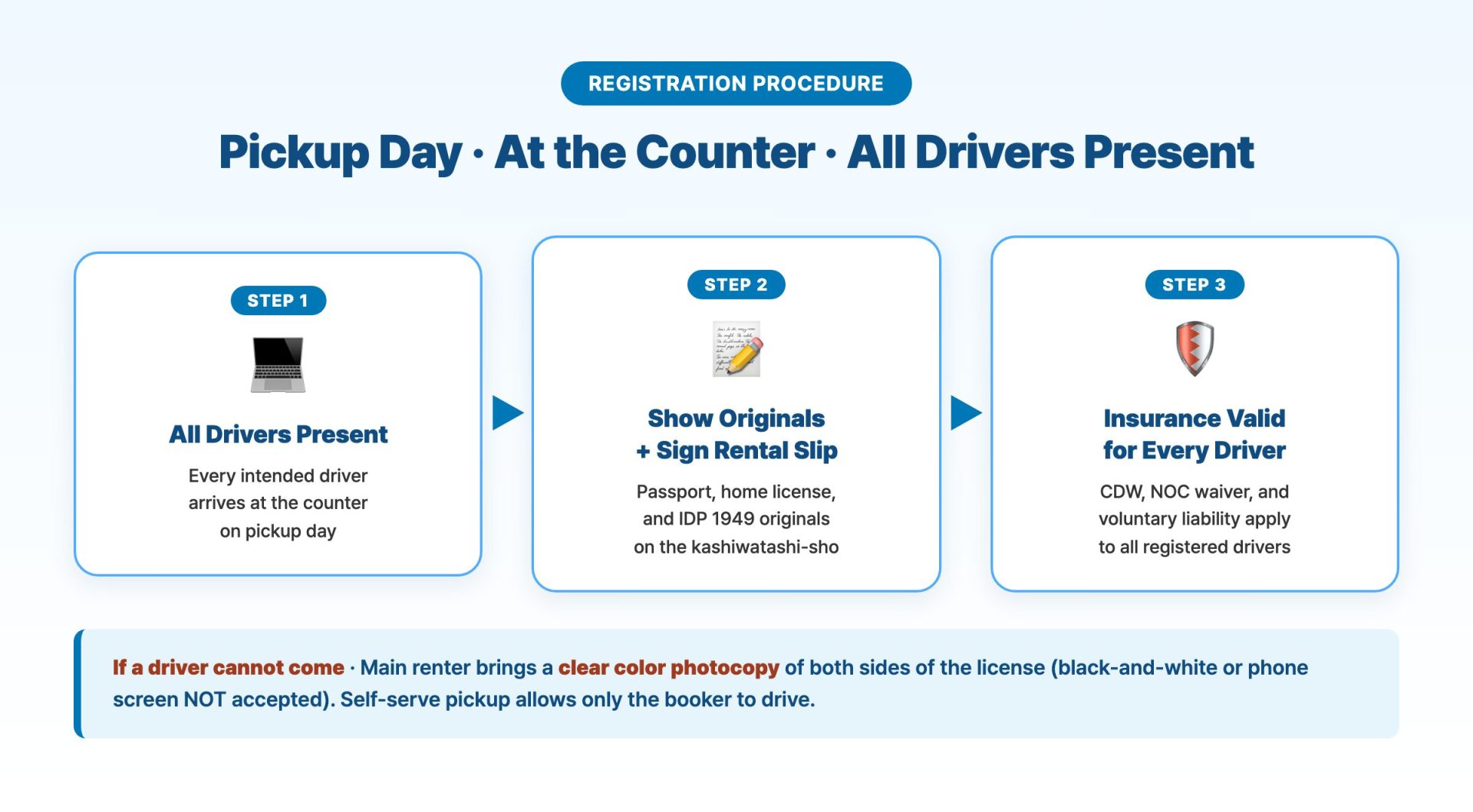
The Registration Procedure — Everyone at the Counter on Pickup Day
The standard rule across every major agency is all intended drivers present at the counter on pickup day, showing original licenses. ORIX and Nippon explicitly state that when the contract holder and driver differ, both must appear at pickup and at return.
Here is the situation that trips up the most people: what if you already picked up the car, and only later realized you should have registered a second driver? The answer is not “too late — just drive carefully.” The answer is go back to the depot and register the second driver, even after pickup. Insurance coverage kicks in from the moment registration is completed. What you lose is coverage for anything that happens before you return — but as long as you register before an accident happens, the coverage is valid from that point forward.
Toyota and Smart Go Okinawa Rent-a-Car (branded storefront) offer web pre-registration — you enter the additional driver’s name and license details from the booking confirmation screen, which shortens counter wait time. Note that pre-registration does not replace the in-person license check — the counter agent still needs to see the original documents on pickup day.
What if the second driver truly cannot make it to the counter? The workaround, though it is store manager’s discretion:
- Main renter brings a clear color photocopy of both sides of the absent driver’s license
- Black-and-white copies and phone-screen displays are not accepted (Toyota explicit)
- On self-serve pickup terminals (Nippon’s Self Rent-a-Car, ORIX self-checkin), only the booker themselves can drive — no additional drivers permitted via self-serve
If the plan is “we’ll just swap for a few minutes in a parking lot later” — that is exactly the scenario that triggers the biggest insurance disaster, which is the next section.
The Real Risk of Driving Unregistered — Every Insurance Layer Voided
This is the most important paragraph in the guide.
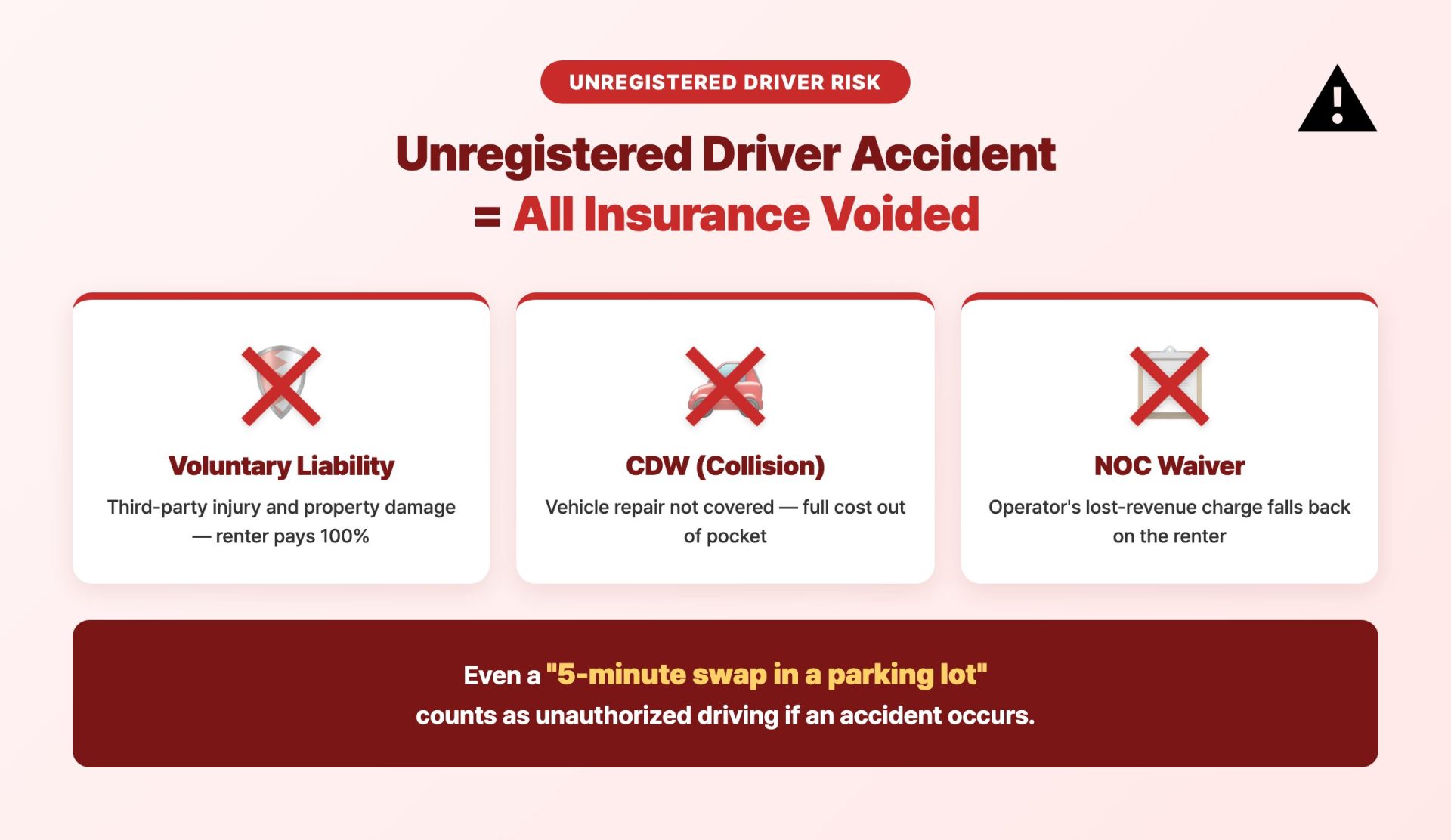
If a driver whose name is not on the rental slip gets into an accident, voluntary liability insurance, CDW (Collision Damage Waiver), and NOC (Non-Operation Charge) waiver are all voided simultaneously. Vehicle repair, lost-revenue charge, third-party liability — all of it becomes the renter’s out-of-pocket expense.
Japan travel media outlet Tabinfo summarizes three specific penalties:
- Insurance voided — “No insurance or CDW coverage applies; the entire cost is borne by the renter”
- Third-party liability voided — Even the other driver’s damage becomes your responsibility
- Contract violation — penalty fee possible
The most dangerous moment is “we’ll just swap in the parking lot for five minutes.” Tabinfo is explicit: “Even a brief driver swap inside a parking lot is treated as unauthorized driving if an accident occurs.” Accidents take a fraction of a second — the definition of “brief” is meaningless once metal starts crumpling.
Nippon Rent-A-Car’s terms say the same in legal language: any accident caused by “the borrower or a driver other than one declared at pickup” is excluded from all insurance and NOC coverage. And falsifying an accident report afterward (claiming the registered driver was actually behind the wheel) can escalate into criminal exposure under Japan’s Minor Offenses Act or false-accusation statutes.
The real value of “free additional driver registration” is not the money saved. It is keeping your insurance valid. Five minutes or 500 kilometers, if someone will drive, their name goes on the rental slip. That is the only safety mechanism.
Renting a Car in Okinawa? Read This
Okinawa has very limited public transport once you leave central Naha, so a rental car is effectively mandatory for real exploration. Our team at GOGO TOUR handles Okinawa rental cars, Fukuoka rental cars, and Hokkaido rental cars across Japan, and all of them follow the same free-additional-driver rule described above.
OTS Rent-A-Car in particular publishes English-language guidance that explicitly requires all intended drivers to present their license before departure — which for international visitors means the process is transparent from the booking stage.
For itinerary planning, our Okinawa model course guide covers the southern beach loop, Nago and the northern coast, and the Yanbaru forest. Driving distance and time vary sharply between routes, so if two or more people will share driving, make sure everyone brings a valid IDP — the person who forgot theirs will be a passenger for the entire trip.
Frequently Asked Questions
Q1. Is there any fee for adding an additional driver to a Japan rental car?
No — every major Japanese domestic chain (Times, ORIX, Toyota, Nippon, Nissan, OTS) registers additional drivers for free. Toyota Rent-a-Car explicitly calls this “an industry-standard rule.” Only when five or more drivers are registered may an extra CDW premium apply, and only at Toyota.
Q2. How many drivers can I register for free?
For in-person counter contracts, the practical limit is however many names fit on the rental slip (kashiwatashi-sho). Most agencies do not publish a hard cap. For most family or friend groups (two to four drivers), the answer is effectively “no limit.”
Q3. Can I drive in Japan with only an International Driving Permit?
No. You need all three: passport + original home-country license + IDP (Geneva 1949 booklet). The IDP alone is not sufficient — the counter will refuse.
Q4. My country issues 1968 Vienna Convention IDPs. Can I use that in Japan?
No. Japan only accepts the 1949 Geneva Convention IDP. If your country issues only Vienna-format IDPs, you cannot legally drive a rental car in Japan on that document. Check the format before you travel — the physical booklet will say “1949” on it if it is valid for Japan.
Q5. Can I pre-register additional drivers online?
Yes at Toyota Rent-a-Car — the additional driver menu is available on the reservation confirmation screen. Pre-registration does not skip the in-person license verification on pickup day, but it does shorten the queue.
Q6. I used the auto-gate at the airport and my passport has no stamp. Can I still rent?
Some agencies will refuse. Times Car Rental states that without a landing sticker or stamp confirming entry and re-entry dates, they cannot release the vehicle. Always request a landing stamp at the side counter when using auto-gate immigration.
Q7. What if an additional driver cannot come to the counter?
The main renter can bring a clear color photocopy of both sides of the absent driver’s license — often accepted, but this is store manager’s discretion, so confirm at booking. Phone-screen displays are not accepted.
Q8. Can we just swap drivers briefly without registering?
Absolutely not. Even a five-minute swap inside a parking lot triggers full insurance voiding if an accident occurs — you become personally liable for the repair, third-party damage, and the operator’s lost revenue. Since registration is free, the only rational choice is: if they will drive, register them.
Closing — “Free, But Register Anyway” is the First Seatbelt of a Japan Road Trip
Put it all together and the story is short:
Adding an additional driver to a Japan rental car is free at every major domestic agency. But you must bring passport + home license + 1949 Geneva IDP, and every driver must be registered at the counter, or your insurance evaporates the second something goes wrong.
In one sentence: “Because it is free, there is zero reason not to register. Even a five-minute swap — no exceptions.”
Before you fly, make sure every planned driver has their own valid 1949 Geneva IDP, and cross-check the name spelling against the passport. Those two checks alone eliminate 90% of counter refusals.
If you have any questions about Okinawa car rentals or additional driver registration, feel free to reach out to GOGO TOUR.
GO!GO!TOUR — Okinawa Rental Car & Marine Activity Booking
- Kei-car (K) search — narrow-street friendly, ideal for first-time Japan driving
- Compact (S) search — 2 to 3 passengers, Aqua / Yaris class
- Mid-size / Wagon (M / W) search — 4 to 5 passengers, long-distance or heavy luggage
- Minivan (V) search — 6 to 8 passengers, family or group travel
- Okinawa marine activity booking
- Okinawa restaurant & attraction guide