Ryukyu Village — 100+ Year-Old Kominka Houses, Daily Hanagasa Dance & Eisa Drum Performances
Quick Answer: Ryukyu Village in Yamada, Onna, central Okinawa is a “living cultural village” where 100+ year-old kominka houses have been relocated and restored, with daily Okinawan Hanagasa dance and Eisa drum parade performances. Adults ¥2,000 / 9:30-17:00 / open year-round / free parking. About 60 minutes by car from Naha — the perfect stop on your way north to Churaumi Aquarium or Kouri Island.
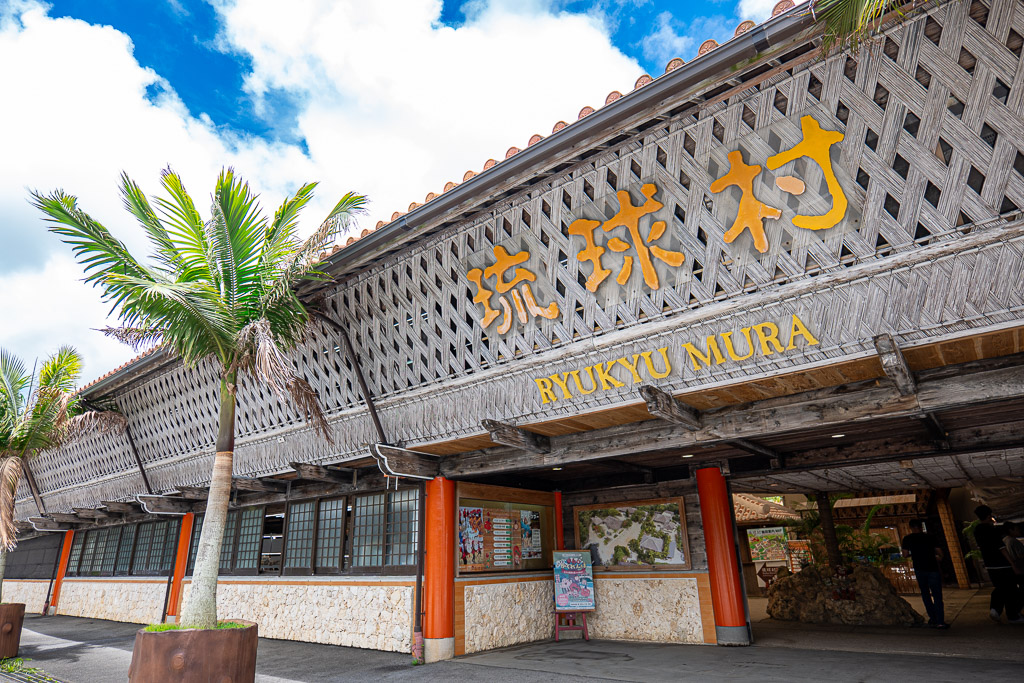
When planning your central and northern Okinawa itinerary and looking for a spot that lets you experience the Ryukyu Kingdom era in one place, the first pick is Ryukyu Village. Original 100+ year-old kominka houses from around Onna and Yomitan have been relocated and rebuilt here, with seven of them registered as National Tangible Cultural Properties. This is a genuine “historical site,” not a stage set.
This article lays out the most efficient way to enjoy Ryukyu Village by rental car, from a traveler’s point of view. Kominka houses, Okinawan Hanagasa dance and Eisa drum performances, Sanshin and Bingata workshops, the Awamori brewery, and the souvenir corner — the core highlights, ticket prices, showtimes, and parking info all in one read.
The freest way to enjoy central and northern Okinawa is by rental car. Easy English booking, transparent pricing — secure your wheels with GO!GO!TOUR Okinawa Car Rental before you lock in your route.
- Ryukyu Village — 100+ Year-Old Kominka Houses, Daily Hanagasa Dance & Eisa Drum Performances
- Ryukyu Village at a Glance — Key Info Table
- What Is Ryukyu Village? — A Culture Park Built from Real Kominka Houses
- Getting There — Why a Rental Car Is the Answer
- (1) Kominka House Cluster — Seven Houses Registered as Cultural Properties
- (2) Eisa + Hanagasa Dance Show — Okinawa's Two Traditional Arts in One Performance
- (3) Folk Song & Dance Show — Sanshin, Ryukyuan Folk Songs + Traditional Dance
- (4) Sanshin, Bingata & Ryuso Workshops — Make Your Own Okinawa Memory
- (5) Sakimoto Sake Brewery — Watch Ryukyu's National Spirit Being Made
- (6) Okinawa Rural Life Zone — Water Buffalo, Sugarcane Press & Habu Snake
- (7) Tropical Garden — Dragon Trees, Pineapples & Sacred Spring
- (8) Pohpoh Shop, Sugarcane Juice & Shaved Ice — Okinawan Sweet Treats
- (9) Ryuso Dress-up — Become a Ryukyuan Princess or Prince
- (10) Souvenir Corner — Shisa, Bingata Goods & Awamori, All in One Place
- Driving Routes — Three Model Itineraries Linking Ryukyu Village
- Okinawa Trip = Maximum Freedom with a Rental Car
- Ryukyu Village — Map Location
- FAQ
- Wrapping Up...
Ryukyu Village at a Glance — Key Info Table
| Item | Details | Quick note |
|---|---|---|
| Location | 1130 Yamada, Onna, Kunigami, Okinawa | About 60 min by car from Naha Airport / city |
| Hours | 9:30 – 17:00 (last entry 16:00) | 2 show types × 4 shows = 8 total; arrive in the morning |
| Closed | Open year-round | Open on holidays and New Year |
| Admission | Adults ¥2,000 / Students ¥1,500 / Ages 6-15 ¥800 / Under 5 free | Pricing per the official site |
| Parking | Free (about 200 spaces) | Bus-friendly; rarely full on weekdays |
| Suggested stay | 2 – 3 hours | Includes shows + house tour + workshop |
| Eisa + Hanagasa Dance Show | 4 shows/day (times per the official site) free with admission | Held in the kominka courtyard |
| Folk Song & Dance Show | 4 shows/day (times per the official site) free with admission | Sanshin, Ryukyu folk songs + traditional dance |
| Paid workshops | Sanshin, Bingata, Ryuso dress-up (¥500-¥3,000) | Pricing per the official site / on-site sign-up |
* All prices, showtimes, and workshop fees may change by season — always confirm with the official Ryukyu Mura website. Grab a park map at entry for the day’s schedule.
What Is Ryukyu Village? — A Culture Park Built from Real Kominka Houses
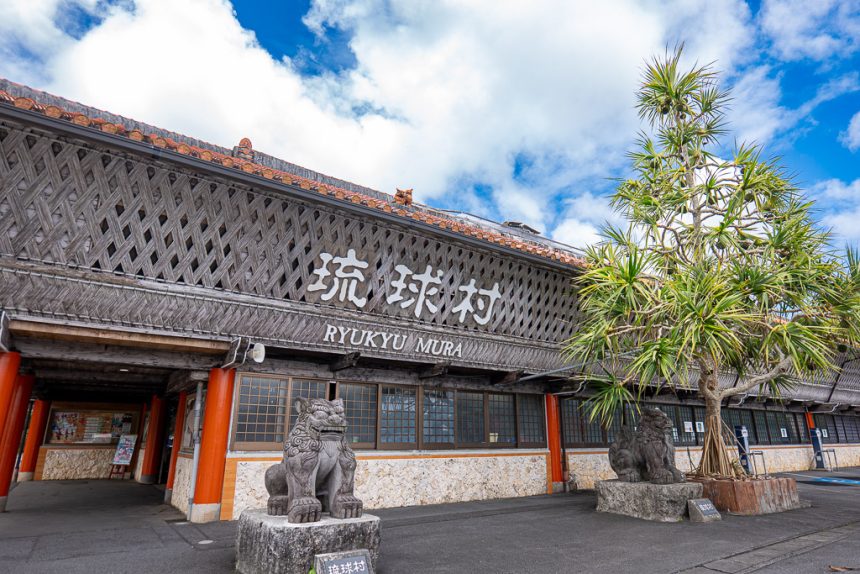
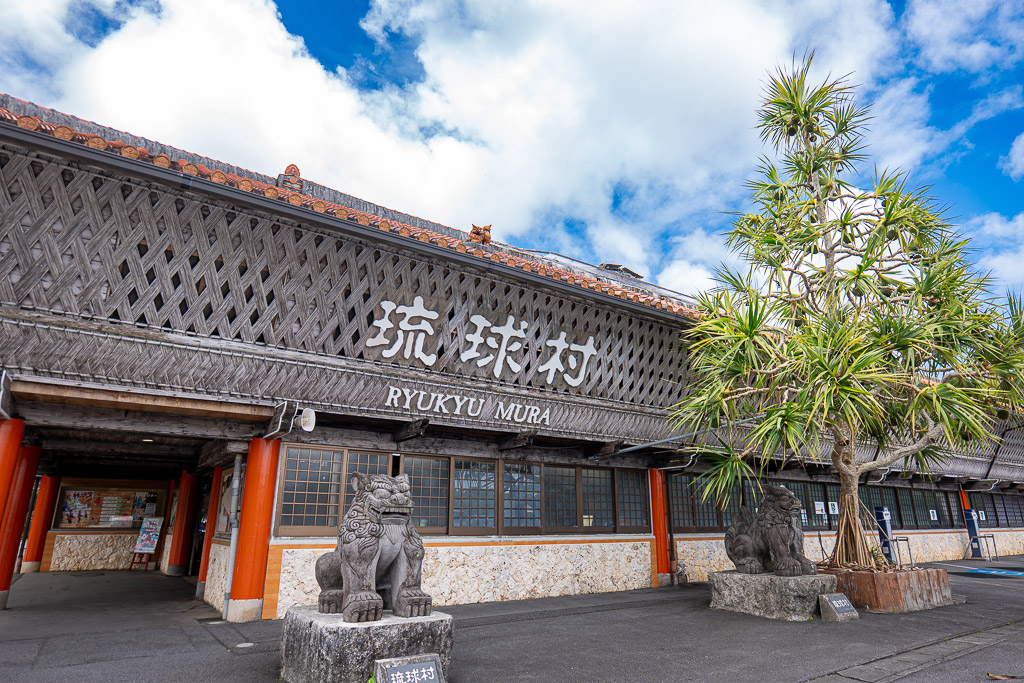
Opened in 1982 in Yamada, Onna, on central Okinawa’s main island, Ryukyu Village is a Ryukyuan culture theme park. Kominka houses over 100 years old, originally slated for demolition in Onna and Yomitan, were moved here and reassembled in their entirety, and seven of them are now Registered National Tangible Cultural Properties. These are not stage props — they are real residences from the Ryukyu Kingdom era, which sets the village apart from typical theme parks.
The courtyards host daily traditional Okinawan performances — the vibrant Hanagasa dance and the thunderous Eisa drum parade — while the houses themselves run Sanshin, Bingata, and Ryuso (Ryukyuan costume) workshops. Whether you come to watch, to play, or to take photos, there’s plenty to fill the day.
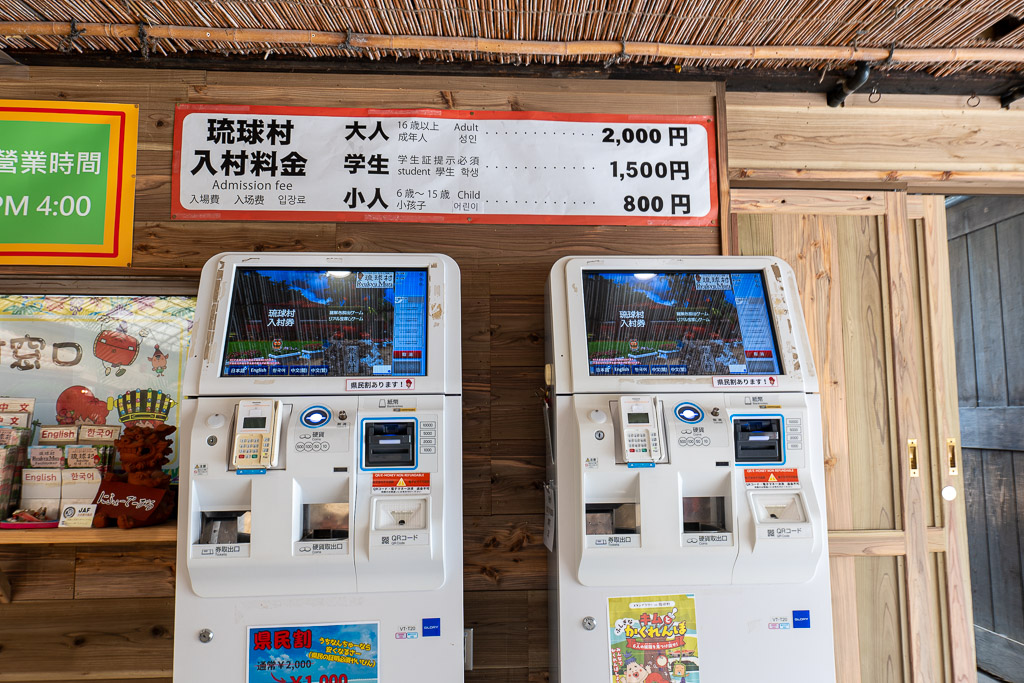
Tickets are bought from self-service vending machines at the entrance: Adults ¥2,000 / Students ¥1,500 / Ages 6-15 ¥800 / Under 5 free. The machines support English, Chinese, and Korean menus, so international visitors can purchase smoothly.
Getting There — Why a Rental Car Is the Answer
- Naha Airport to Ryukyu Village: about 60 min by car (Okinawa Expressway, exit Ishikawa IC, then 10 min)
- Kokusai Street / Naha city to Ryukyu Village: about 60 min by car
- Manzamo to Ryukyu Village: about 15 min (the Onna golden combo)
- Churaumi Aquarium to Ryukyu Village: about 75 min (perfect stop on your way north)
- Kouri Island to Ryukyu Village: about 75 min
Around 200 parking spaces, all free, with room for tour buses. On weekdays the lot rarely fills up.
Buses are an option — from Naha Bus Terminal / Asahibashi, take Bus 20 or 120 and get off at “Ryukyu-mura Mae” (1 minute on foot). But buses along the central west coast run infrequently, so a rental car is at least twice as efficient.
(1) Kominka House Cluster — Seven Houses Registered as Cultural Properties
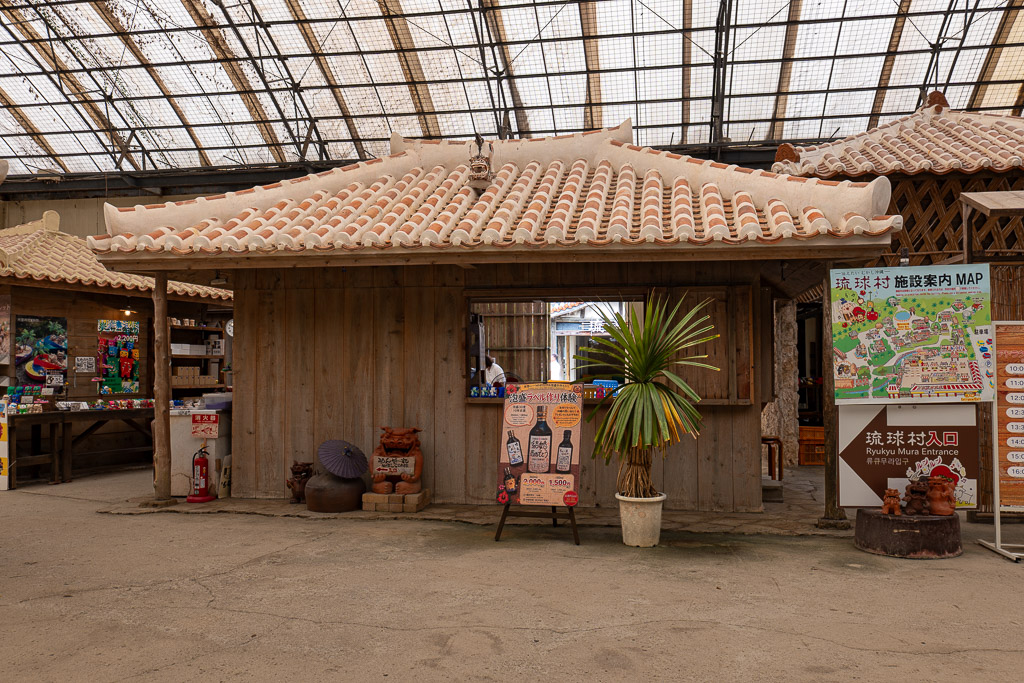
The first thing you see inside the village is the cluster of red-tile-roof kominka houses. Moved in whole from Yomitan and Onna, these include the Former Oshiro House, the Former Kuba House, the Former Higa House, and four others — seven in total registered as National Tangible Cultural Properties. Every one of them is over 100 years old.
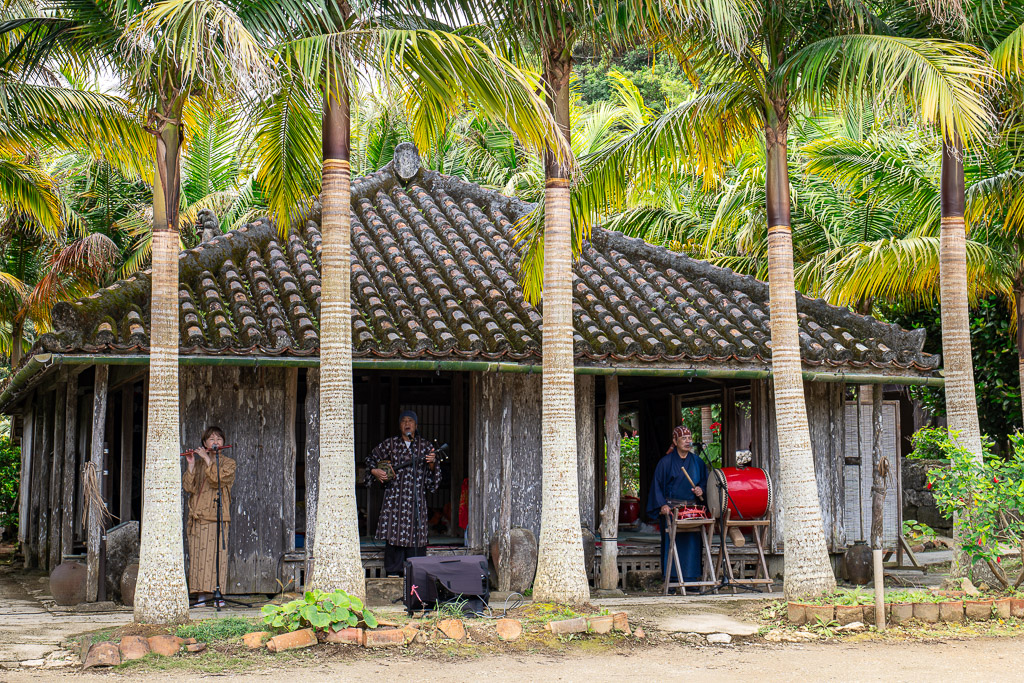
Wooden red-tile-roof houses framed by coconut palms — these are real lived-in homes, with floors worn smooth by decades of footsteps and pillars that still bear marks of daily life. Beyond the usual “Okinawa = beach” image, the “Okinawa = Ryukyu Kingdom culture” origin point is right here.
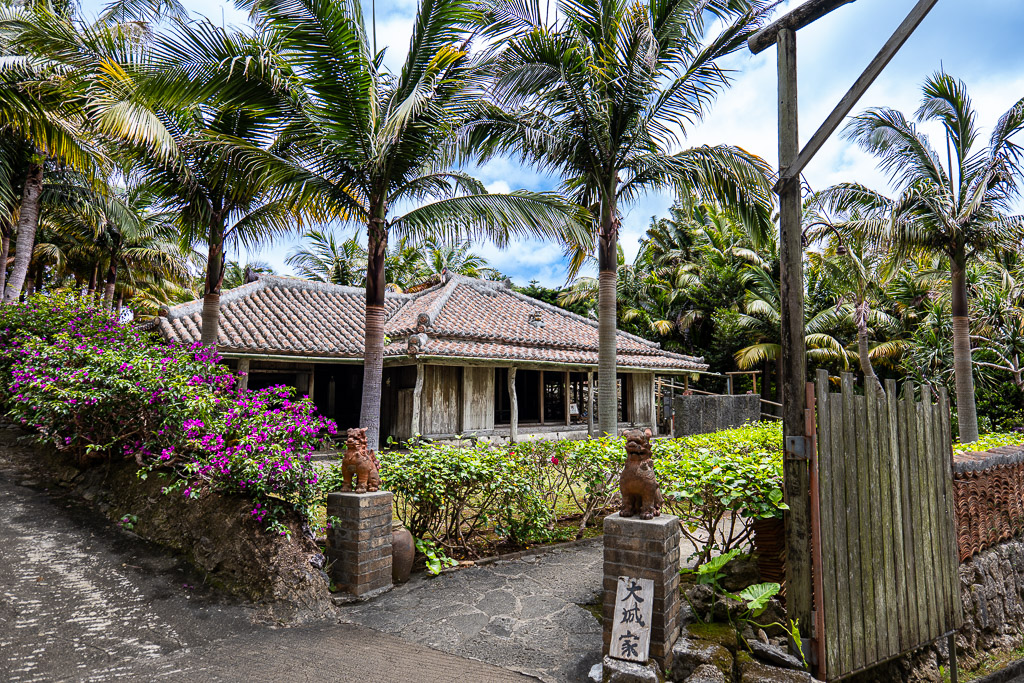
The most famous is the Former Oshiro House. The classic Okinawan red-tile roof, Shisa lion-dogs guarding the entrance, traditional water jars in the yard — every corner is photo-worthy. You can take off your shoes and step inside any of the houses to sit and soak it in.
Inside the houses you’ll find displays of period tools — stone mills, weaving looms, farm tools, fishing gear — giving you a real sense of how Ryukyuan ancestors lived day to day.
(2) Eisa + Hanagasa Dance Show — Okinawa’s Two Traditional Arts in One Performance
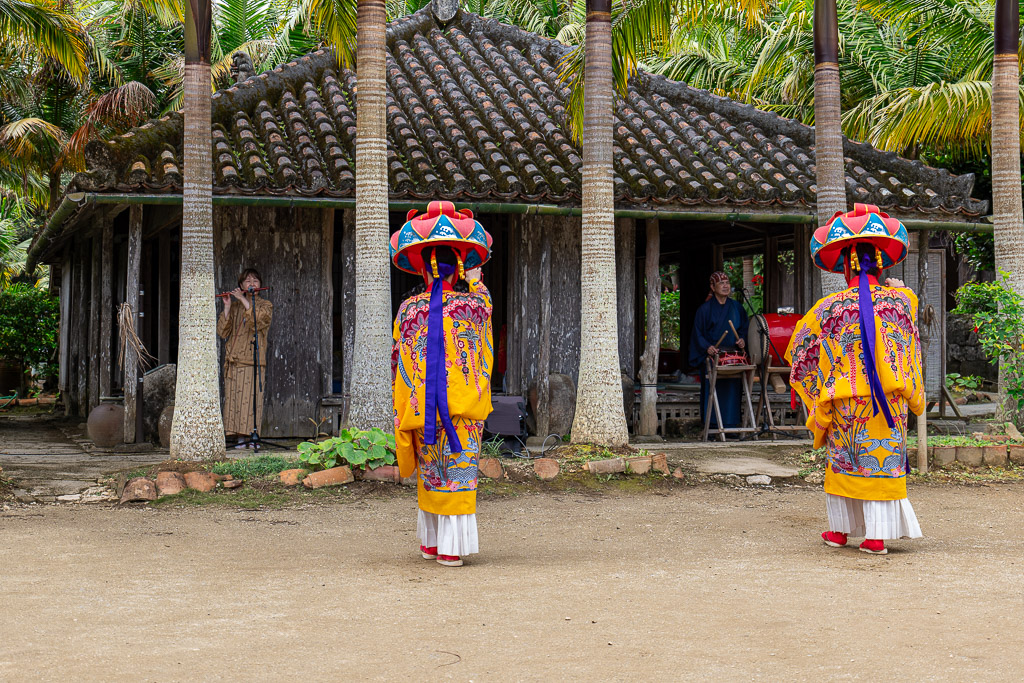
Ryukyu Mura’s headliner is the Eisa + Hanagasa Dance Show. Dancers in red-and-yellow flower hats (hanagasa) and vibrant Bingata-dyed Ryukyuan costumes glide to live Sanshin music, before red-and-black uniformed drummers burst in with thundering taiko — two of Okinawa’s signature traditional arts in a single performance. It’s the absolute must-see when you come to Ryukyu Mura.
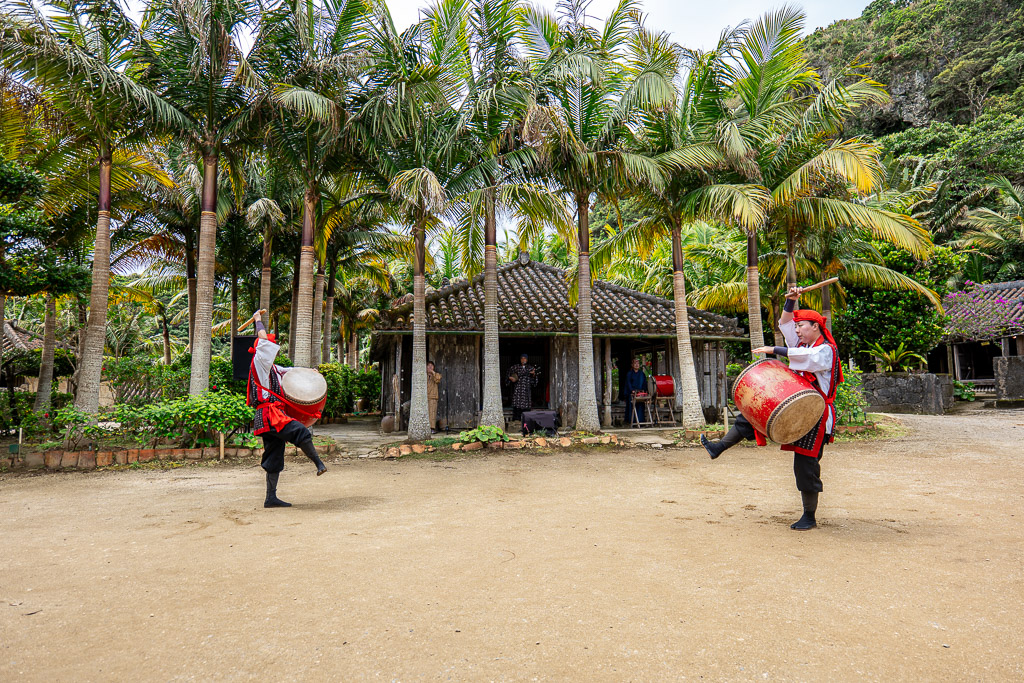
“Michi-junee” (the road parade) is a traditional Obon practice where young people drum their way through the village. Ryukyu Mura combines this lively parade with the graceful Hanagasa dance into a 4-show daily program held in the kominka courtyard.
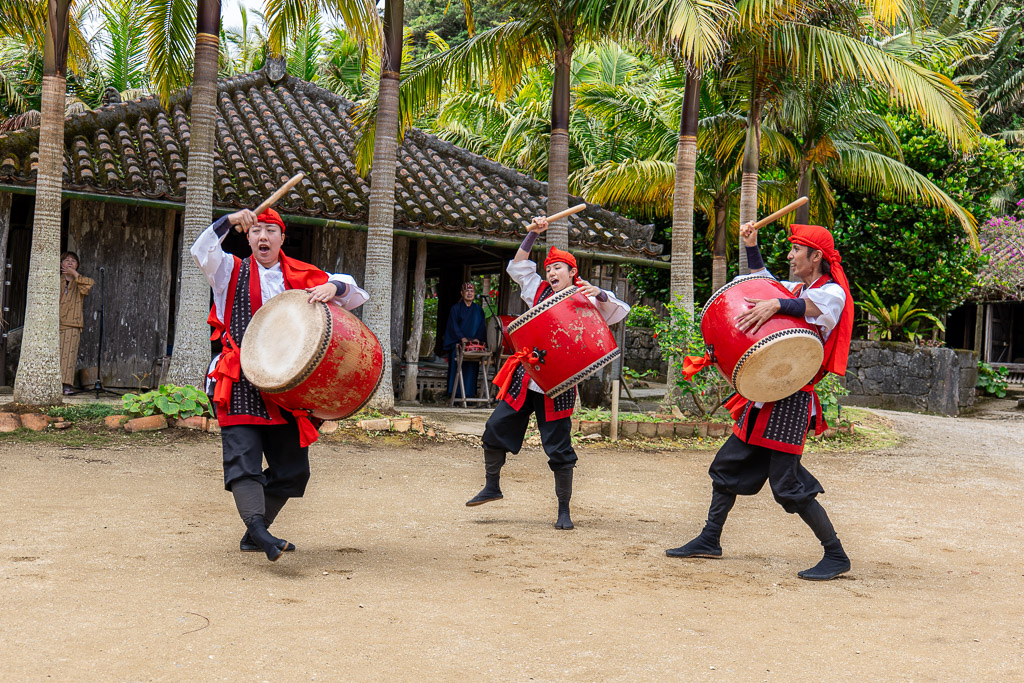
Drummers in traditional red-and-black uniforms shoulder massive drums and leap as they strike — the impact and rhythm get you nodding along before you realize it. Mid-show the drummers invite the audience to join in for drumming and photos. The performance ends at the central plaza, where the entire park vibrates with drums at once — an energy you can only feel in person.
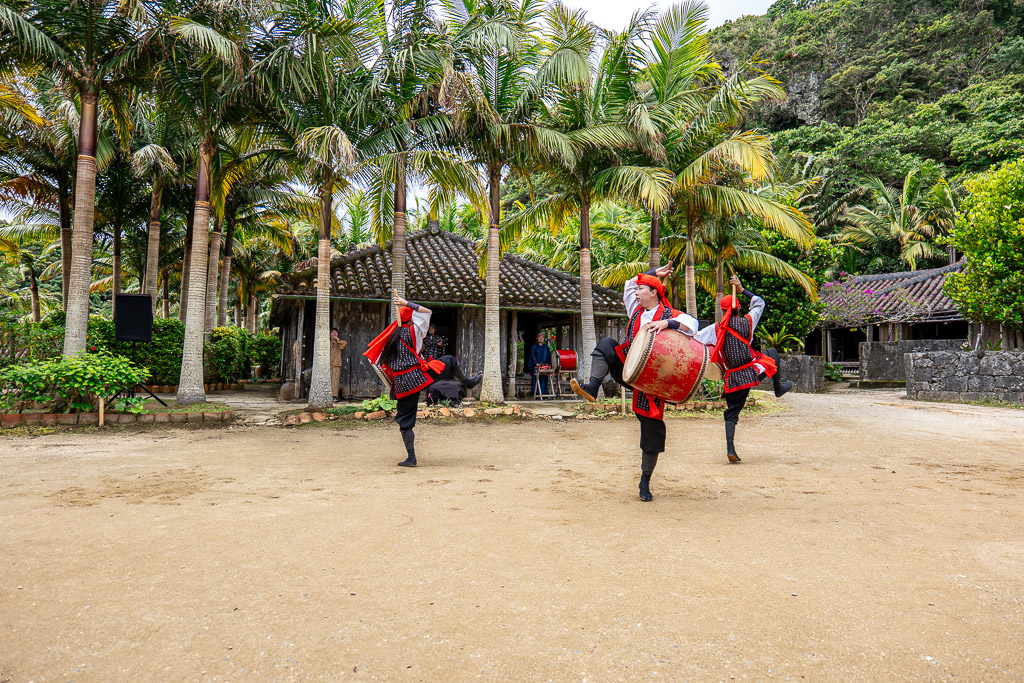
Eisa + Hanagasa Dance Show — quick facts
- 4 shows per day (in the kominka courtyard)
- Free with admission
- Open seating, no reservation
- Photo opportunity with dancers after the show
- For exact showtimes, please check the official Ryukyu Mura website; confirm the day’s schedule with the park map after entry
(3) Folk Song & Dance Show — Sanshin, Ryukyuan Folk Songs + Traditional Dance
Beyond the Eisa + Hanagasa Dance Show, Ryukyu Mura runs another signature program: the Folk Song & Dance Show. Set to live Sanshin folk songs, dancers perform a range of Ryukyuan traditional dances — a more everyday slice of Okinawan culture. Unlike the high-impact Eisa show, this one showcases the grace and subtlety of Ryukyuan tradition.
The Folk Song & Dance Show also runs 4 times per day, free with admission. It’s scheduled offset from the Eisa + Hanagasa Dance Show, so over the course of a single day you can catch up to 8 performances total.
Folk Song & Dance Show — quick facts
- 4 shows per day
- Free with admission
- Open seating, no reservation
- For exact showtimes, please check the official Ryukyu Mura website; confirm the day’s schedule with the park map after entry
(4) Sanshin, Bingata & Ryuso Workshops — Make Your Own Okinawa Memory
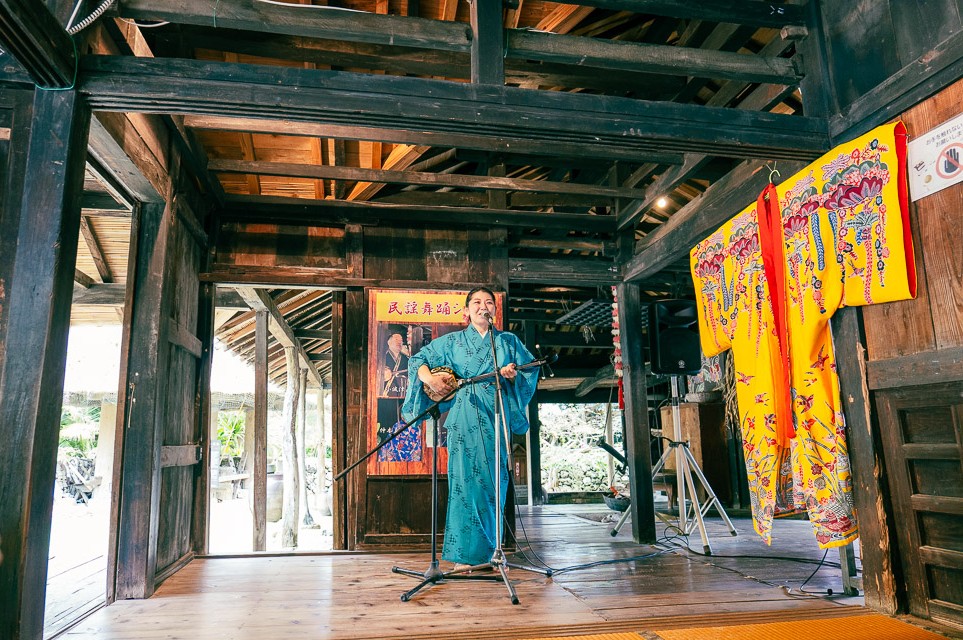
Each kominka houses a different paid workshop:
- Sanshin lesson — Okinawan three-string lute, 30 min (from ¥1,650)
- Bingata workshop — colorful Ryukyuan dyeing (from ¥1,500)
- Ryuso dress-up — wear the same Bingata-style Ryukyuan dress as the Hanagasa dancers and take photos (from ¥500)
- Pottery and Shisa painting — paint your own Shisa lion-dog (from ¥1,500)
- Indigo dyeing and washi paper — handkerchiefs, T-shirts, Ryukyuan paper
- Awamori knowledge and tasting — brewery tour with expert commentary
Most workshops run 30 min to 1 hour. Sign-up is generally on-site, and popular sessions fill up early on weekends and holidays — head straight to the reception desk after entering to lock in your slot.
(5) Sakimoto Sake Brewery — Watch Ryukyu’s National Spirit Being Made
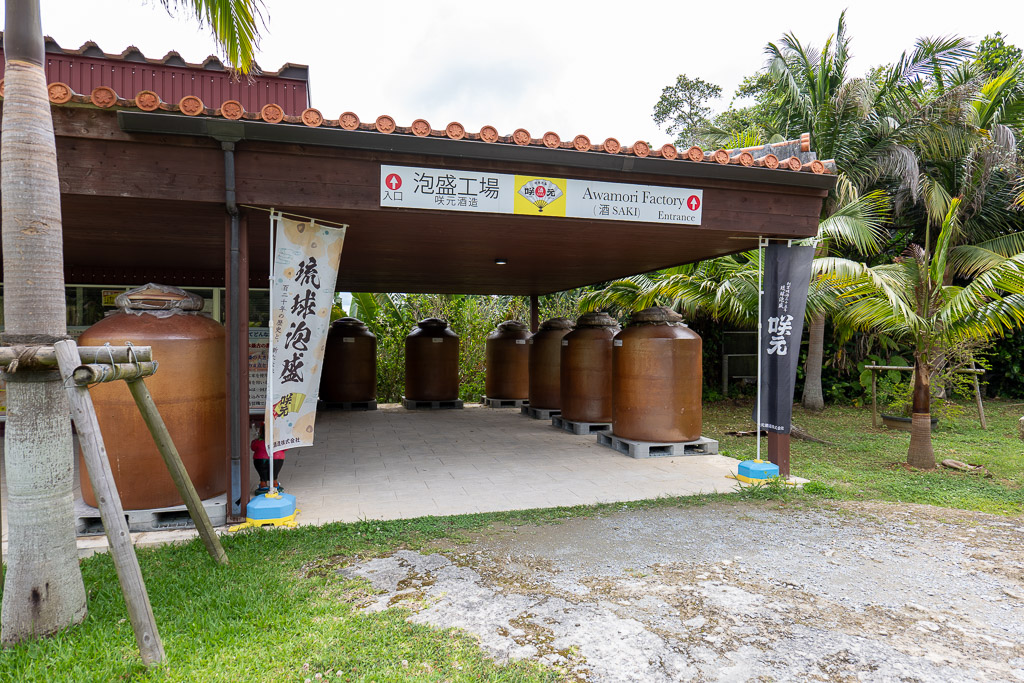
The Sakimoto Sake Brewery partners with Ryukyu Village to let you see the brewing of Awamori — Okinawa’s national spirit — up close. The row of huge reddish-brown clay jars, seven lined up side by side, is genuinely impressive.
Awamori is a distilled spirit made from Thai long-grain rice and black koji mold. At 30-43 proof it’s stronger than sake, but the mouthfeel is surprisingly smooth with a fragrant rice note. Sakimoto Sake Brewery, founded in 1902, is a long-established Naha brewer with deep heritage. Sampling on the spot and then grabbing a bottle directly is a smart souvenir move.
(6) Okinawa Rural Life Zone — Water Buffalo, Sugarcane Press & Habu Snake
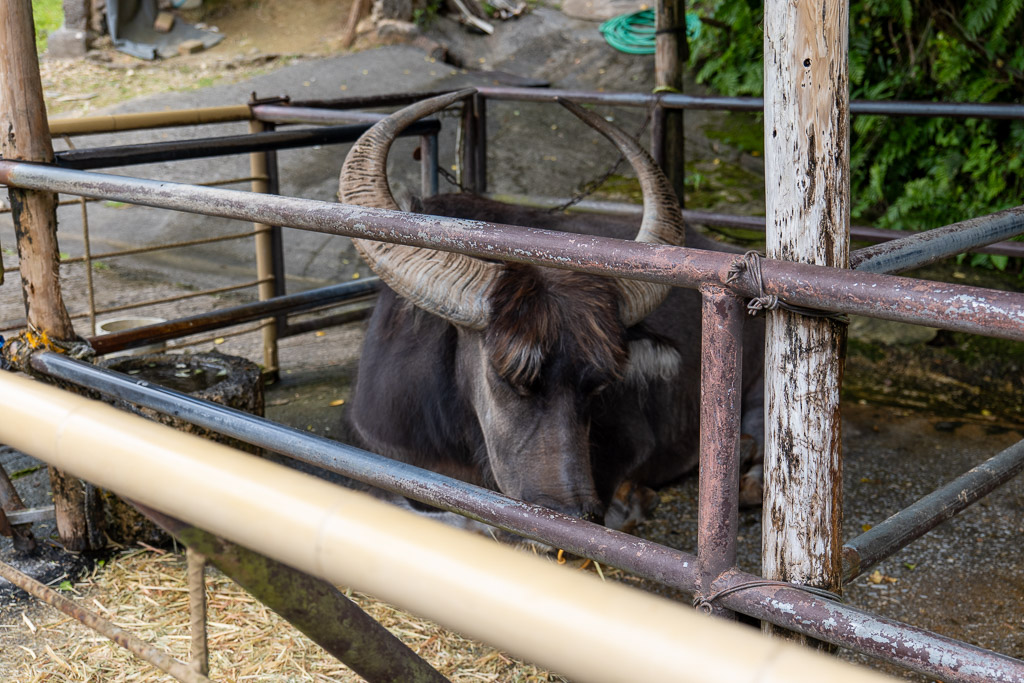
Another corner of the park is the water buffalo area. Old Okinawa used water buffalo to power sugarcane presses for brown sugar — a defining image of Ryukyuan rural life. The buffalo are gentle, so you can get a close look.
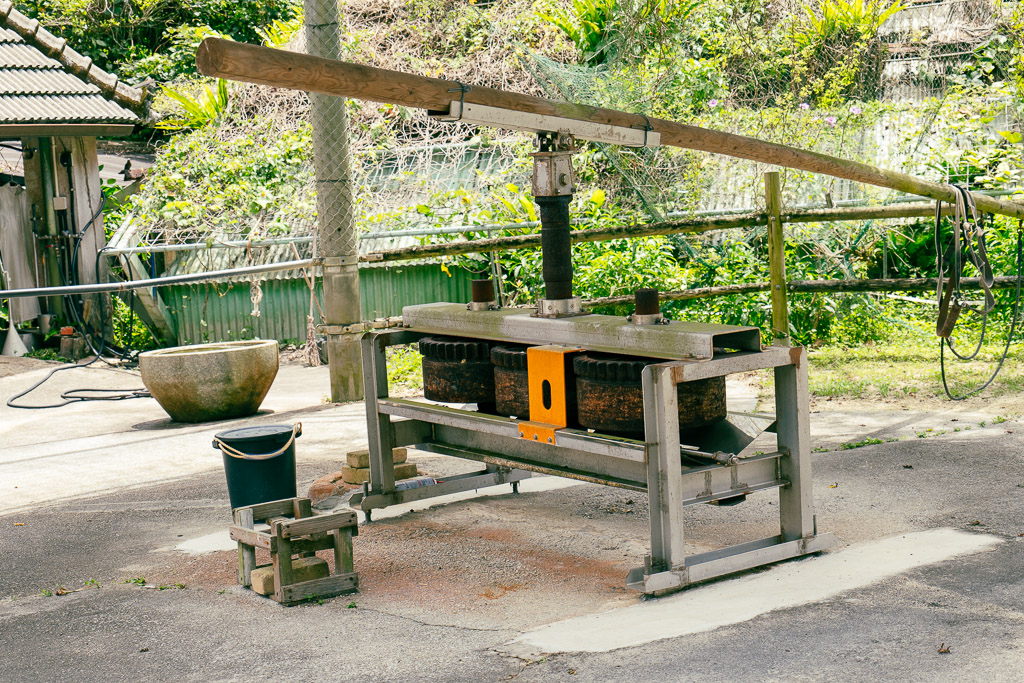
Right next to the buffalo is the traditional sugarcane press (sata-guruma): a large wooden beam the buffalo pulls in circles to extract cane juice, which is then boiled down into brown sugar. There are live brown sugar demonstrations and tastings at certain times — the raw cane sweetness is amazing.
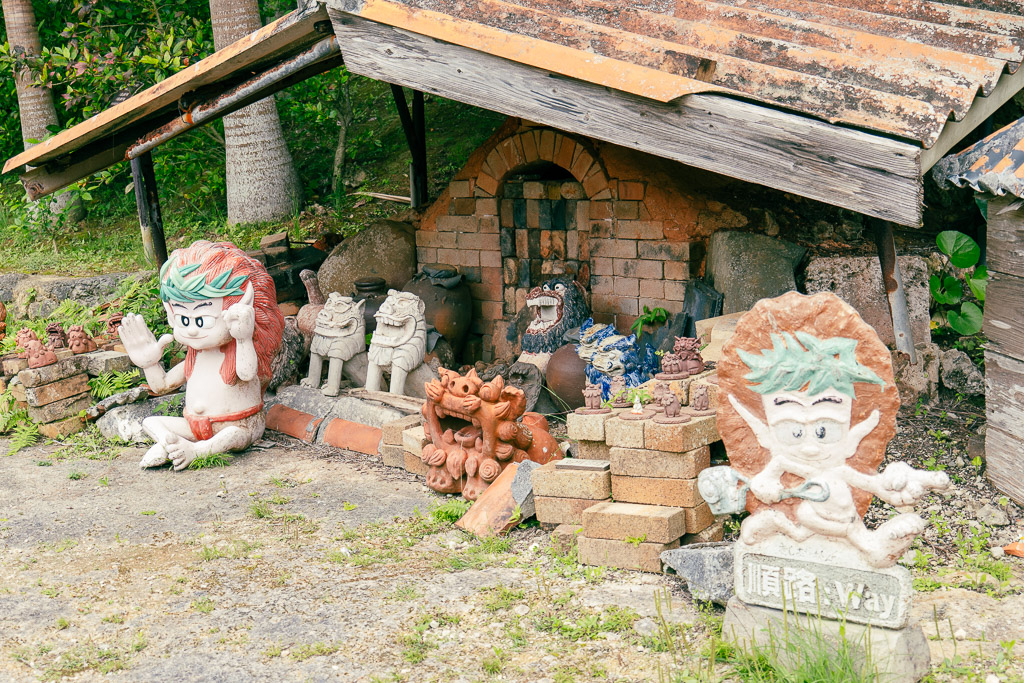
There’s also a Shisa pottery kiln display. Shisa figurines in every color and expression line up in rows, and the “Shisa painting workshop” is held in the nearby studio — paint your own one-of-a-kind Shisa to take home.
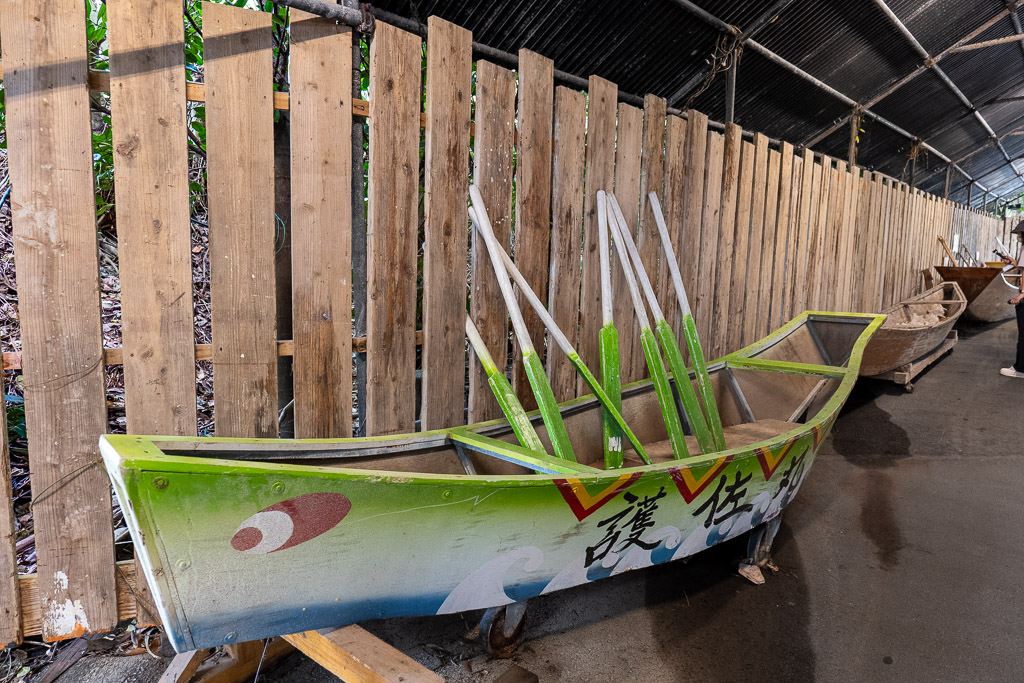
Another fun display is the traditional Ryukyuan Sabani fishing boat and the Itoman Harii (dragon boat race). The wooden Sabani boats taper at both ends — once the daily tool of Okinawan fishermen, now the racing craft of Okinawa’s summer Harii sea festivals.
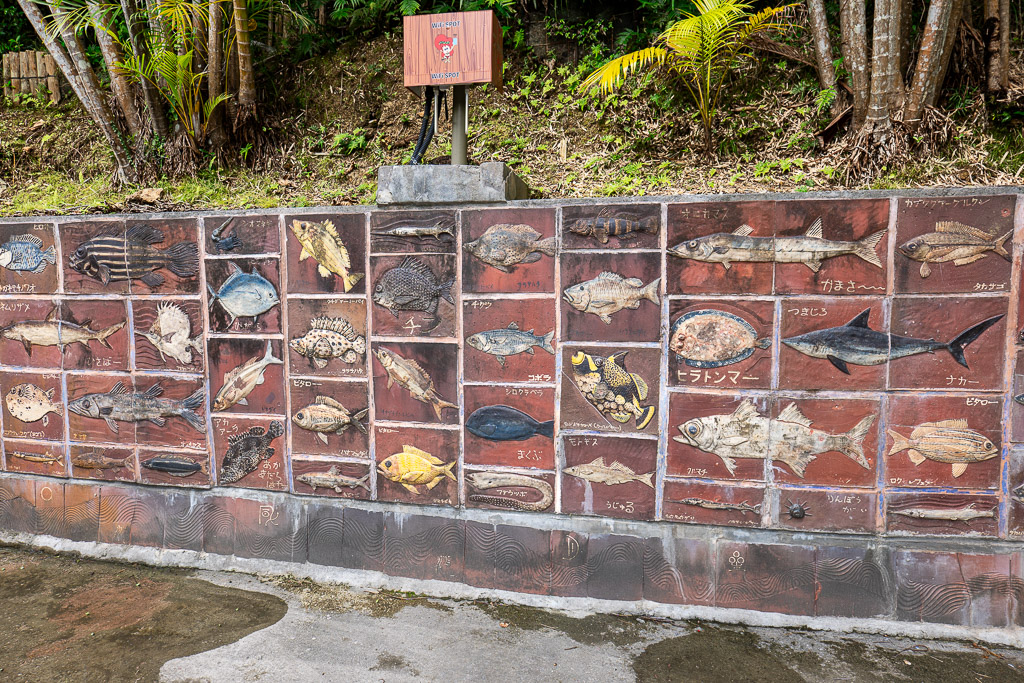
The Okinawan sea fish mural along one of the park’s walls is another fun stop — dozens of reef fish painted on red brick, names labeled. Brush up before you go snorkeling or do marine activities, and you’ll recognize the species in the water.
(7) Tropical Garden — Dragon Trees, Pineapples & Sacred Spring
Ryukyu Village isn’t just human-made culture — the grounds themselves double as a subtropical botanical garden. Dragon trees, pineapples, palms, cycads, and other Okinawan native plants are scattered along the paths, making the stroll itself therapeutic.
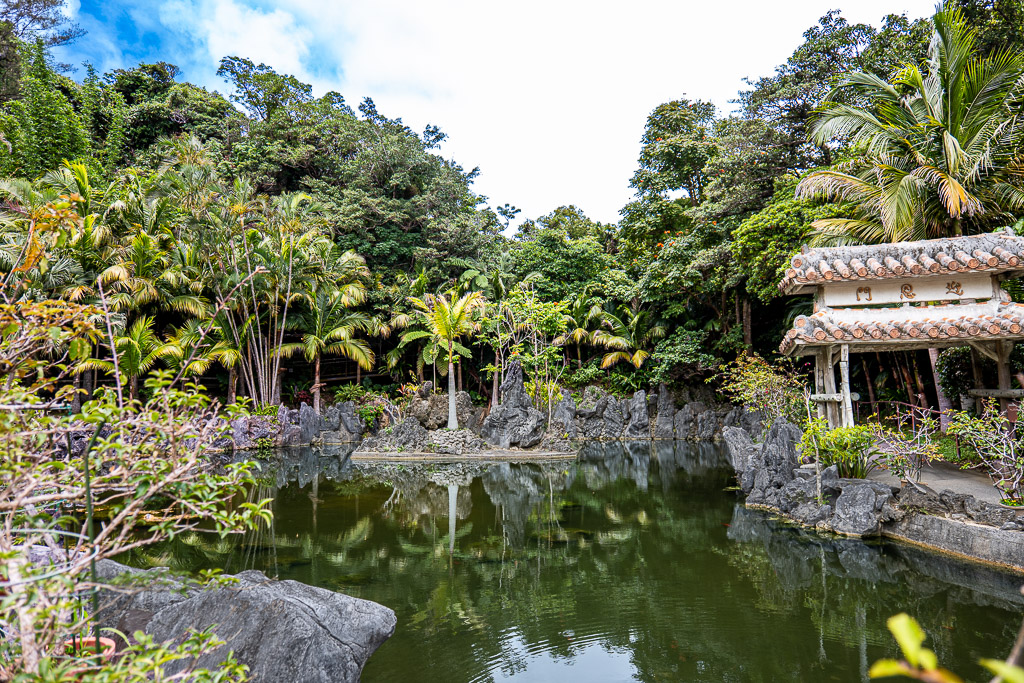
Deep in the park, the spring-water pond is a hidden photo spot. Lush greenery reflects on the surface, red-tile gazebos sit by the water — for a moment you feel like you’ve slipped into the forests of Okinawa’s outer islands.
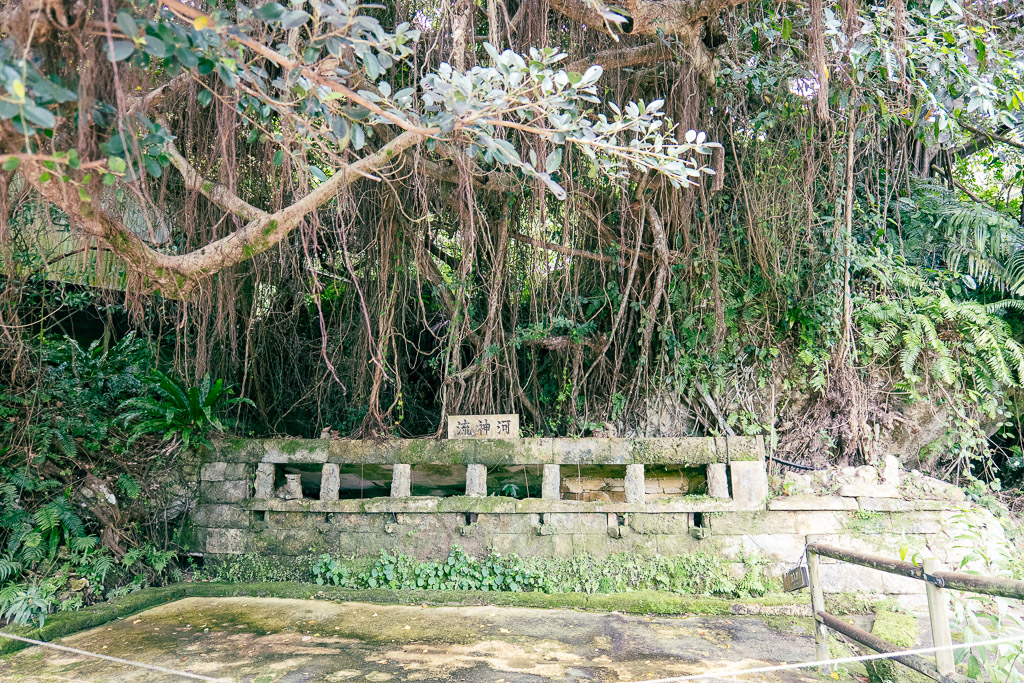
Next to the pond is an ugan-jyu (sacred spot) — aerial roots draping from an old tree, a stone water basin sitting quietly: a Ryukyuan sacred site. The ancient Ryukyuans treated water sources as sacred, and these spots are still found all over Okinawa. Walk softly here and avoid stepping on the stone steps.
In the garden corners you’ll find Shisa lion-dogs of all sizes. Ryukyu Village has more than 100 Shisas throughout the park, each with a different face and color — Shisa-hunting becomes its own little game.
(8) Pohpoh Shop, Sugarcane Juice & Shaved Ice — Okinawan Sweet Treats
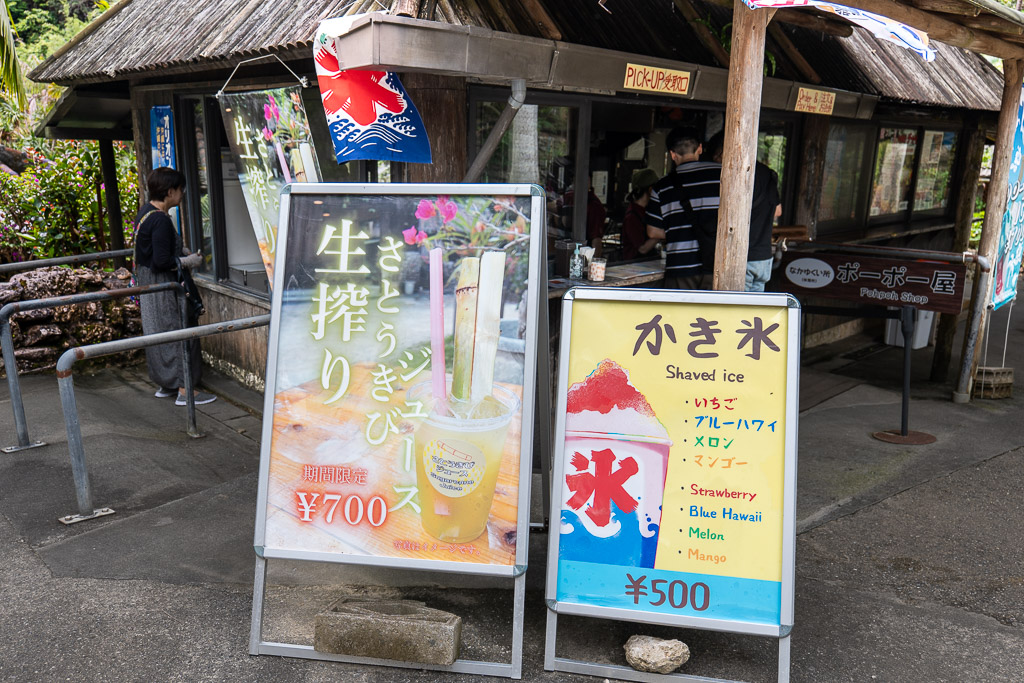
When you need a break, head to the Pohpoh Shop (Okinawan crepe-roll stand). Along with the signature Pohpoh (an Okinawan brown-sugar crepe roll), fresh-pressed sugarcane juice (¥700) and shaved ice (¥500) are also crowd favorites.
Shaved ice flavors include strawberry, blue Hawaiian, melon, and mango. Eating a huge bowl in the cool shade of a kominka in the summer heat is the textbook “Okinawan summer memory.”
(9) Ryuso Dress-up — Become a Ryukyuan Princess or Prince
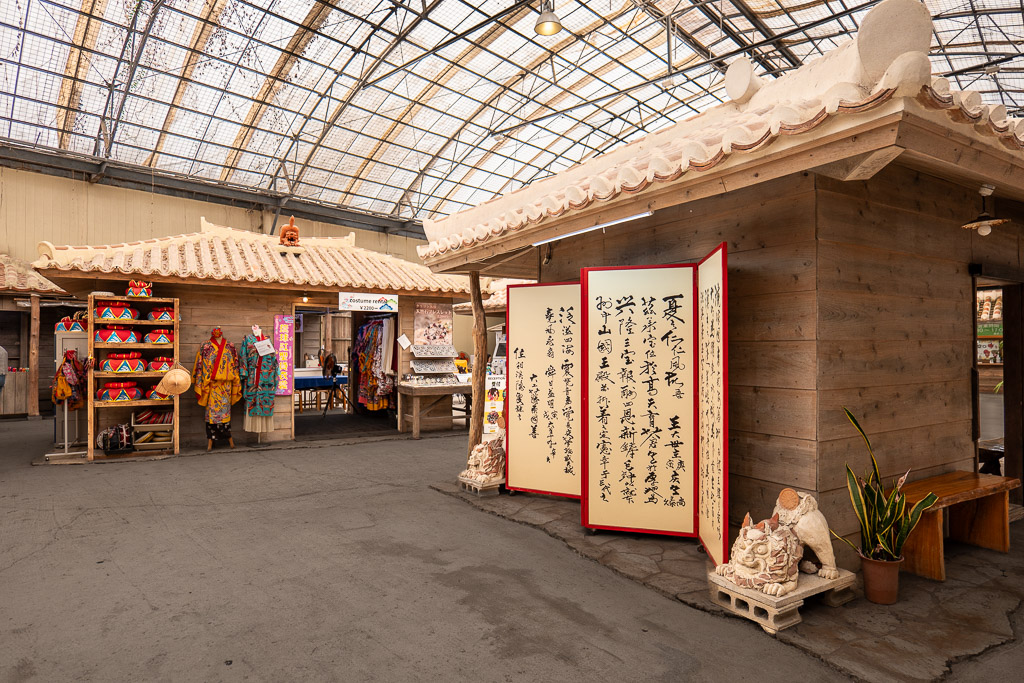
For women and families, another must-do at Ryukyu Village is the Ryuso dress-up. The same Bingata Ryukyu royal court costume worn by the Hanagasa dancers, paired with a flower hat — slip it on and you’re instantly a Ryukyuan princess.
Pricing starts at ¥500, very wallet-friendly, and includes a souvenir photo with data. The full set including the photo session takes about 30 minutes. A shot of you in a Bingata costume in front of a 100-year-old kominka is guaranteed cover-photo material for your Okinawa album.
(10) Souvenir Corner — Shisa, Bingata Goods & Awamori, All in One Place
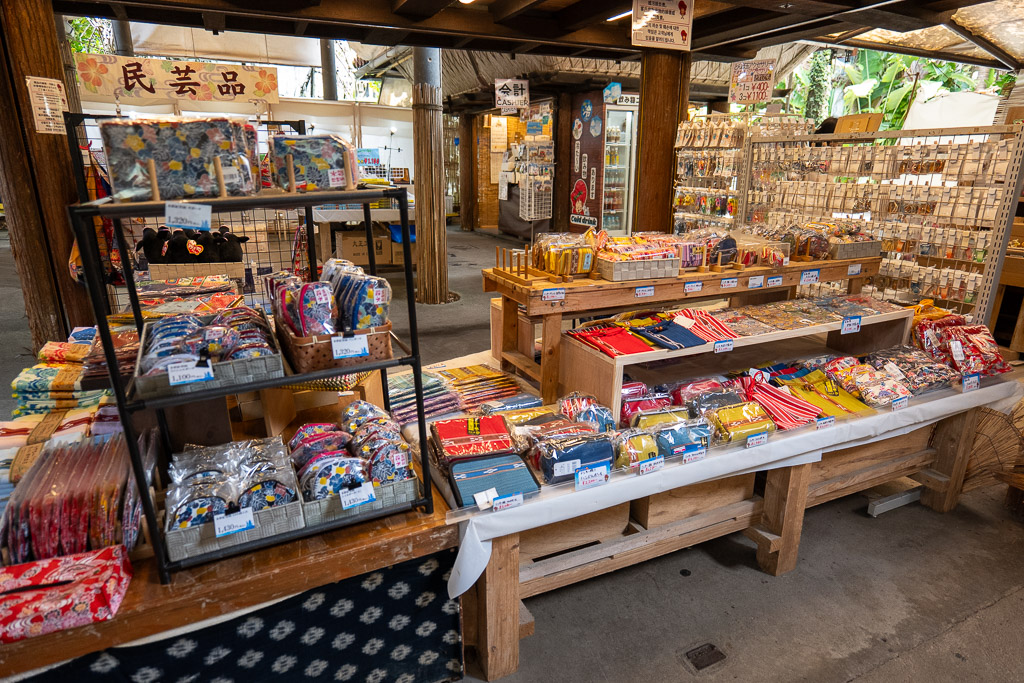
The souvenir corner near the exit is well-stocked. The rustic folk-craft section carries Bingata-dyed handkerchiefs, bags, and coin purses — Okinawan crafts and small goods in such variety it’s hard to choose.
The other side is a bright, modern souvenir shop: Ryukyu Village-limited T-shirts, Ryukyu Village x sweet potato tart collabs, cookies, and small bottles of Awamori. If you can’t make it to a city souvenir street, this corner is one-stop.
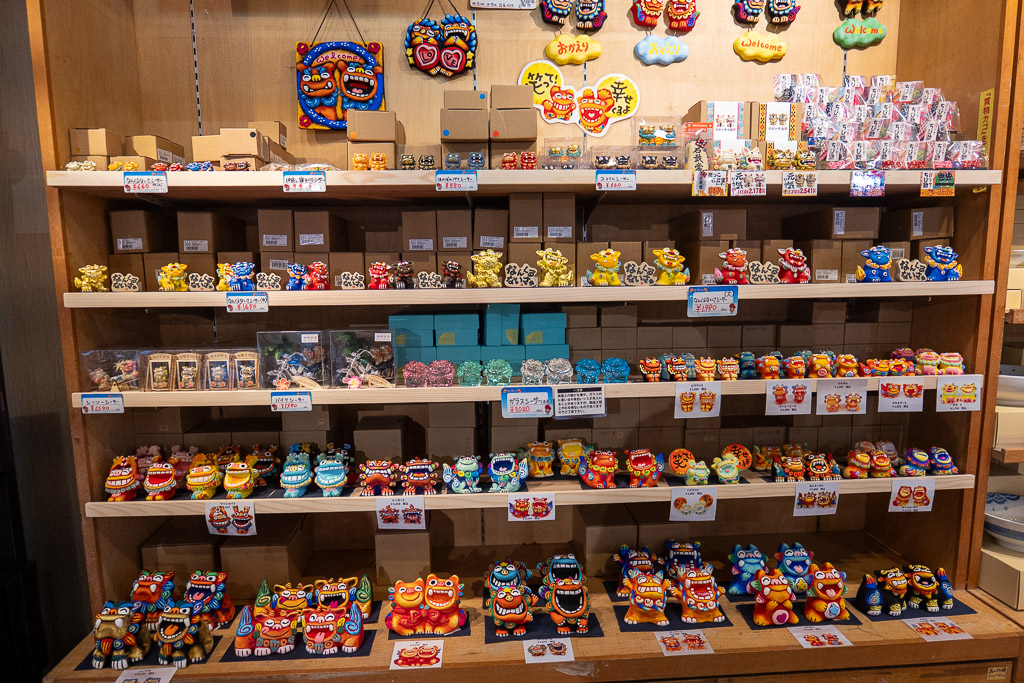
The most popular section is the Shisa pottery shelf. Hundreds of colors, expressions, and sizes of Shisa lion-dogs stand in rows, from palm-sized minis to desk-sized statement pieces — every face is unique, and picking through them is great fun. A “Shisa pair” — one male, one female placed at the front door — is the traditional Okinawan home-protection set.
Driving Routes — Three Model Itineraries Linking Ryukyu Village
Route 1: “Ryukyu Village + Manzamo + Cape Maeda” — Classic Onna One-Day
- Morning: Leave Naha to Ryukyu Village (kominka + Hanagasa + Eisa, 2-3 hours)
- Lunch: Pohpoh Shop inside Ryukyu Village, or a seaside restaurant in Onna
- Afternoon 1: Manzamo (30 min, photos at the elephant-trunk cliff)
- Afternoon 2: Cape Maeda / Blue Cave (snorkeling, 2-3 hours)
- Evening: Back to Naha, dinner on Kokusai Street
Route 2: “Ryukyu Village + Churaumi Aquarium” — Northern Loop One-Day
- Morning: Leave Naha to Ryukyu Village (kominka + 10:00 Eisa, 1.5 hours)
- Noon: Onna seaside lunch
- Afternoon: Churaumi Aquarium (3-4 hours)
- Evening: Kouri Bridge and Kouri Island
- Night: Back to Naha
Route 3: “Ryukyu Village + Bios Hill + Cape Zanpa” — Central Family Culture Deep Dive
- Morning: Ryukyu Village (2 hours, kominka + show)
- Noon: Lunch at Yomitan Pottery Village
- Afternoon: Bios Hill (2 hours, buffalo cart and lake boat ride)
- Evening: Sunset at Cape Zanpa lighthouse
- Night: Back to Naha
Any of these routes more than doubles in time without a rental car. The central and northern Route 58 corridor has no monorail and infrequent buses — a rental car plus prep is the key to a satisfying day.
Okinawa Trip = Maximum Freedom with a Rental Car
- Easy English booking — done in a few clicks
- Naha Airport pickup, Chatan and northern Onna pickup points all set
- Transparent pricing, no hidden fees — insurance explained in English
- Itinerary changes and questions handled in English — local English support
Book here: GO!GO!TOUR Okinawa Car Rental English Booking
Related reads:
- Okinawa Travel Info Hub
- Okinawa Marine Activity Booking (Onna’s Blue Cave snorkeling is the No.1 pick)
Ryukyu Village — Map Location
Address (kept in original Japanese for navigation and MAPCODE entry):
| Address | 〒904-0416 沖縄県国頭郡恩納村山田1130 |
| Phone | +81-98-965-1234 |
| MAPCODE | 206 033 067*22 |
FAQ
Q1. How is Ryukyu Village different from Okinawa World? Should I visit both?
Both are Ryukyuan culture parks, but they differ in location and character. Ryukyu Village is in central Onna (on the way north to Churaumi), smaller in scale, with more authentic and historic kominka houses; Okinawa World is in southern Nanjo (on the way to the Peace Memorial Park), larger in scale, with the Gyokusendo limestone cave. Pick based on your overall direction — heading north, go for Ryukyu Village; heading south, go for Okinawa World. If you have the time, both are worth it.
Q2. Are the Eisa + Hanagasa Dance Show and Folk Song & Dance Show free? Do I need to book?
Both are free, included with admission. No reservation needed, open seating. There are 8 performances total per day (2 shows × 4 each). After entering, grab a park map and check the day’s showtimes (actual times are per the official Ryukyu Mura website), then plan your kominka tour and workshop order around them.
Q3. Is it family-friendly?
Very. Under 5 free, the park is mostly flat paths and open-air space, and kids love the water buffalo, Sabani boats, and Shisa pottery. The Ryuso dress-up comes in kids’ sizes — a family photo in matching Ryukyuan costumes is incredibly memorable. The summer heat is real outdoors, so bring hats, sunscreen, and water.
Q4. Is it OK to visit on a rainy day?
Partly yes. The interiors of the kominka, souvenir shops, workshops, and Awamori brewery are all indoor and work in rain. But the Eisa + Hanagasa Dance Show is held outdoors. And may be cancelled or shifted in heavy rain. Call ahead on rainy days at +81-98-965-1234 to check.
Q5. How long should I stay?
Core visit (kominka + 1-2 shows + souvenirs) takes about 2-3 hours. Add the Ryuso dress-up, Sanshin lesson, and a meal, and you’re at 3-4 hours. With 8 performances per day, if you want to catch all the shows, plan to arrive in the morning and stay into the afternoon. Actual showtimes are per the official Ryukyu Mura website.
Q6. Is there English-language guidance?
Ticket machines and main park signage are labeled in English, Chinese, and Korean. Paper English brochures are available at the reception desk on entry. English-speaking staff aren’t on a fixed schedule, so it’s best to plan your own flow and showtimes.
Wrapping Up…
Ryukyu Village is a high-value spot for “a classic central Okinawa day plus a pure taste of Ryukyu Kingdom culture.” 100+ year-old kominka houses, Eisa + Hanagasa Dance Show, Folk Song & Dance Show, Sanshin and Bingata workshops, Awamori, Shisa, and souvenirs — every “Ryukyuan element” you’d want on an Okinawa trip, all in one stop.
Core checklist:
- Yamada, Onna — about 60 min by car from Naha, 200 free parking spaces
- Adults ¥2,000 / Students ¥1,500 / Ages 6-15 ¥800 / Under 5 free
- 9:30 – 17:00 (last entry 16:00), open year-round
- Daily Eisa + Hanagasa Dance Show 4 shows + Folk Song & Dance Show 4 shows (all free)
- Ryuso dress-up from ¥500 — a family and couple’s photo must
- Sanshin, Bingata, pottery, and indigo workshops at ¥1,500-¥3,000
- Sakimoto Sake Brewery tour and Awamori tasting
- Perfect stopover en route to Churaumi Aquarium and Kouri Island
- * All prices, showtimes, and workshop fees are per the latest info on the official Ryukyu Mura website
Okinawa Travel, GO!GO!TOUR Has You Covered
- Okinawa Marine Activity Booking (Onna’s Blue Cave snorkeling is the No.1 pick)
- Okinawa Dining and Spot Info